
18 Built-In Shelf Styling Ideas for the Living Room
Look, we get it. Built-in shelves can feel like a gift and a problem at the same time. They give you all this lovely space, and then they just sit there waiting for you to fill them without making them look cluttered or bare. If yours currently hold a random mix of books, remotes, and things you meant to put away weeks ago, you’re not alone. Most built-ins start out that way, and they usually get better one small, thoughtful change at a time.
That’s what this list is for. You’ll find simple ways to handle books, baskets, art, plants, ceramics, and light, plus a few ideas for working around a TV or a fireplace. Some of these are ten minute fixes, like leaving a little breathing space or stacking a few books flat. Others ask a bit more patience, like grouping by color. You don’t need to do all eighteen. Two or three that fit your room will usually change how the whole wall feels.
Start with the foundation ideas if your shelves feel messy, then move to the art and greenery if they feel flat, and finish with the lighting ideas if they disappear after dark. Work in that order and you’ll typically see progress quickly. Take a photo before you begin, step back often while you work, and remember that a shelf you can easily change later is always better than one you feel stuck with.
In This Article
- Group Books by Warm Color for a Calm Gradient
- Stack Books Flat to Create Low Display Pedestals
- Leave Breathing Space Between Every Grouping
- Hide Everyday Clutter in Lidded Woven Baskets
- Style One Side Symmetrically for a Polished Anchor
- Break the Symmetry on the Opposite Side for a Relaxed Feel
- Lean Framed Art Against the Back of a Shelf
- Let Trailing Plants Soften the Hard Shelf Edges
- Gather Ceramics in Odd Numbers for Easy Rhythm
- Mix Tall and Short Pieces on Every Shelf
- Leave One Shelf Almost Empty on Purpose
- Swap in Seasonal Touches Without Restyling Everything
- Add Warm Picture Lights Above the Shelves
- Tuck a Small Lamp Inside a Deep Shelf Cubby
- Style Around the TV Without Competing With It
- Frame the Fireplace With Balanced Shelves on Both Sides
- Turn the Lowest Shelves Into Cozy Everyday Storage
- Finish With Personal Pieces That Tell Your Story
Start With Books and Breathing Room
Before you buy anything new, work with what you already own. Books, baskets, and empty space do most of the heavy lifting on built-in shelves, and they cost nothing to rearrange. These first six ideas help you create a calm base, hide the everyday mess, and set up a gentle balance between tidy and relaxed, so everything you add later has room to shine.
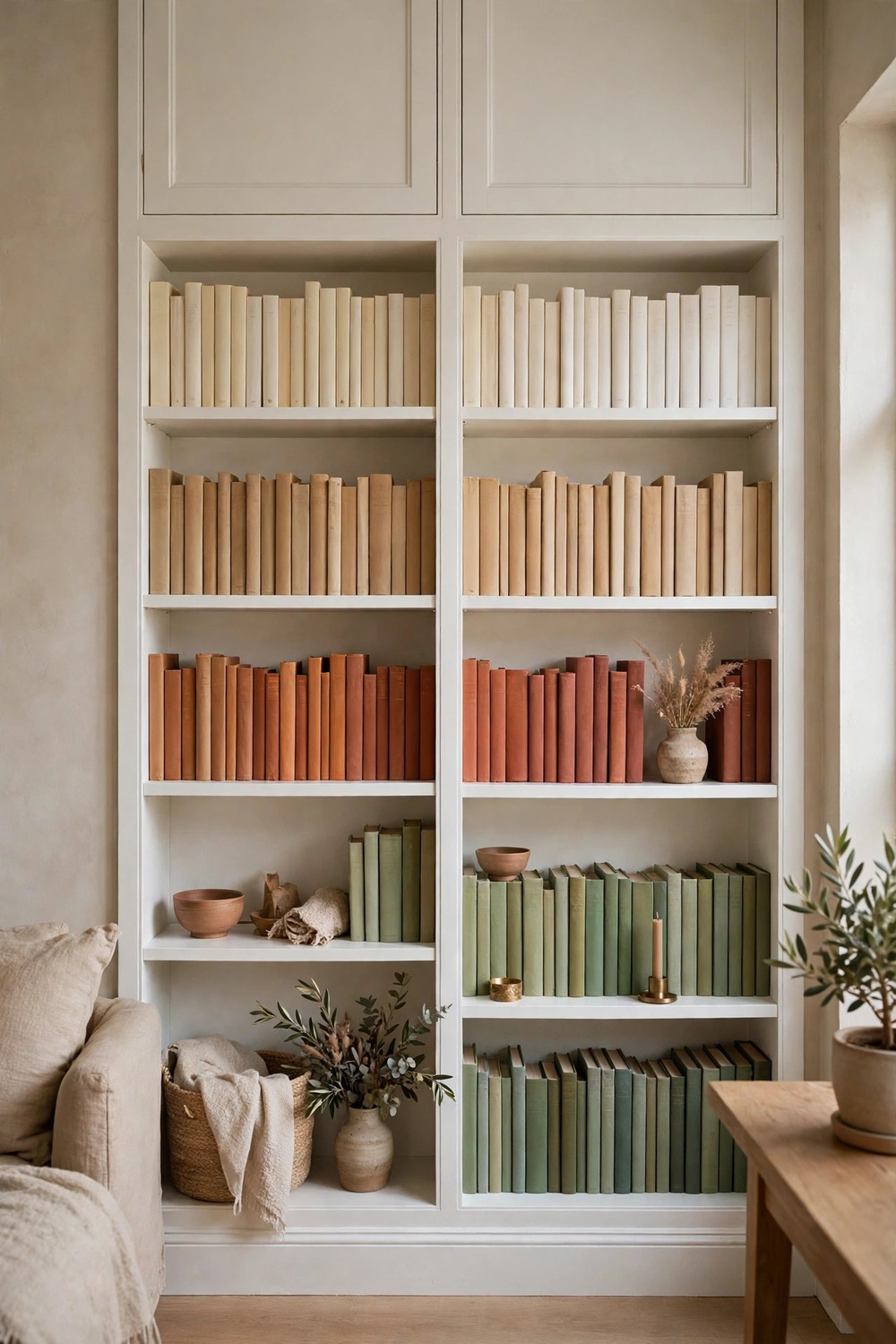
1. Group Books by Warm Color for a Calm Gradient
Grouping books by color is one of the easiest ways to make busy shelves feel calmer. Start by pulling your books into loose piles of cream, tan, rust, soft brown, and muted green, then place each color together so the shades drift gently from light to dark across a shelf. You don’t need a perfect rainbow, and you shouldn’t worry if a few covers don’t fit neatly. Leave those for another shelf or turn their spines inward if the color really fights the rest. The result usually reads as one soft, warm gradient rather than dozens of separate titles all shouting at once.
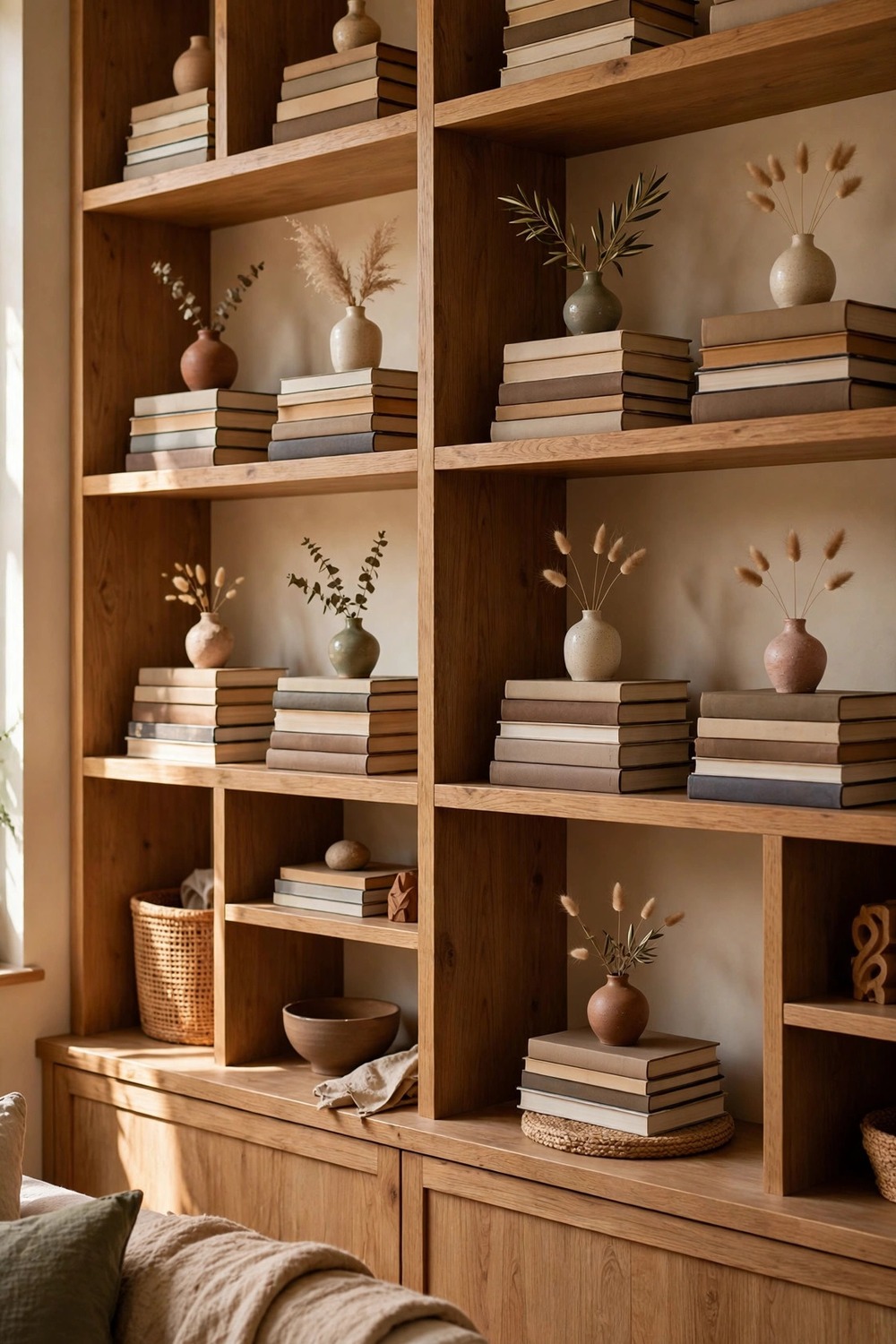
2. Stack Books Flat to Create Low Display Pedestals
A small flat stack of books can do the job of a riser, a bookend, and a little stage all at once. Lay two or three books flat, slightly offset so the stack doesn’t look stiff, then set a small vase, bowl, or framed photo on top. That extra height typically helps a short object hold its own beside taller pieces nearby. Choose books with plain, warm covers and keep the stack low, because a tall wobbly pile can look messy and isn’t practical to dust. Repeat the trick in two or three places so the shelves feel connected rather than random.
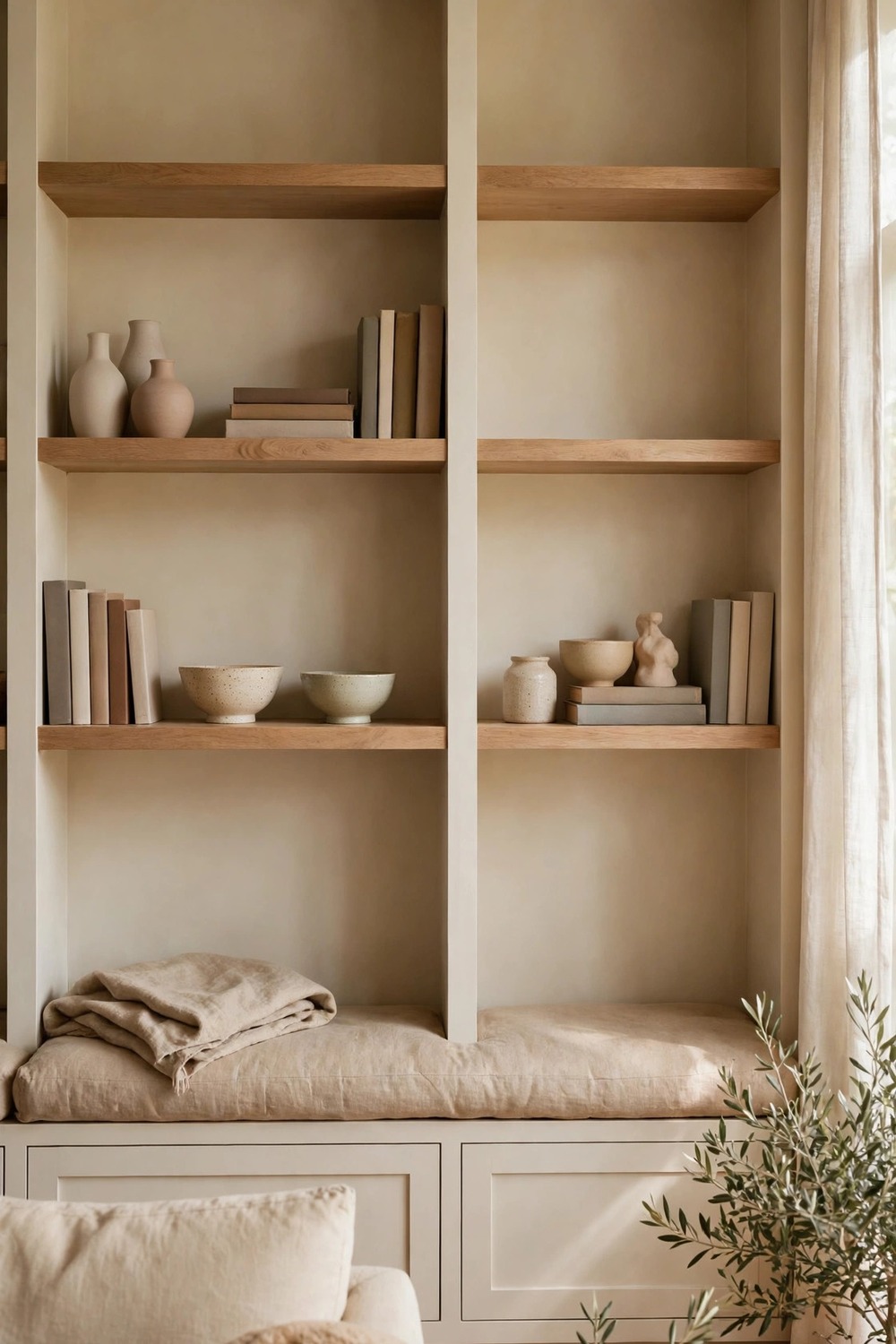
3. Leave Breathing Space Between Every Grouping
Breathing space is what stops styled shelves from turning into storage with better intentions. Instead of spreading objects evenly along a whole shelf, gather them into small groups of two or three, then leave a clear gap before the next group starts. Your eye will read each group as one calm moment instead of a long line of stuff. If you’re unsure how much space is enough, try leaving roughly a hand’s width or more between groups and step back to check. Shelves usually look better a little emptier than you first think, especially in a room where you sit and relax every day.
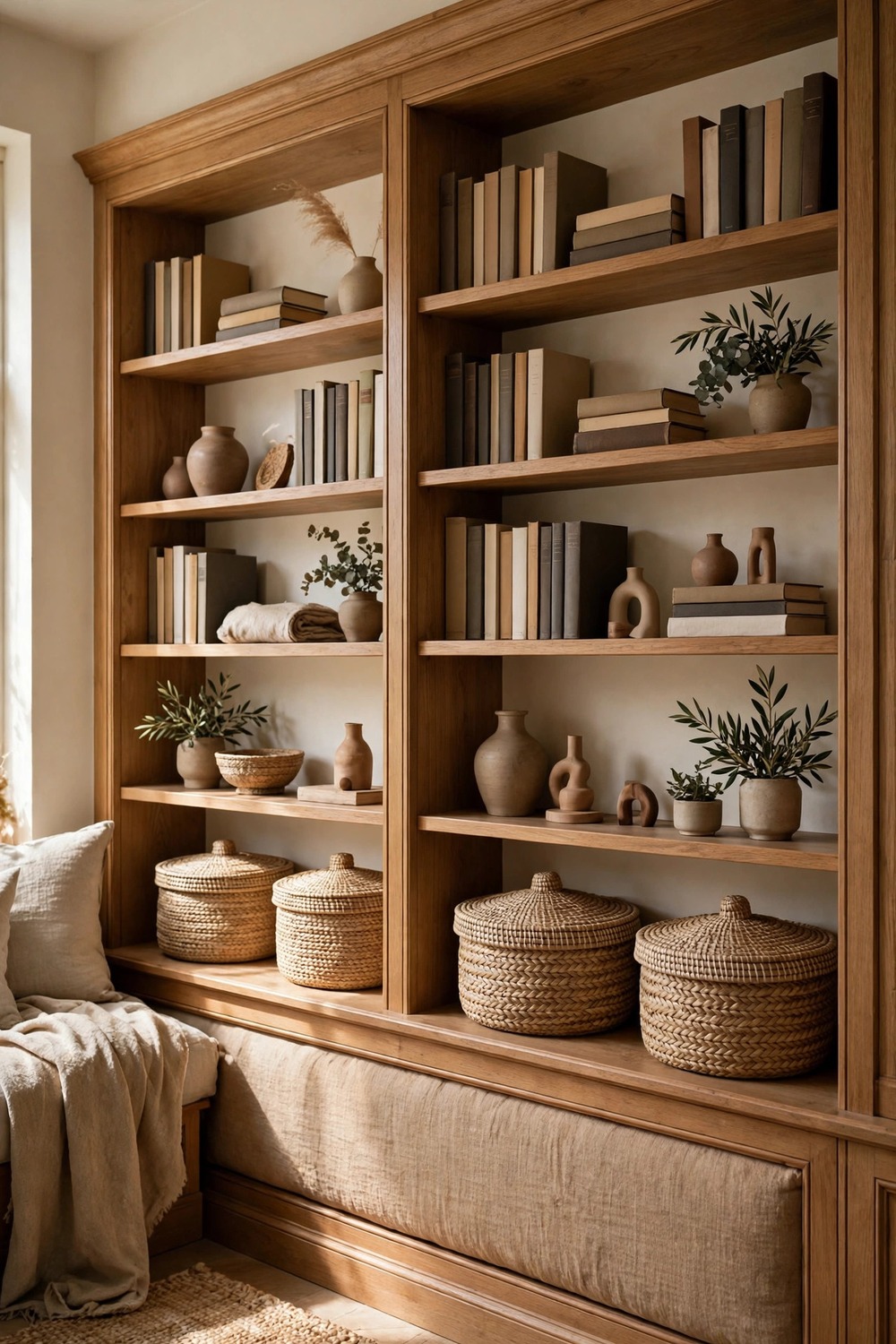
4. Hide Everyday Clutter in Lidded Woven Baskets
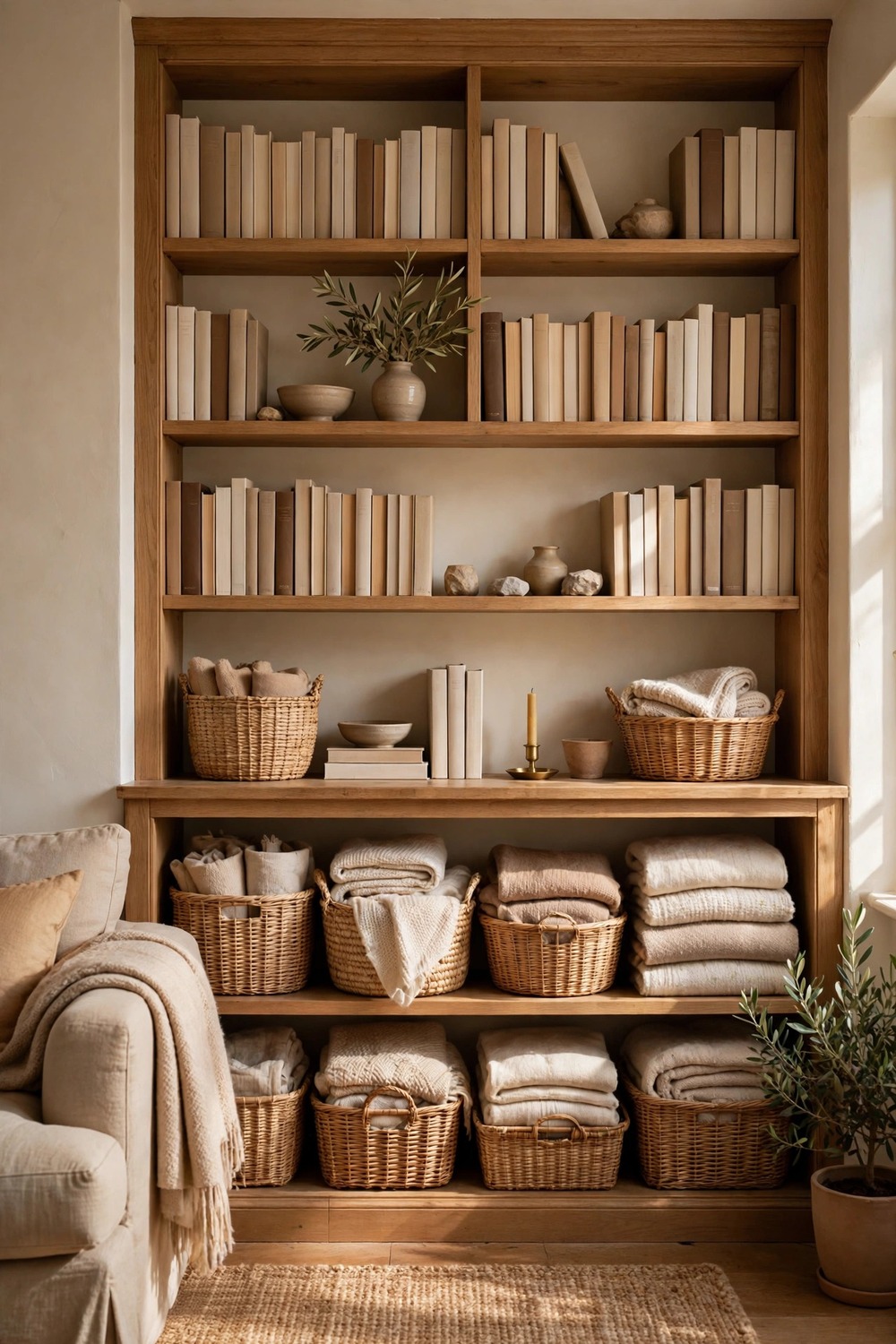
Every living room has things that need to live nearby but don’t need to be on show, like chargers, remotes, game controllers, and coasters. Lidded woven baskets are perfect for that job because the lid hides the mess while the natural texture adds warmth to the shelf. Pick baskets that fill most of the cubby width so they look built for the space, and try to keep one basket per type of clutter so you can actually find things later. Place them on lower shelves where they’re easy to reach, and let the shelves above stay lighter and more decorative in comparison.
5. Style One Side Symmetrically for a Polished Anchor
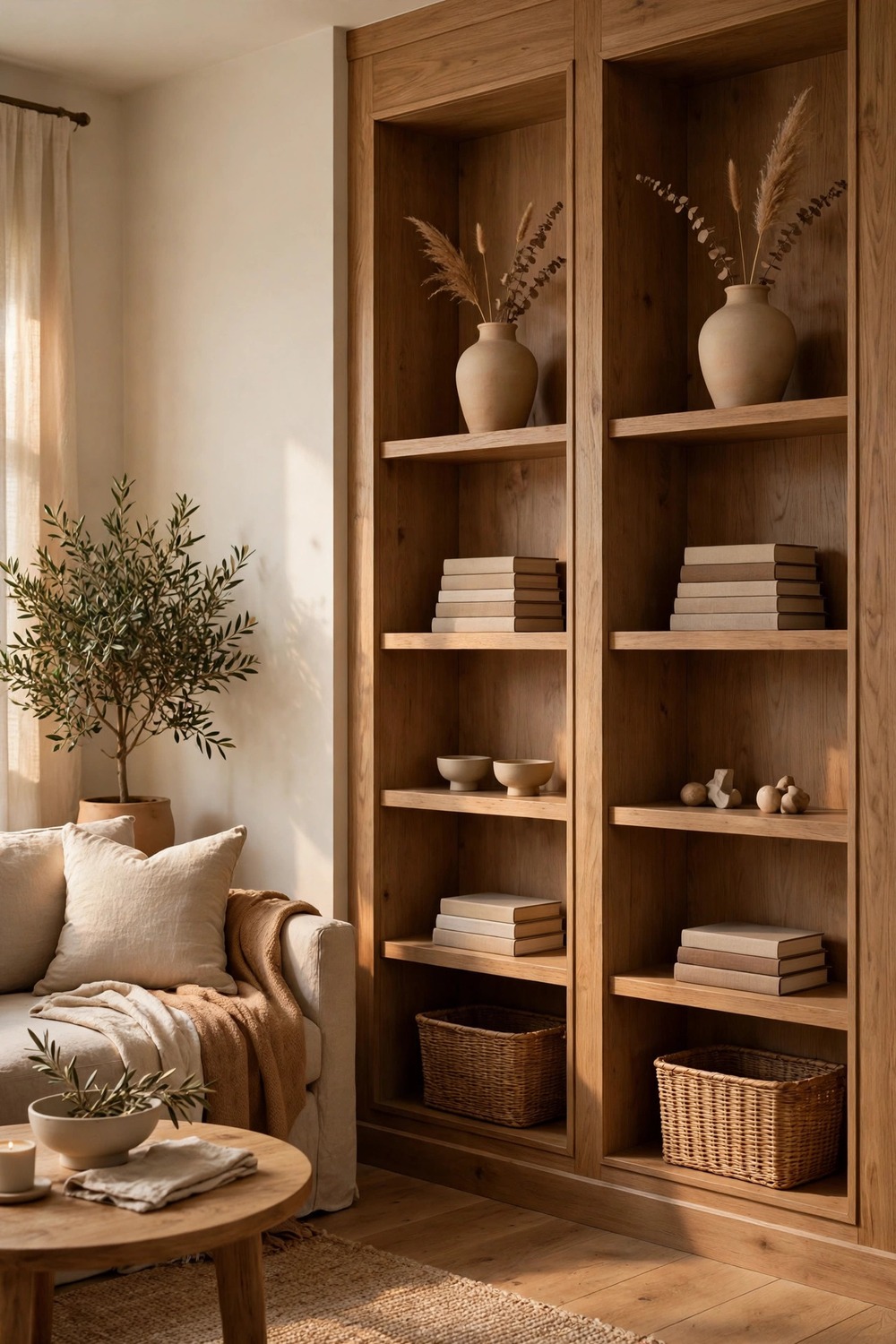
A little symmetry gives built-ins a sense of order, even if the rest of your styling is relaxed. Choose one side, or one central section, and mirror it fairly closely with a matching pair of vases, two similar book stacks, or the same basket on the same shelf height. It doesn’t have to be identical down to the last object, because close enough usually feels calm without feeling stiff. This polished anchor works especially well around a fireplace or in a formal room. Think of it as the tidy reference point that lets the looser shelves nearby feel intentional rather than unfinished.
6. Break the Symmetry on the Opposite Side for a Relaxed Feel
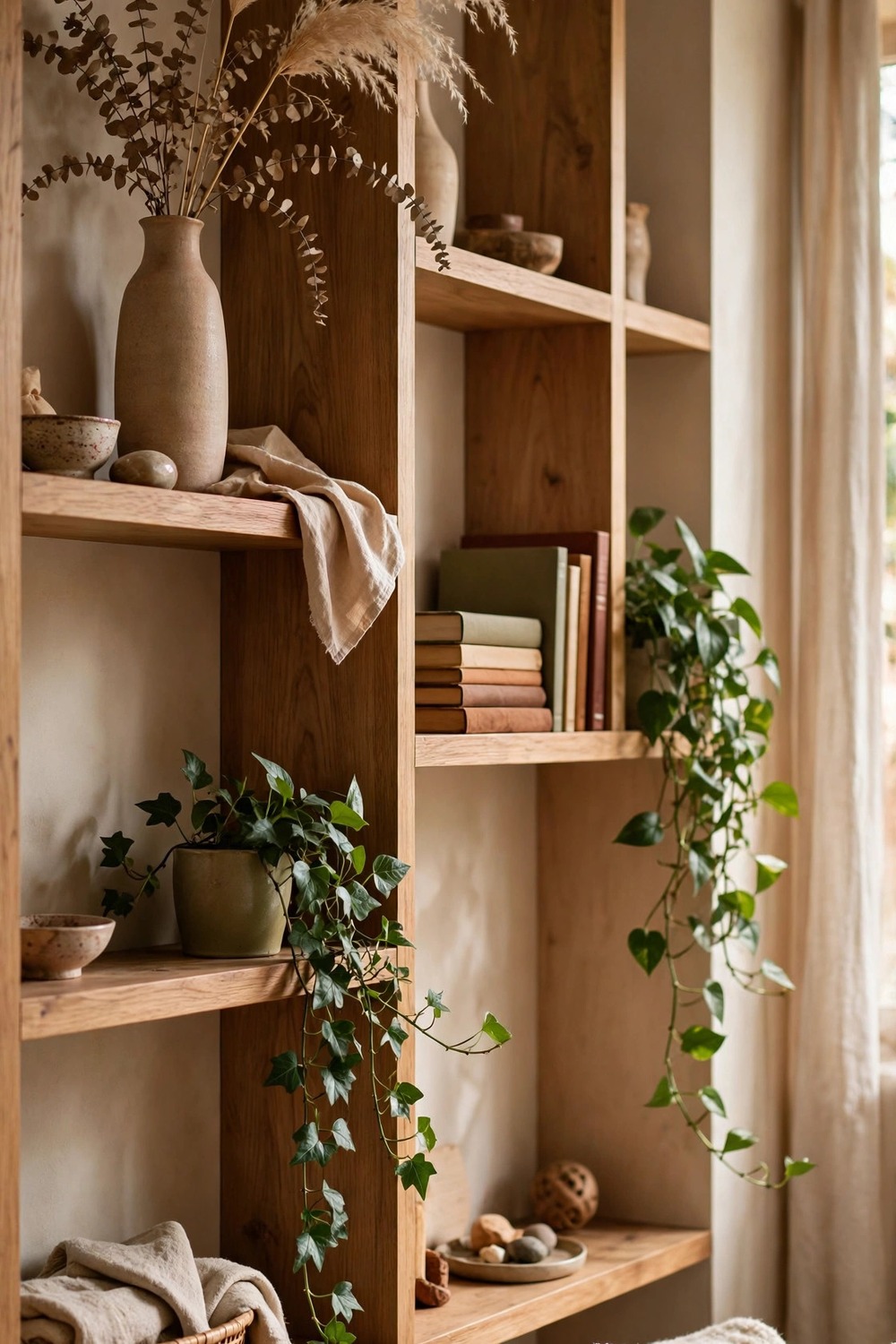
Once one side feels ordered, let the other side loosen up. Instead of mirroring everything, try a tall vase on one shelf, a low stack of books on the next, and a trailing plant somewhere completely different. That gentle imbalance typically keeps built-ins from feeling like a showroom and makes them feel more like a home someone actually lives in. The trick is to repeat a couple of colors or materials from the tidy side, so the two sides still talk to each other. Step back and squint a little. If the overall weight feels even, you’ve probably got the balance right.
Layer In Art, Greenery, and Texture
With the base sorted, it’s time to add the pieces that give shelves their personality. Art, plants, and handmade ceramics bring in shape, softness, and a sense of life that books alone can’t provide. These next ideas focus on layering without overfilling, varying height as you go, and making small seasonal changes that keep the whole wall feeling fresh through the year.
7. Lean Framed Art Against the Back of a Shelf
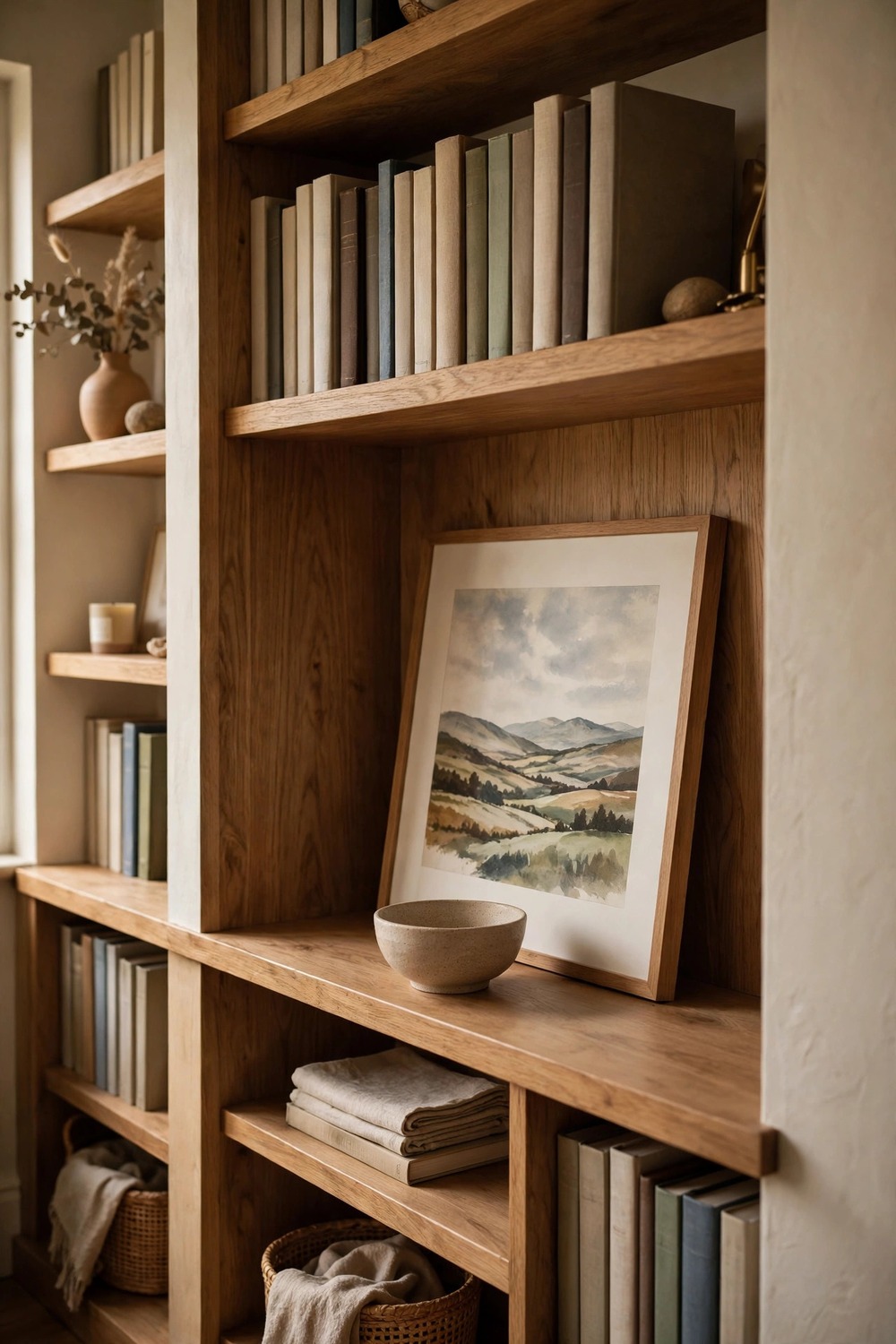
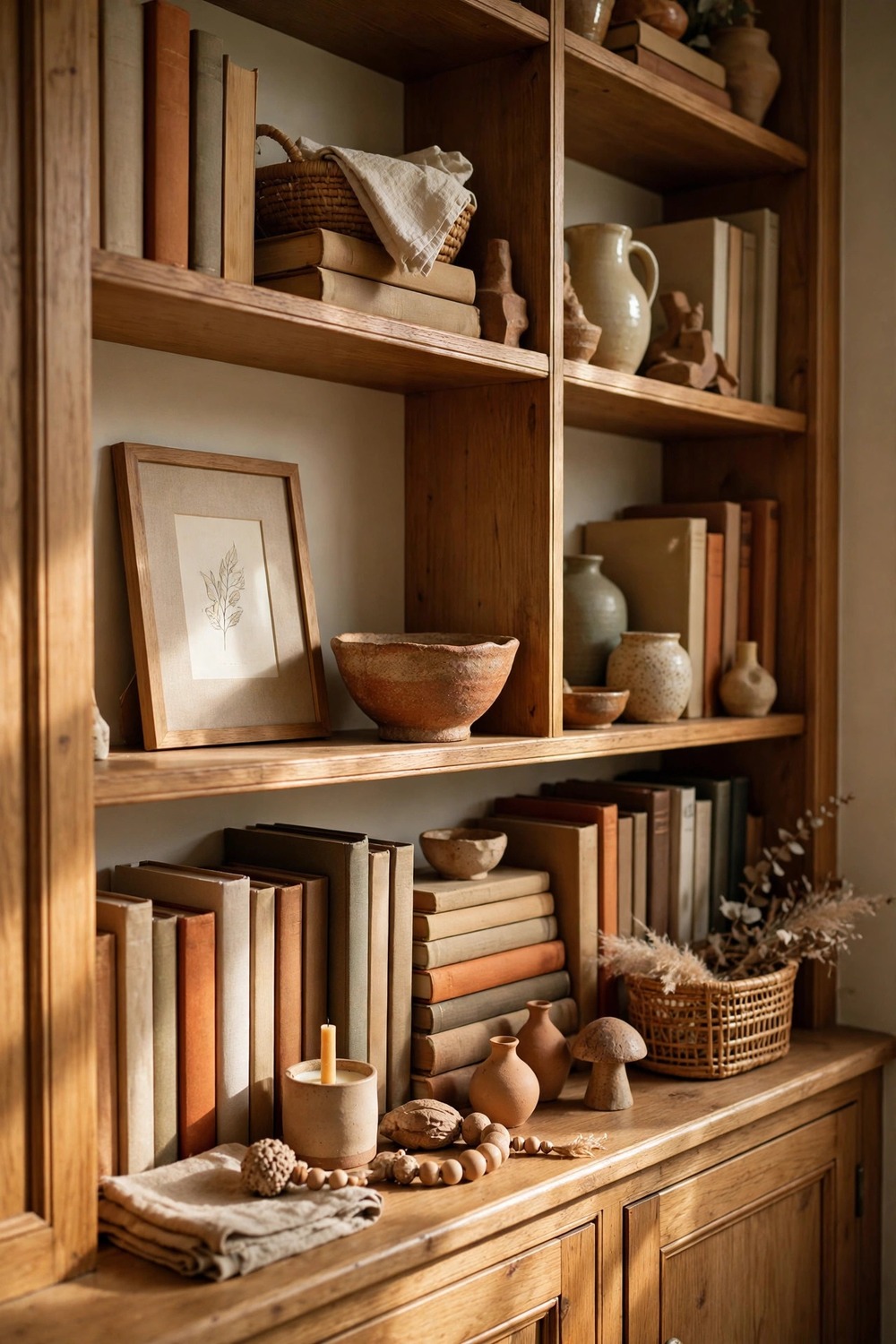
Leaning a framed print against the back of a shelf is a forgiving way to add art without drilling a single hole. Choose a frame that fills a good part of the cubby height, then lean it at a slight angle and layer one or two smaller objects in front, like a short stack of books or a small bowl. Landscapes, simple sketches, and soft abstract pieces usually work well because they add color without demanding too much attention. Keep the frame finish in the same warm family as your shelves or baskets, and you’ll get a layered look that feels collected rather than placed in a hurry.
8. Let Trailing Plants Soften the Hard Shelf Edges
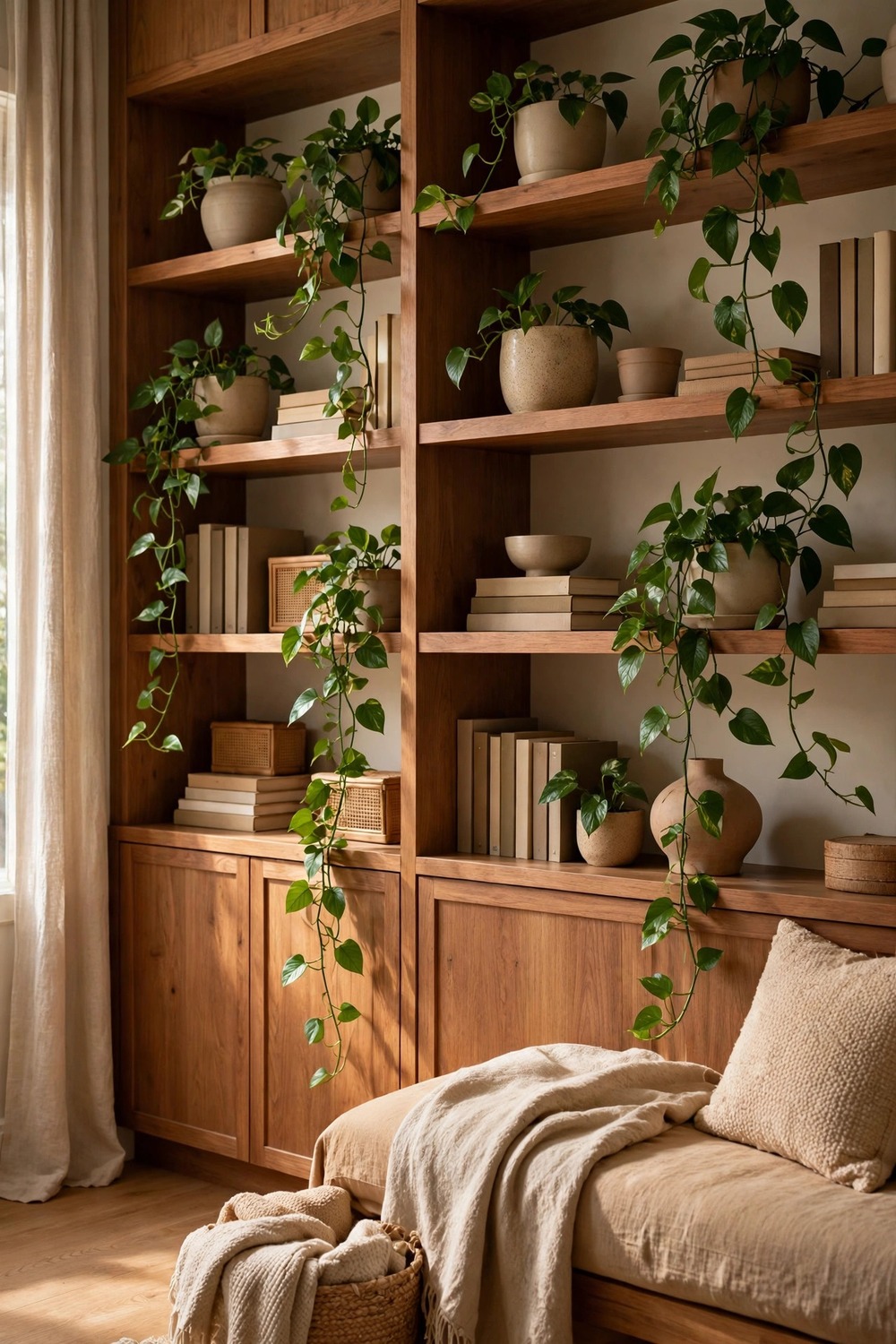
Built-ins are full of straight lines and right angles, so a trailing plant is a welcome bit of softness. Set a pothos or similar trailing plant on a higher shelf and let a few stems spill gently over the edge, guiding them away from books that could be marked by water. A simple ceramic pot in a warm neutral usually looks best, because the greenery is the star here. If real plants feel like too much upkeep in a darker corner, a good quality faux trail can still give you the shape. Just dust it now and then so it keeps looking fresh and cared for.
9. Gather Ceramics in Odd Numbers for Easy Rhythm
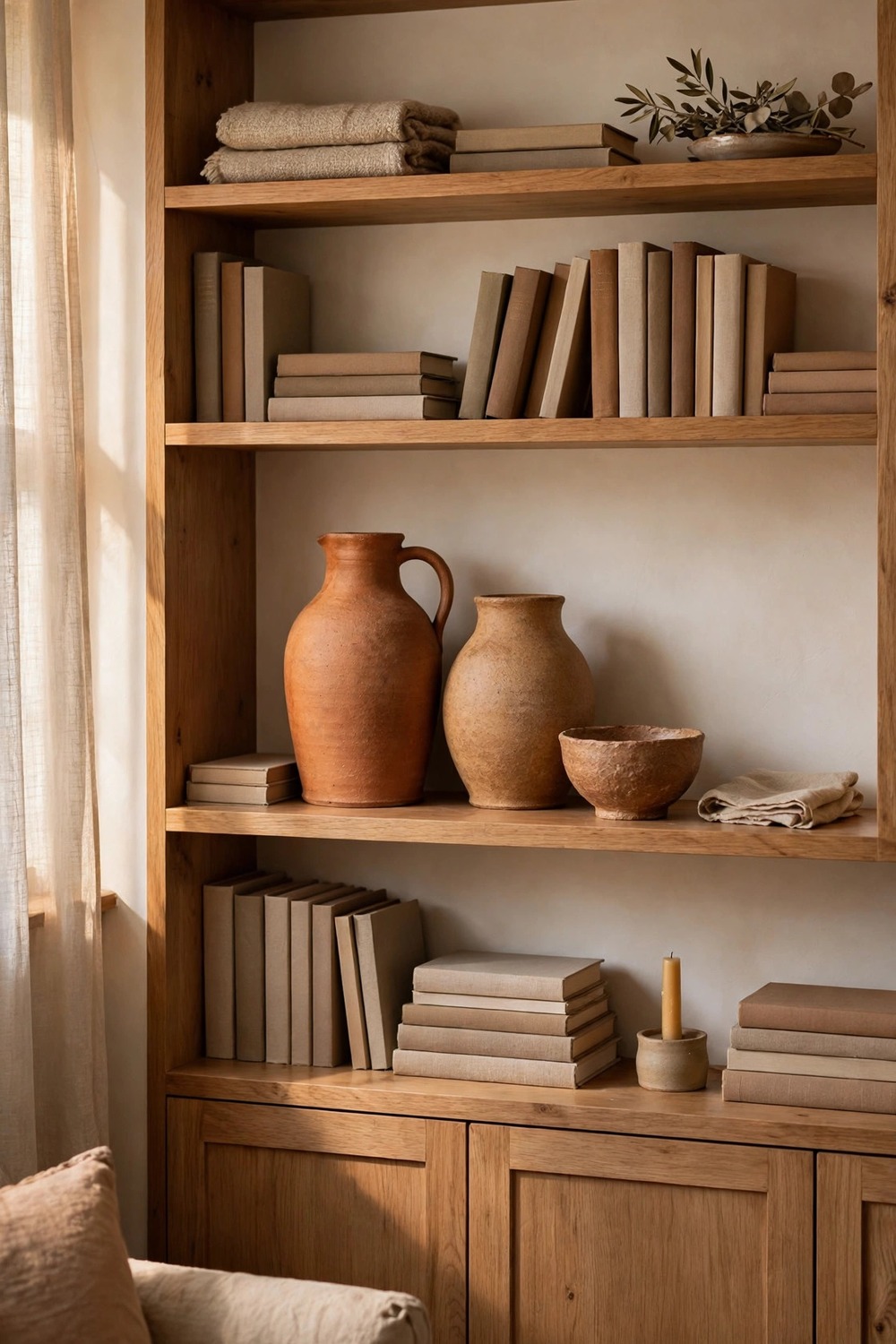
Groups of three have a way of looking right without much effort, and ceramics are ideal for trying it. Gather a tall jug, a medium vase, and a small bowl together, keeping them close enough to read as one group but not so close that they touch. Pieces in the same warm color family usually sit happily together even if their shapes and finishes differ, and a little handmade unevenness only adds charm. Leave the next shelf section emptier so the group can breathe. If three feels crowded in a small cubby, a single strong piece with one tiny companion can give you a similar relaxed rhythm.
10. Mix Tall and Short Pieces on Every Shelf
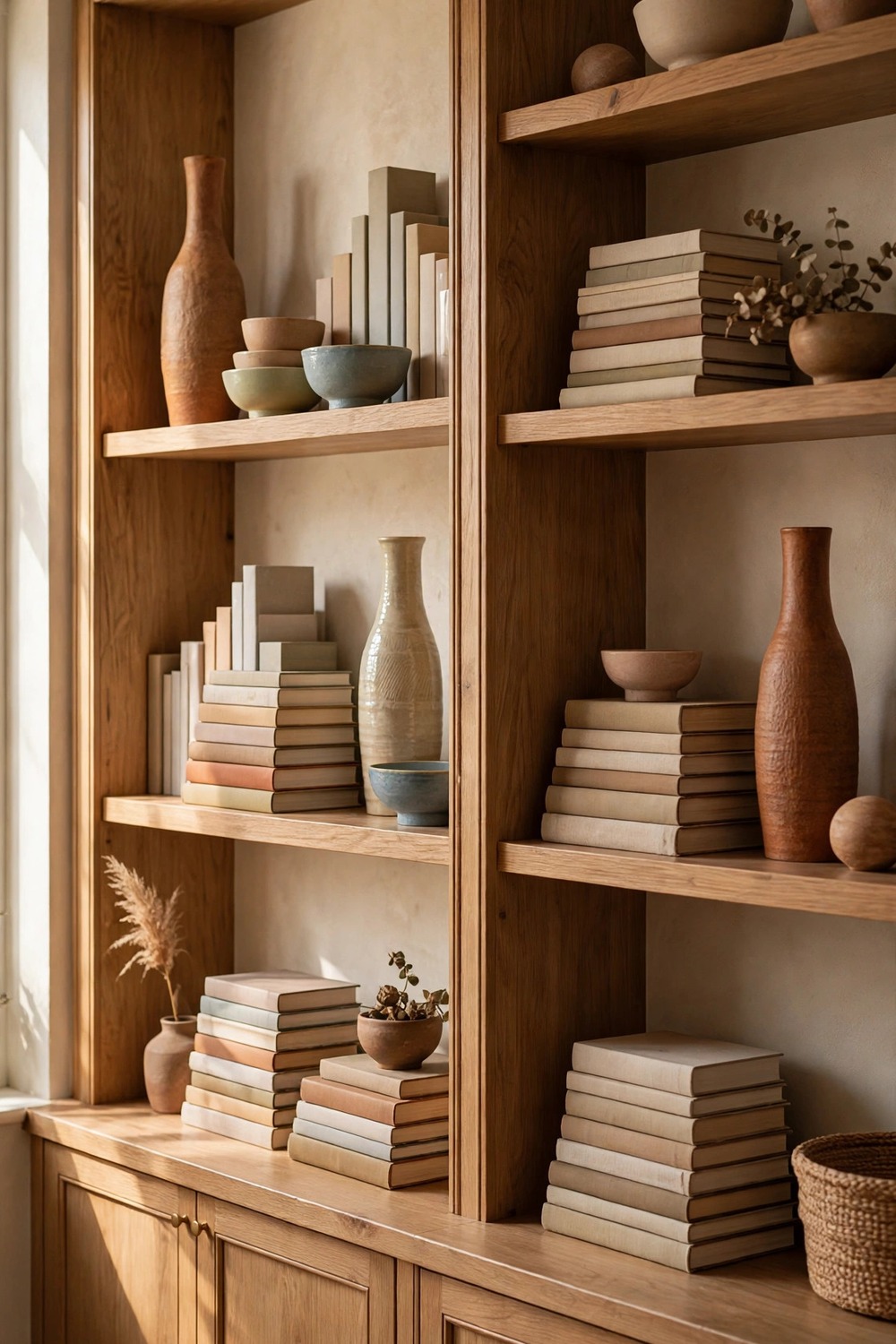
When everything on a shelf is the same height, the whole thing can feel flat and a bit like a shop display you aren’t meant to touch. Mixing heights fixes that quickly. Pair a tall vase or a vertical row of books with something low and wide, like a shallow bowl, a short candle, or a flat book stack. Let the heights rise and fall as your eye moves along the shelf, a bit like a gentle skyline. Typically, the tallest piece looks best toward one end or near the back, with shorter pieces stepping down in front so nothing important gets hidden from view.
11. Leave One Shelf Almost Empty on Purpose
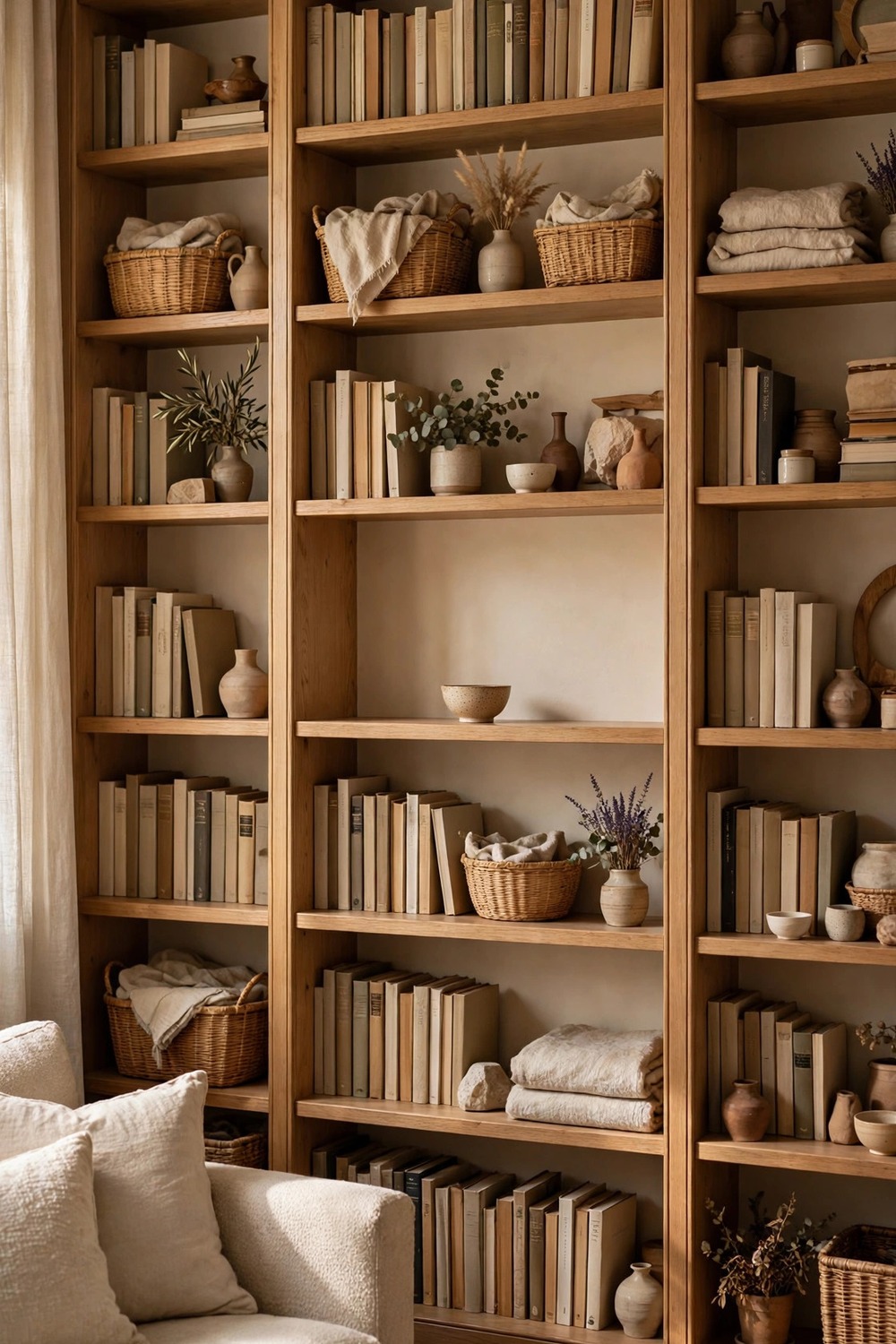
An almost empty shelf can feel like a bold choice, but it’s often the thing that makes all the fuller shelves look better. Choose one shelf, ideally near eye level, and give it just one quiet object, like a single bowl, a small sculpture, or a short stack of two books with nothing on top. That pause gives your eye somewhere to rest, and it signals that the styling was done on purpose rather than by gradually filling every gap. If a completely bare shelf feels too stark at first, try it for a week. Most people find the calm grows on them pretty quickly.
12. Swap in Seasonal Touches Without Restyling Everything
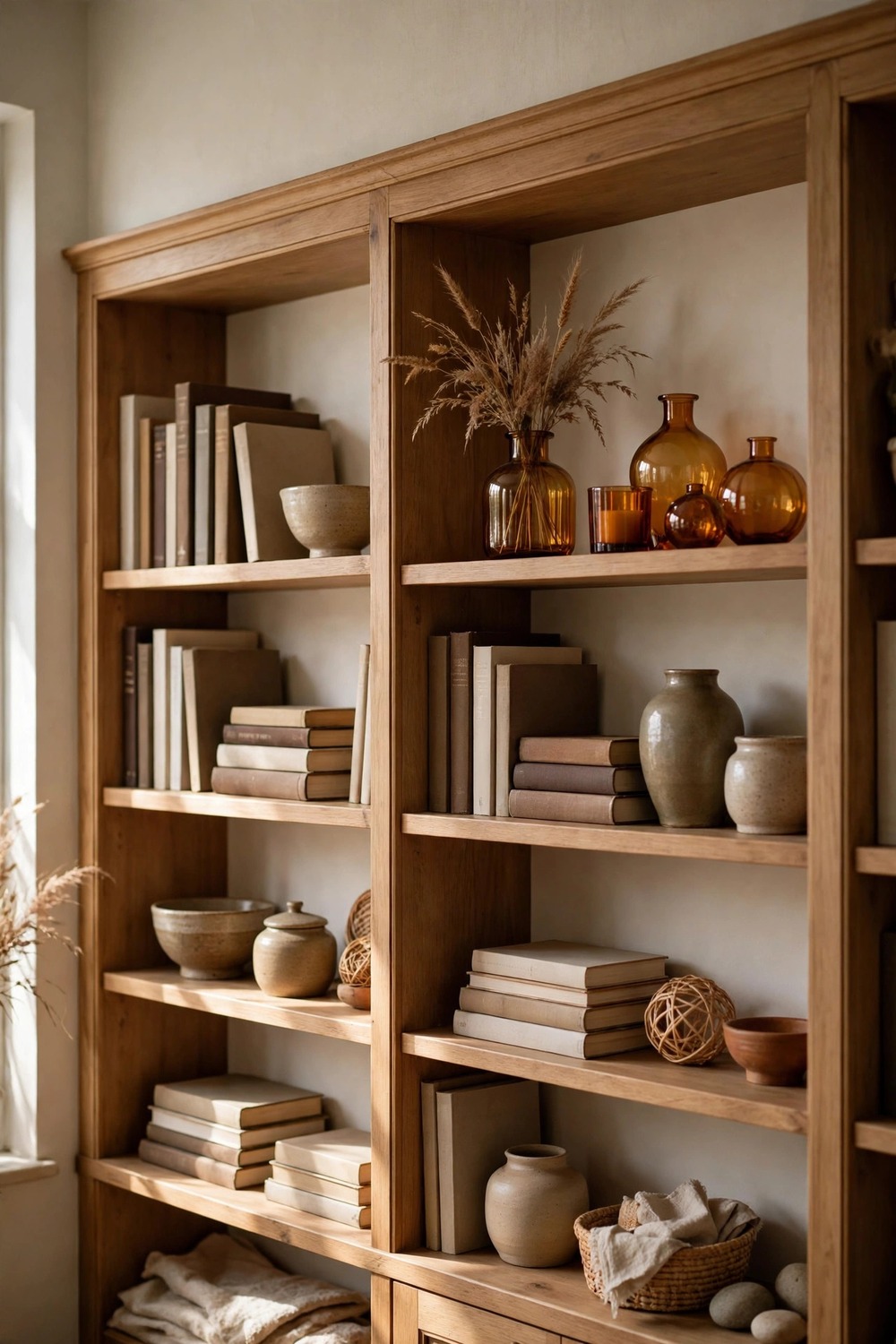
You don’t need to restyle your whole wall every time the season turns. Pick two or three easy swap spots and change only those. In autumn, that might be dried grasses in a vase and a piece of amber glass. In spring, it could be a small bowl of green stems and a lighter linen covered book stack. Keeping the swap small means it takes minutes, stores away in one box, and doesn’t disturb the groupings you’ve already got working. The rest of the shelves stay exactly as they are, which typically makes the seasonal pieces stand out more rather than less against a familiar backdrop.
Light Them Well and Style Around the Room
The last stretch is about how your shelves work with the rest of the room, especially in the evening. Warm light can make ordinary objects look rich, and thoughtful styling around a TV, a fireplace, or your lowest shelves can pull the whole living room together. These final ideas help your built-ins feel useful, welcoming, and personal, not just decorated for the sake of it.
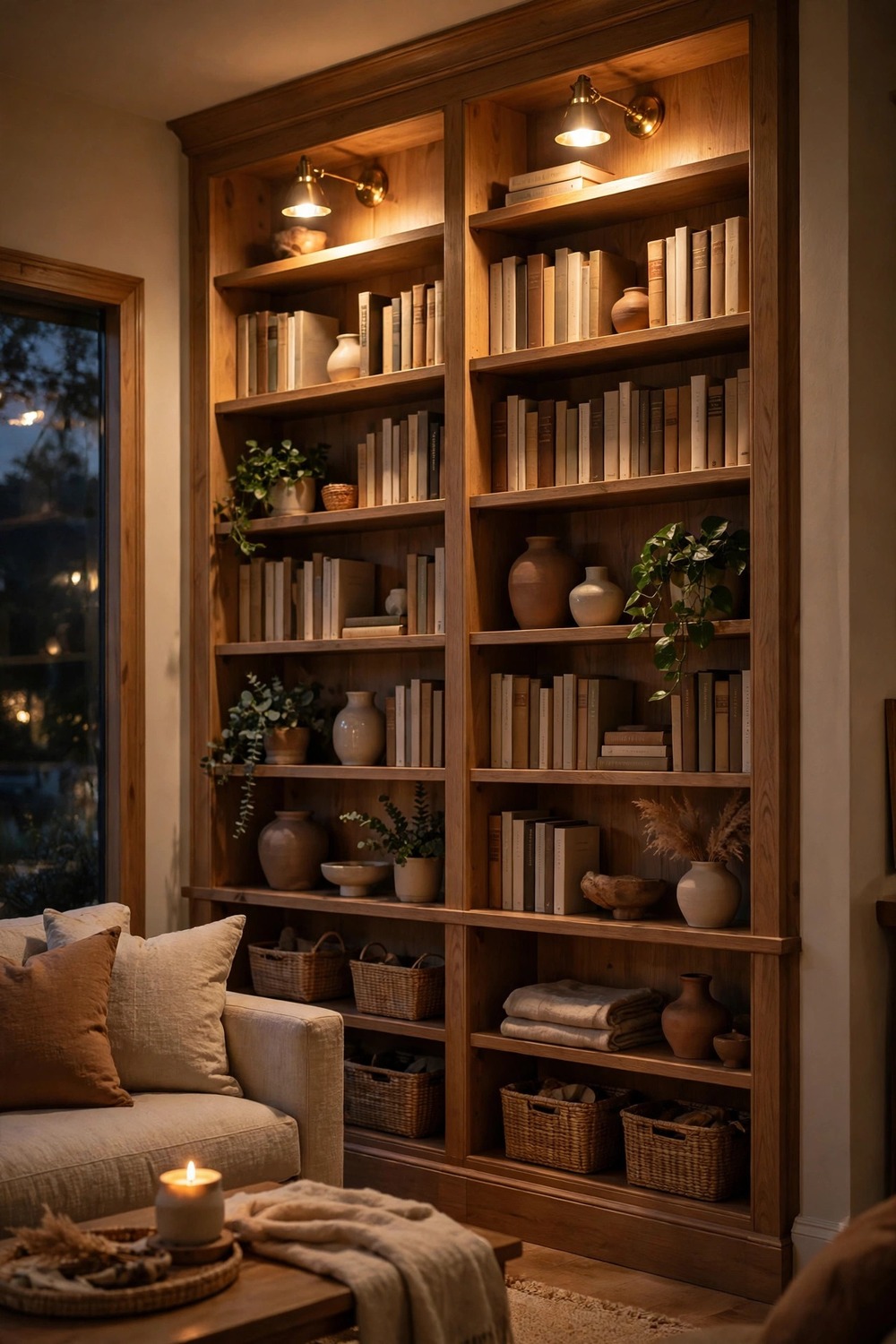
13. Add Warm Picture Lights Above the Shelves
Picture lights mounted above built-ins wash the whole wall in a soft, warm glow that makes evenings feel instantly cozier. They highlight the top shelves, which are often the darkest and most forgotten, and they give ceramics and art a gentle, gallery like lift without any harsh glare. Choose a warm finish and warm bulbs, and space the lights evenly so one section doesn’t end up much brighter than the rest. If wiring isn’t an option, battery powered versions can still give you a similar effect for reading corners and quiet nights in. Keep the light warm rather than bright white, because that warmth is what flatters wood and woven textures most.
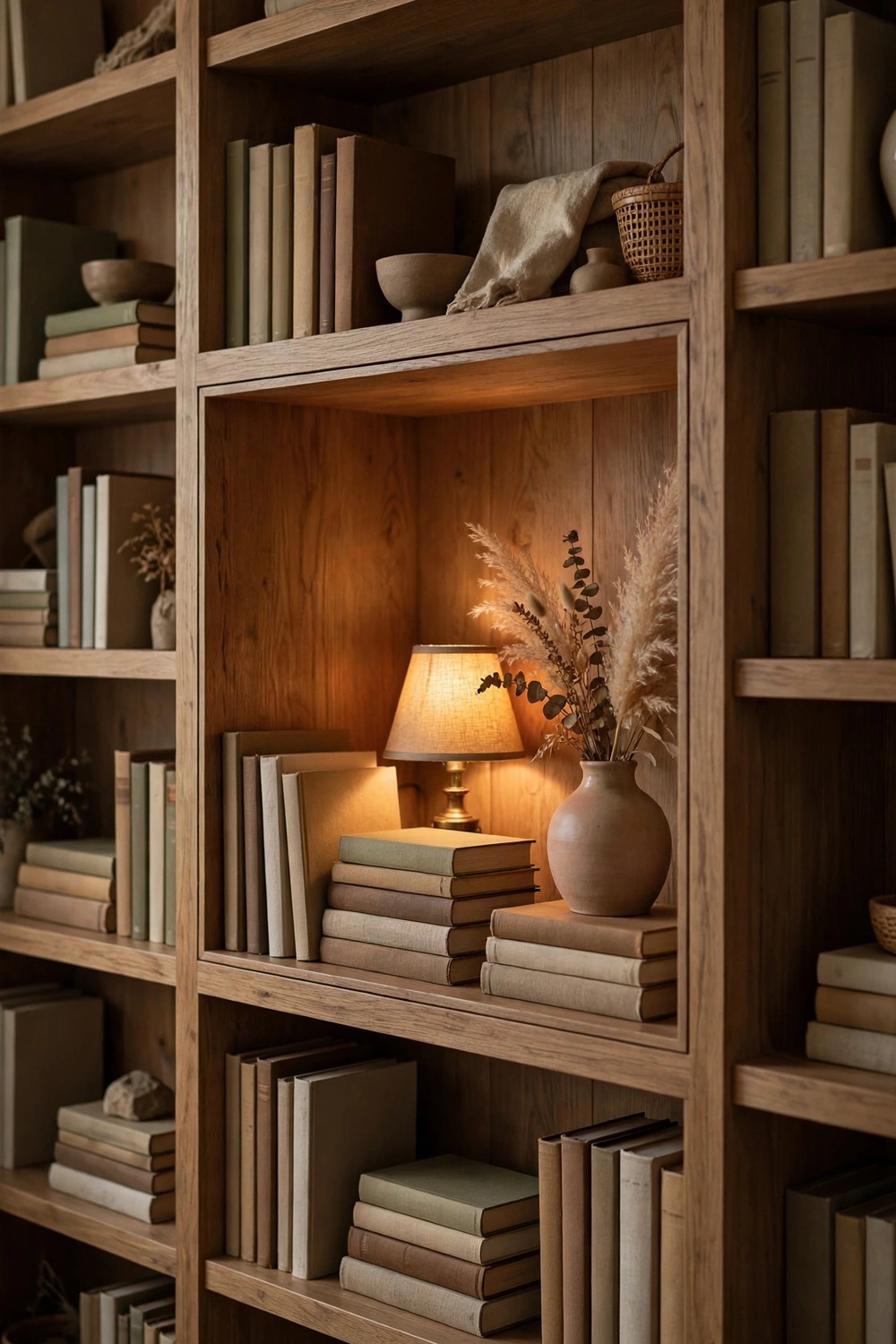
14. Tuck a Small Lamp Inside a Deep Shelf Cubby
A small lamp inside a deep cubby is a lovely surprise, especially on shelves that stretch into a darker corner of the room. It turns a shadowy box into a warm little scene and gives a favorite vase or stack of books its own pool of light. Choose a compact lamp with a soft fabric shade and a warm bulb, and make sure cords are tucked neatly behind books or along the shelf edge so they don’t become the main event. This works particularly well near a reading chair. Typically, one lamp is plenty, because the charm comes from it feeling like a quiet discovery rather than a lighting scheme.
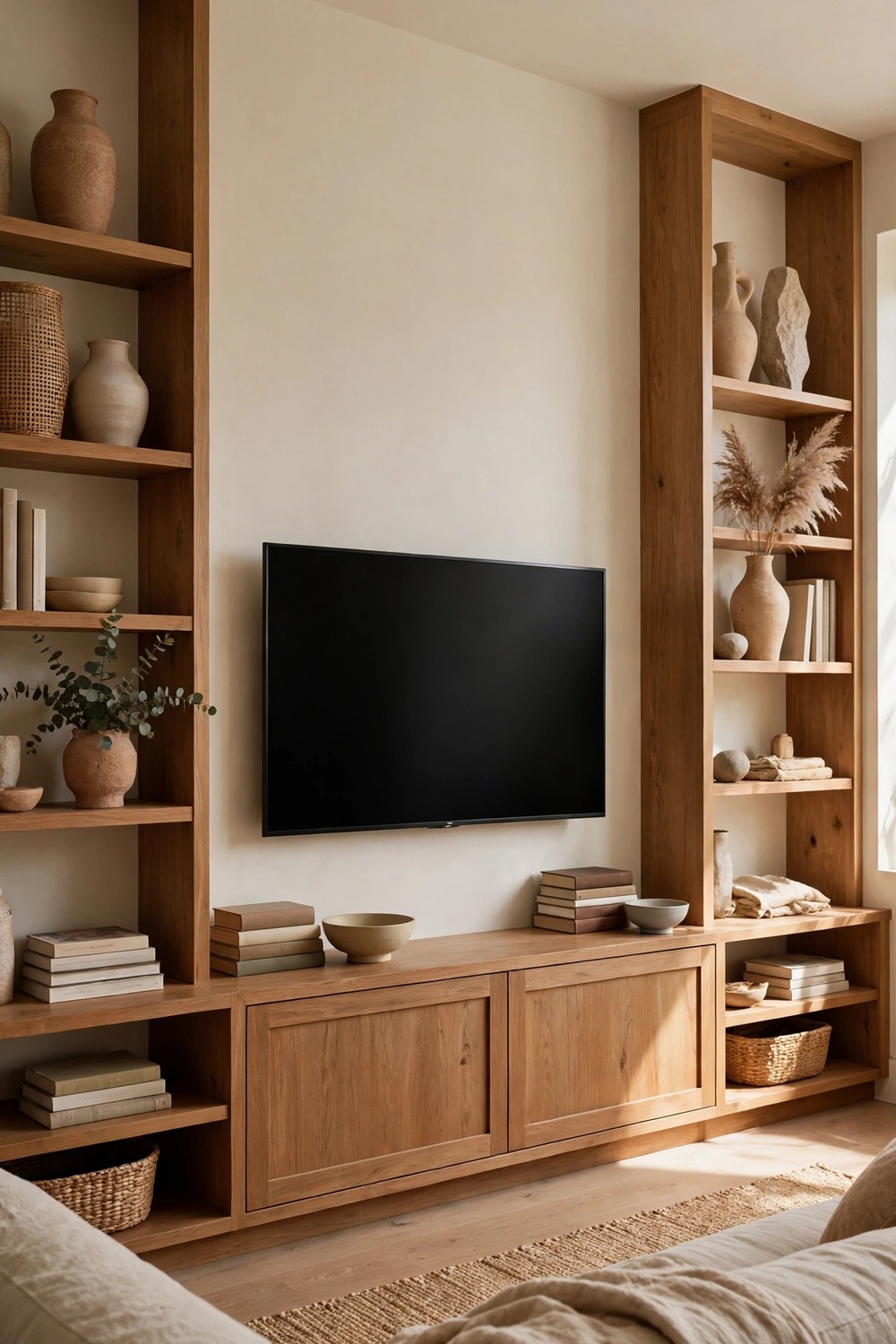
15. Style Around the TV Without Competing With It
When a TV sits between your built-ins, the shelves have a supporting role and that’s completely fine. Keep the styling closest to the screen low, simple, and calm, with short book stacks, a wide shallow bowl, or a small plant that won’t wave in front of the picture. Save taller and more interesting pieces for the outer shelves, where they can be enjoyed when the screen is off. Darker objects near the TV usually blend in better during a film, while very bright or shiny pieces can catch the light and distract. Think of the shelves as a quiet frame, and the room will feel balanced whether the TV is on or off.
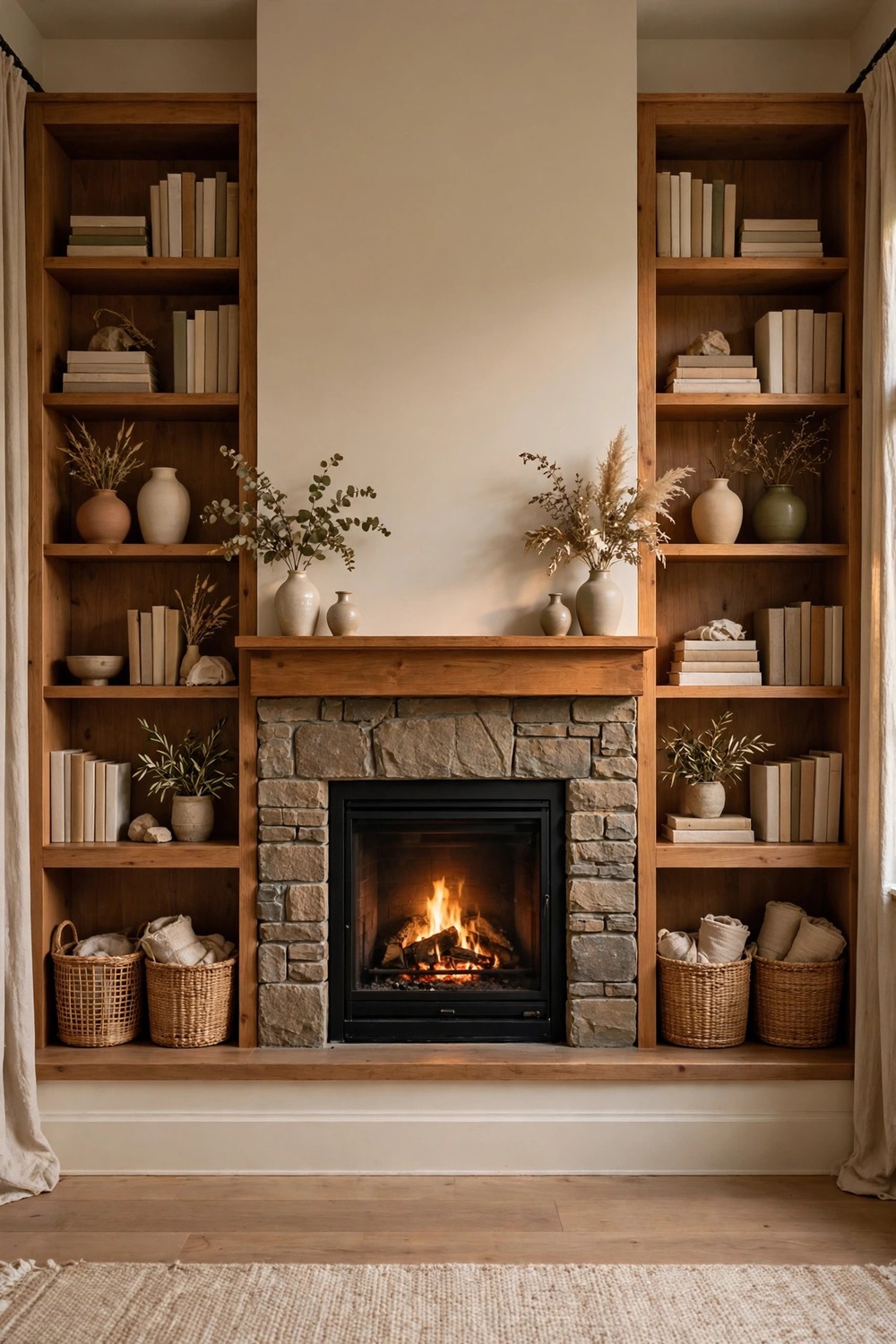
16. Frame the Fireplace With Balanced Shelves on Both Sides
Shelves on either side of a fireplace look best when they feel like a pair, even if they aren’t perfectly matched. Start by placing similar weight at similar heights on both sides, perhaps a basket low on the left and a basket low on the right, or a tall vase echoed by a tall stack of books. Then let the smaller details differ, because that’s what keeps the pairing from feeling copied. Repeat the mantel colors in both sets of shelves, in a cushion toned book cover or a piece of pottery, and the whole fireplace wall will typically read as one calm, connected arrangement.
17. Turn the Lowest Shelves Into Cozy Everyday Storage
The lowest shelves are the easiest to reach, so let them do the practical work in a way that still looks good. Folded throws, a basket of current magazines, board games in plain boxes, and a lidded basket for remotes can all live down there happily. Keeping heavier and bulkier things low also makes visual sense, because it grounds the unit and leaves the higher shelves free for lighter, prettier pieces. If children or pets use the room, this is the safest zone for sturdy, unbreakable storage too. Just keep the arrangement loose and basket led, so it reads as cozy and lived in rather than packed and forgotten.
18. Finish With Personal Pieces That Tell Your Story
After all the practical styling, save a little room for the pieces that are actually yours. A framed print from a trip you loved, a small object you collected years ago, a bowl made by someone you know, or a favorite book with a worn cover can all earn a quiet spot among the tidier groupings. These are the things guests usually notice and ask about, and they’re what stop built-ins from looking like anyone could have styled them. You don’t need many. Two or three personal pieces, placed where you’ll see them often, typically do more for the room than a shelf full of new decor ever could.
When you step back, your shelves don’t need to look finished in any perfect sense. They just need to feel balanced, useful, and a little bit personal. If a section bothers you, change only that section, live with it for a few days, and then decide again. Styling built-ins is usually a slow, pleasant process of small adjustments rather than one big reveal, and your room will keep teaching you what it needs as the light and the seasons change around it.
So start small this week. Clear one shelf completely, put back only what you love, and leave a little space around it. That single calm shelf will show you what the rest of the wall can become, and you’ll probably find the next change suggests itself. Before long, those built-ins won’t feel like a problem to solve anymore. They’ll feel like the part of the living room that quietly tells everyone who walks in exactly how you like to live.

Leave a Reply