
20 Kitchen Lighting Ideas for Every Layer of Light
Look, we get it. A kitchen can have beautiful cabinets, a counter you love, and still feel frustrating the moment you try to cook in it after dark. One bright ceiling light leaves shadows right where you are chopping, the island feels a little flat, and the whole room can look washed out instead of warm. If you’ve ever moved a cutting board around just to find a patch of decent light, you’re definitely not alone. Most kitchens end up that way because lighting is usually planned last, even though you feel it first.
That’s exactly why thinking in layers helps so much. Ambient light fills the room, task light helps you work safely, accent light adds the soft glow in the corners, and decorative light gives the kitchen its personality. You’ll find ideas in this list that start with pendants and recessed cans, move through under cabinet strips and hood lights, and finish with dimmers, bulb temperatures, and evening scenes. Some are simple bulb swaps and some are bigger projects, and you definitely don’t need all twenty. Two or three done well will typically change how your kitchen works every single day.
Start with the ambient ideas if your room feels dim overall, then look at the task ideas if cooking itself feels hard on your eyes, and save the accent touches for when the basics are already sorted. Work in that order and you’ll usually notice the room getting easier and warmer as you go. Take a photo at night before you change anything, live with each new layer for a few evenings, and remember that a kitchen you light slowly, one layer at a time, is always easier to get right than one you try to finish in a rush.
In This Article
- Hang Oversized Pendants Over the Island
- Install Recessed Cans on Dimmers for Even Ambient Light
- Choose a Flush Mount That Spreads Light in Low Rooms
- Add Cove Lighting for a Soft Ceiling Glow
- Let in More Natural Light With Sheer Window Coverings
- Add Under-Cabinet Strips for Shadow-Free Counters
- Hang Sconces Over the Sink Window
- Brighten the Range With Strong Hood Lighting
- Install In-Cabinet Lights So Nothing Hides
- Aim Track Lighting Over Busy Work Zones
- Add Toe-Kick Lighting for a Floating Glow
- Line Open Shelves With Slim LED Strips
- Add Picture Lights Over Kitchen Art
- Highlight a Stone Backsplash With Grazing Accent Light
- Put a Low Glow Under the Island Overhang
- Hang a Statement Chandelier Over the Breakfast Table
- Layer Bulb Temperatures for a Balanced Glow
- Put Each Layer on a Separate Dimmer Switch
- Choose Decorative Bulbs That Look Good Exposed
- Set Evening Scenes With Smart Bulbs and Timers
Build a Warm Ambient Base First
Ambient light is the general light that lets you walk into the kitchen and see the whole room comfortably, without squinting or hunting for a switch. If this base layer is weak, every other light has to work too hard and the room still feels patchy. These first five ideas help you build a soft, even foundation with pendants, recessed lights, ceiling fixtures, and the daylight you already have.
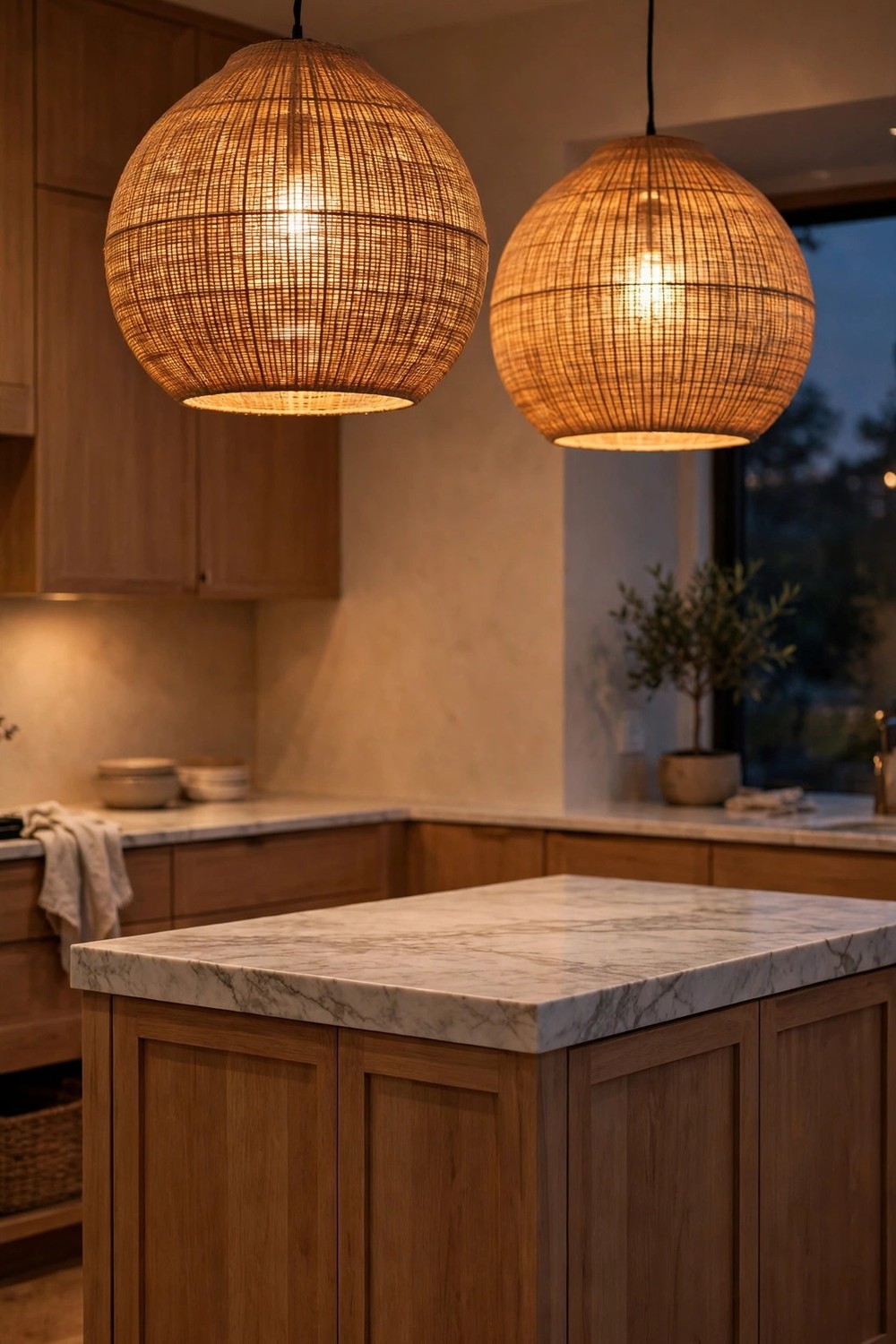
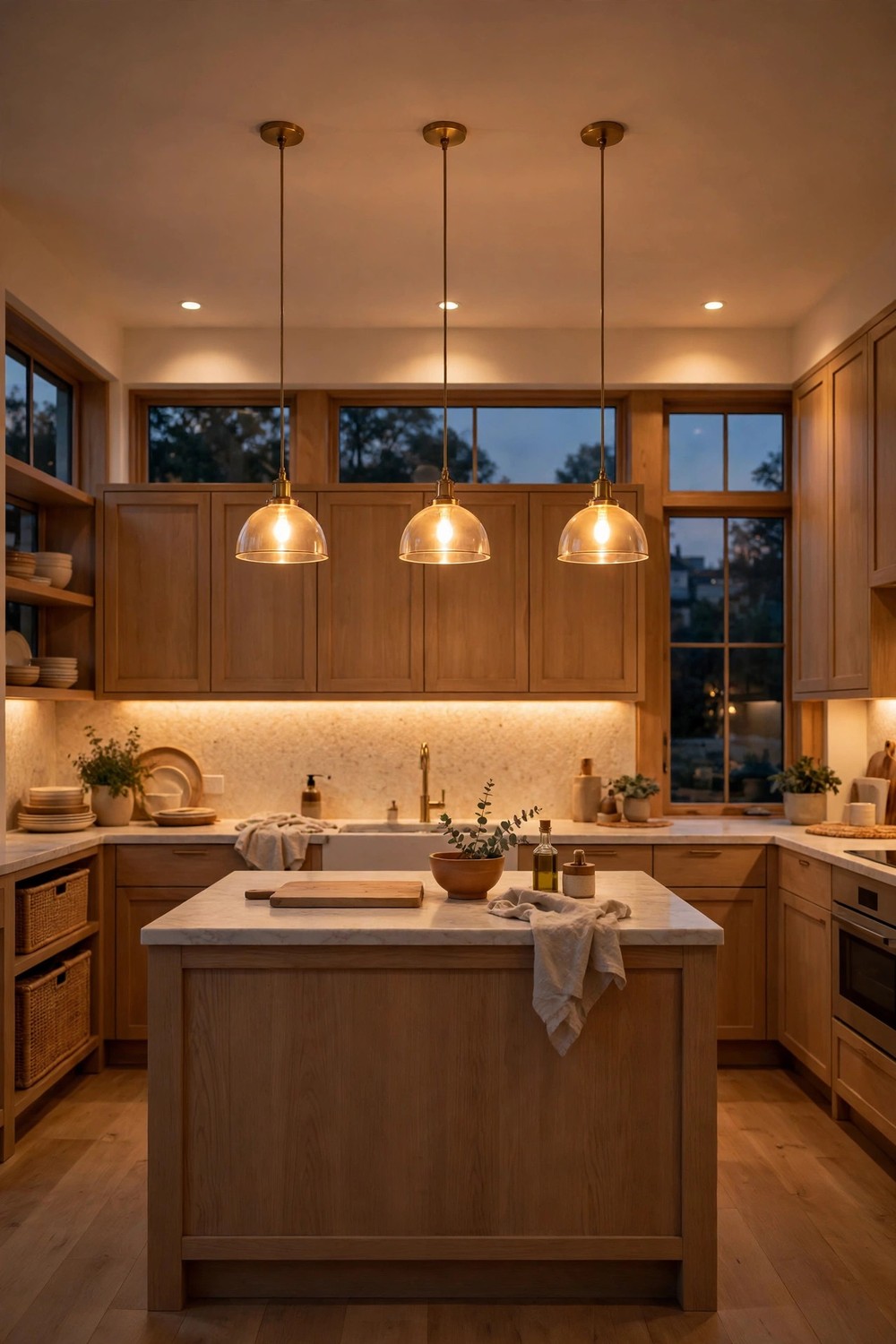
1. Hang Oversized Pendants Over the Island
Oversized pendants over the island do two jobs at once, because they pour useful light onto the surface where you prep, serve, and gather, and they give the whole kitchen a clear focal point. A larger shade usually spreads light more generously than a tiny one, and it tends to look calmer and more confident above a long island. Two pendants often suit a medium island, while three can work on a longer one, but spacing matters more than the exact count. Hang them so the bottom of the shade sits roughly at eye level when you are standing nearby, high enough that you can see across the island without ducking. Choose a shade that directs some light down for tasks and lets a little escape upward for softness. If your island is also where homework and laptops land in the evening, put these pendants on a dimmer from the start.
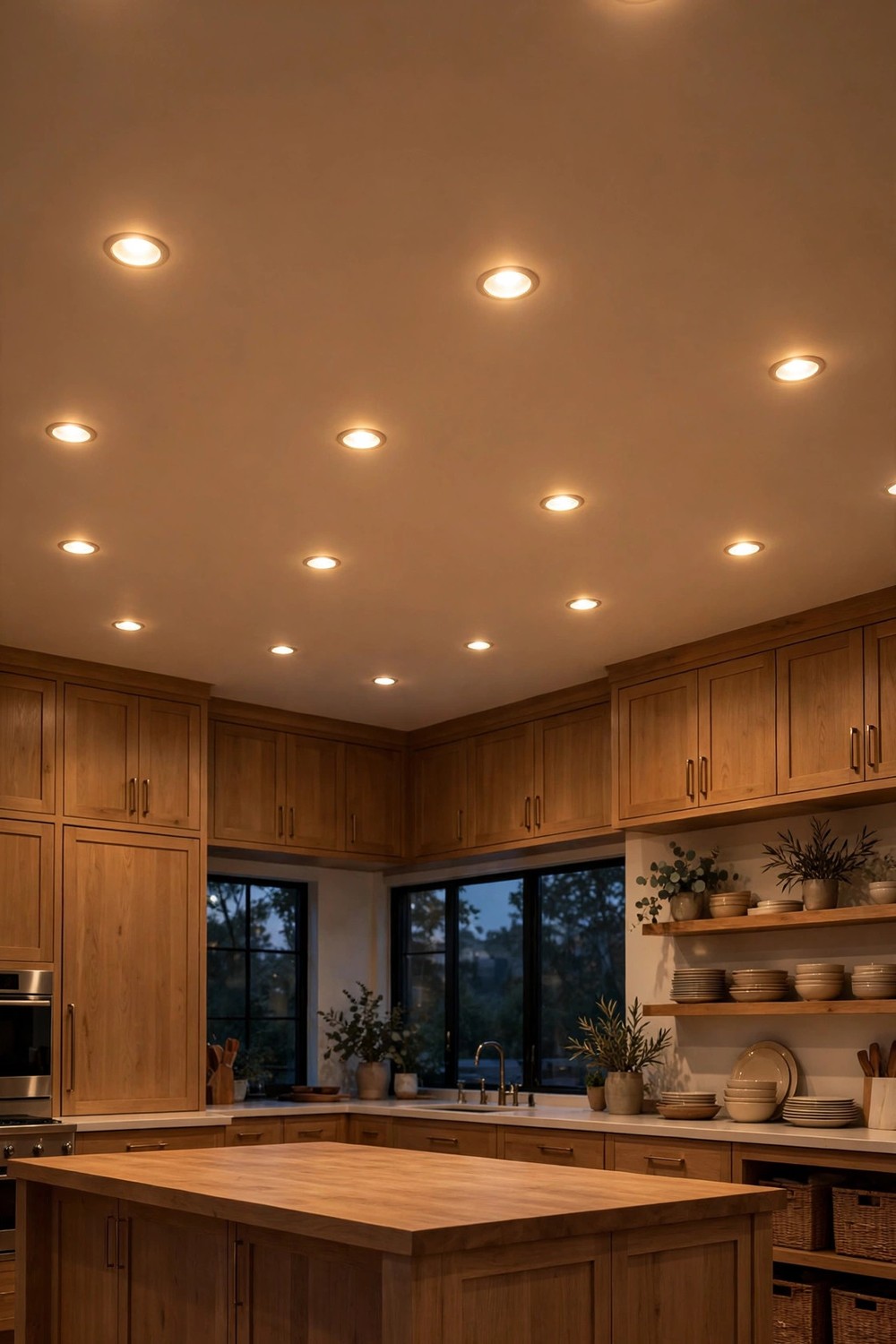
2. Install Recessed Cans on Dimmers for Even Ambient Light
Recessed cans are the quiet workhorse of ambient kitchen lighting, because they spread light evenly across the room without taking up any visual space at all. Placed in a loose grid and kept a comfortable distance from the cabinets, they can fill in the shadows that a single central fixture always leaves behind. The key detail most people miss is the dimmer, because full brightness is helpful for cleaning and busy cooking, but it is usually too harsh for dinner or a slow evening in the kitchen. Warm toned bulbs typically make food, wood, and skin look better than cool daylight bulbs do. If you are adding cans to an older kitchen, start over the main walkways and the open floor area, since your pendants and under cabinet lights will cover the counters. Even spacing looks best, so map the ceiling before anyone cuts a hole.
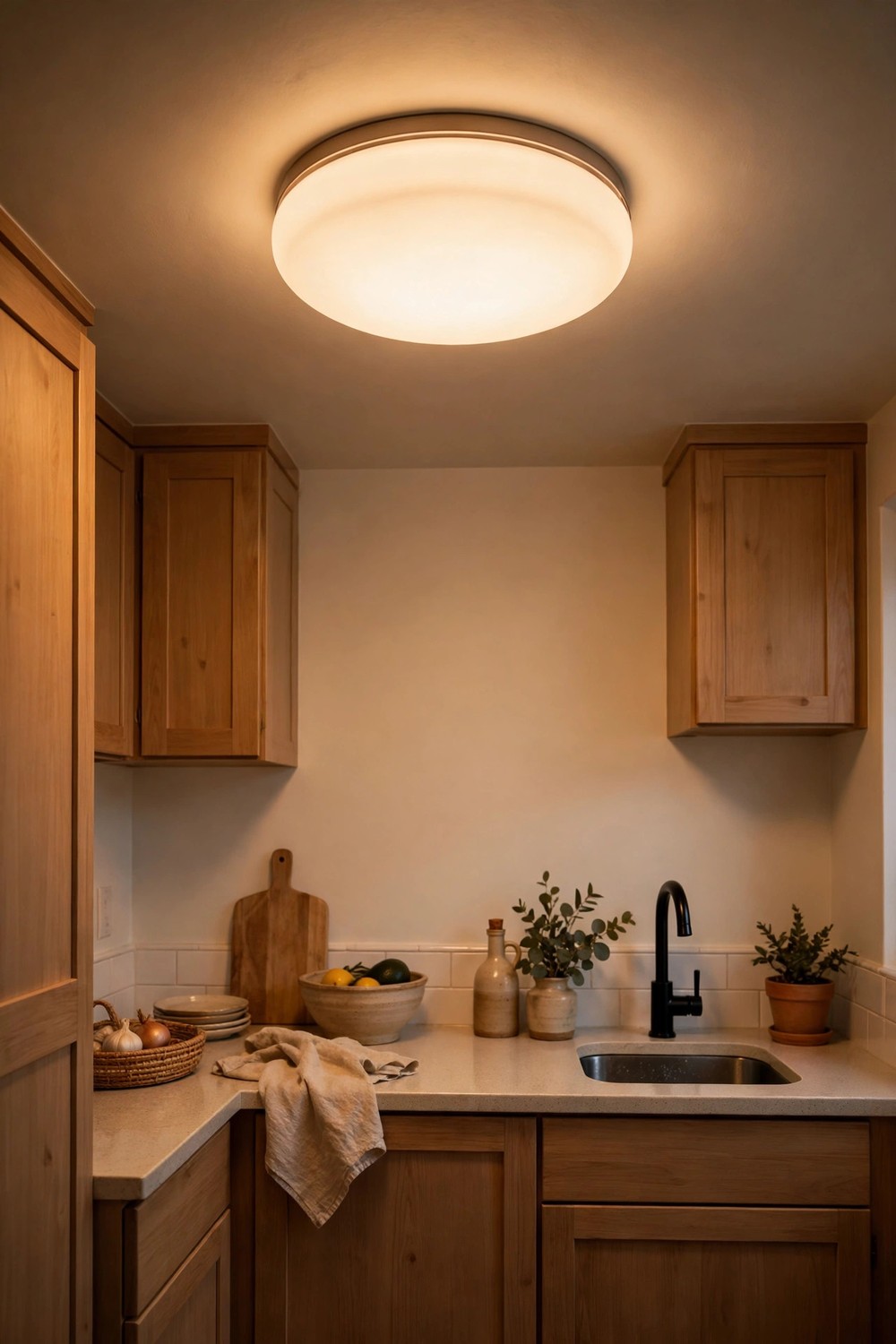
3. Choose a Flush Mount That Spreads Light in Low Rooms
Not every kitchen can carry pendants or a chandelier, and a good flush mount is the honest answer for a low ceiling or a small room. Look for a fixture with a wide, frosted, or fabric style diffuser, because that kind of shade spreads light across the ceiling and walls instead of dropping one hard pool in the middle of the floor. A warm metal rim or a soft white finish keeps it feeling like part of the kitchen rather than a leftover builder choice. In a galley kitchen, two smaller flush mounts spaced along the run usually feel more even than one fixture doing all the work alone. Keep the bulb tone warm and consistent with your other layers, since a single cool fixture can make the whole room feel off. This is a quick swap in most homes, and it is often the change renters and first time owners notice most.
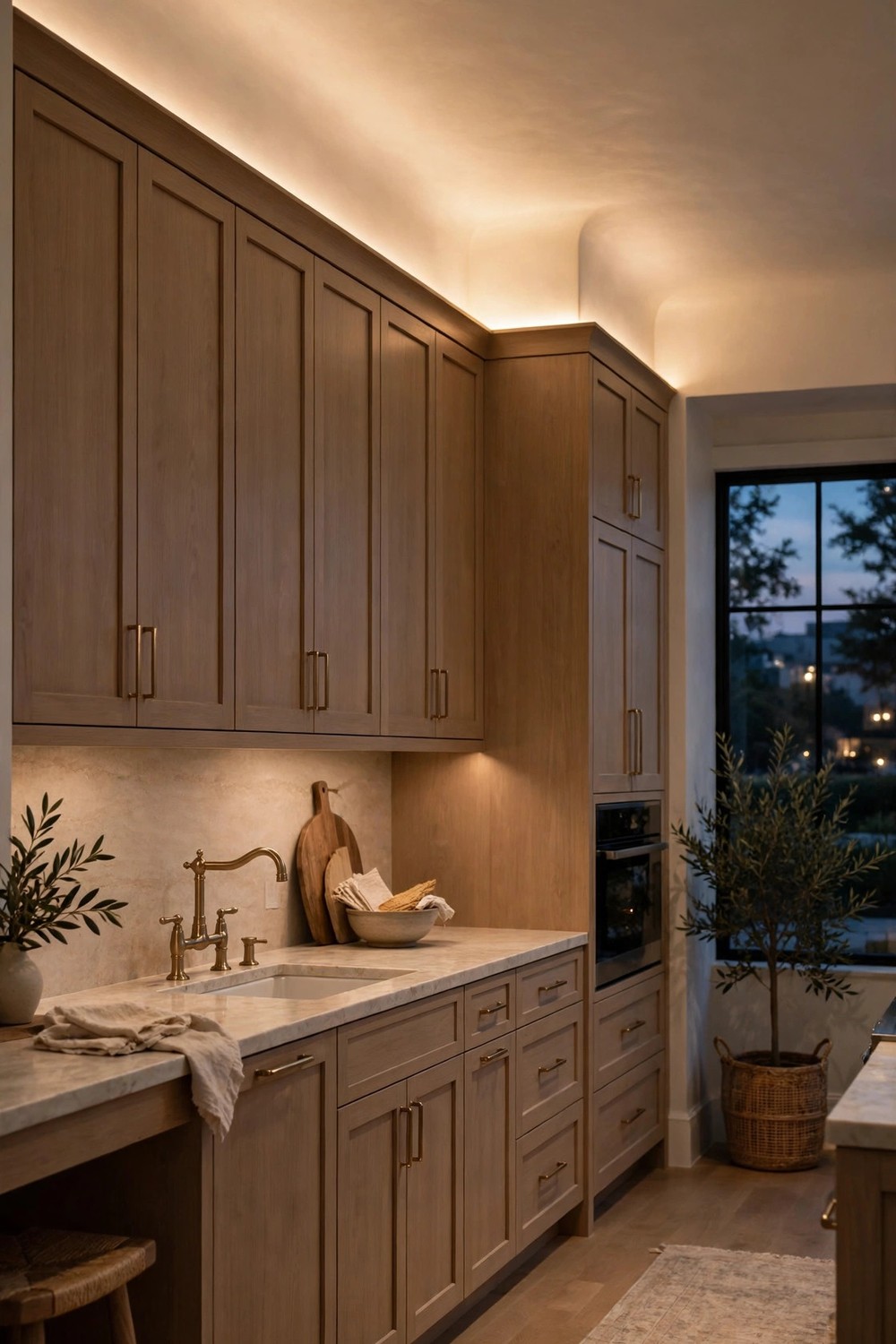
4. Add Cove Lighting for a Soft Ceiling Glow
Cove lighting hides a strip of light in a ledge, a soffit, or along the top of your cabinets and lets the glow wash softly across the ceiling instead of shining straight into your eyes. That indirect quality is what makes it feel so calm, because you see the light it creates rather than the source itself. Above cabinet coves work especially well in kitchens where the cabinets stop short of the ceiling, since that gap is otherwise just a dark line that collects dust. A warm strip tucked up there can make the whole room feel taller in the evening. Keep the color consistent with your main ambient bulbs so the ceiling does not turn a different shade from the counters. Cove light is not meant to help you chop an onion on its own. Think of it as the background layer that makes every other layer look softer.
5. Let in More Natural Light With Sheer Window Coverings
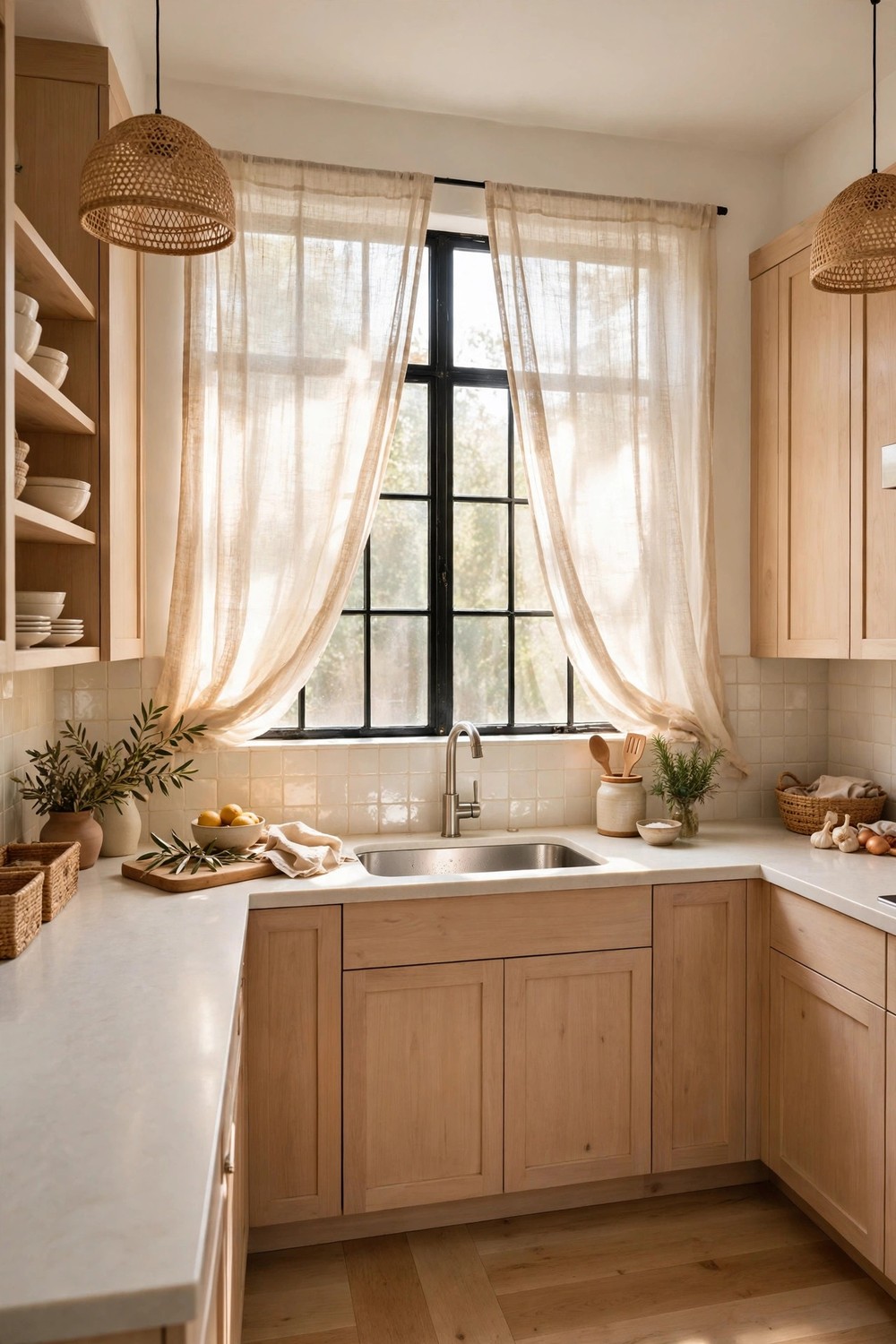
Natural light is the one layer you do not have to buy, wire, or replace, so it is worth helping it do more during the day. Heavy blinds and dark curtains over a kitchen window can cut your best light in half, while a sheer shade, a light linen panel, or a simple top down blind keeps privacy and still lets the daylight pour in. Pale counters, a light backsplash, and even a glossy kettle or a glass cabinet door will bounce that daylight a little deeper into the room. If your window sits over the sink, keep the covering short and washable, since splashes are just part of life there. On a very sunny window, a sheer that softens glare usually feels better than bare glass at midday. Good daylight also tells you the truth about your bulb colors at night, which helps every other choice in this list.
Add Task Lighting Where You Actually Work
Task light is the layer that helps you read a recipe, check whether chicken is cooked through, and find the edge of a knife safely. It needs to be brighter, closer, and more focused than ambient light, and it should land on the work itself rather than behind you. These ideas cover the counters, the sink, the range, the inside of your cabinets, and the busy zones in between.
6. Add Under-Cabinet Strips for Shadow-Free Counters
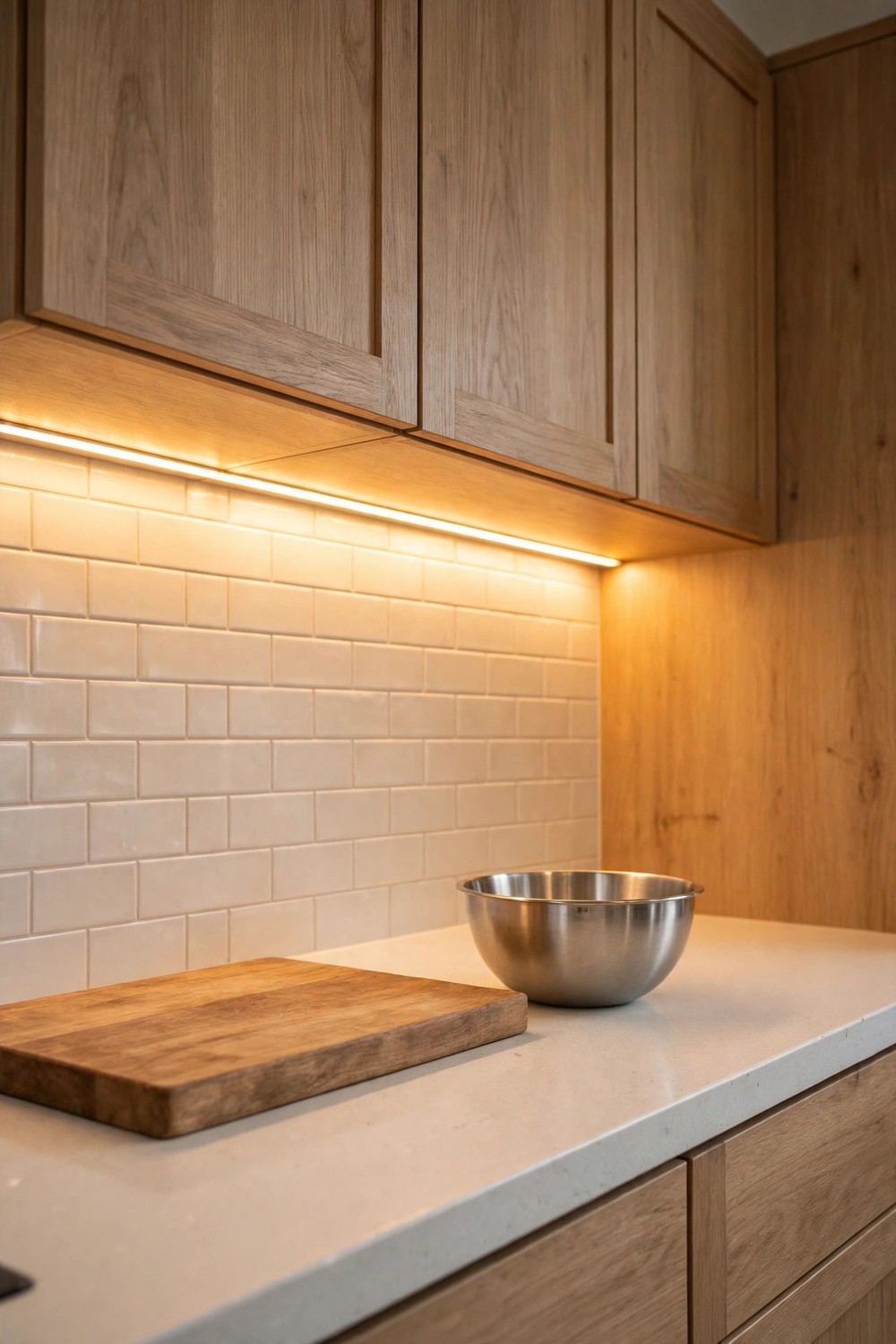
Under cabinet strips are usually the single most useful lighting upgrade in a kitchen, because your own body and your upper cabinets block ceiling light from reaching the counter where you actually work. A slim LED strip mounted toward the front edge of the cabinet shines straight down onto the chopping board, the mixing bowl, and the recipe card, with almost no shadow in the way. Choose a warm to neutral bulb tone that matches your ambient light, and look for a strip you can cut or connect to fit your exact run of cabinets. Mounting the strip slightly forward, rather than against the wall, typically lights the whole depth of the counter instead of just the backsplash. If you can, put these on their own switch so you can use them alone in the early morning without lighting the whole room. Once you’ve cooked with them for a week, cooking without them feels surprisingly hard.
7. Hang Sconces Over the Sink Window
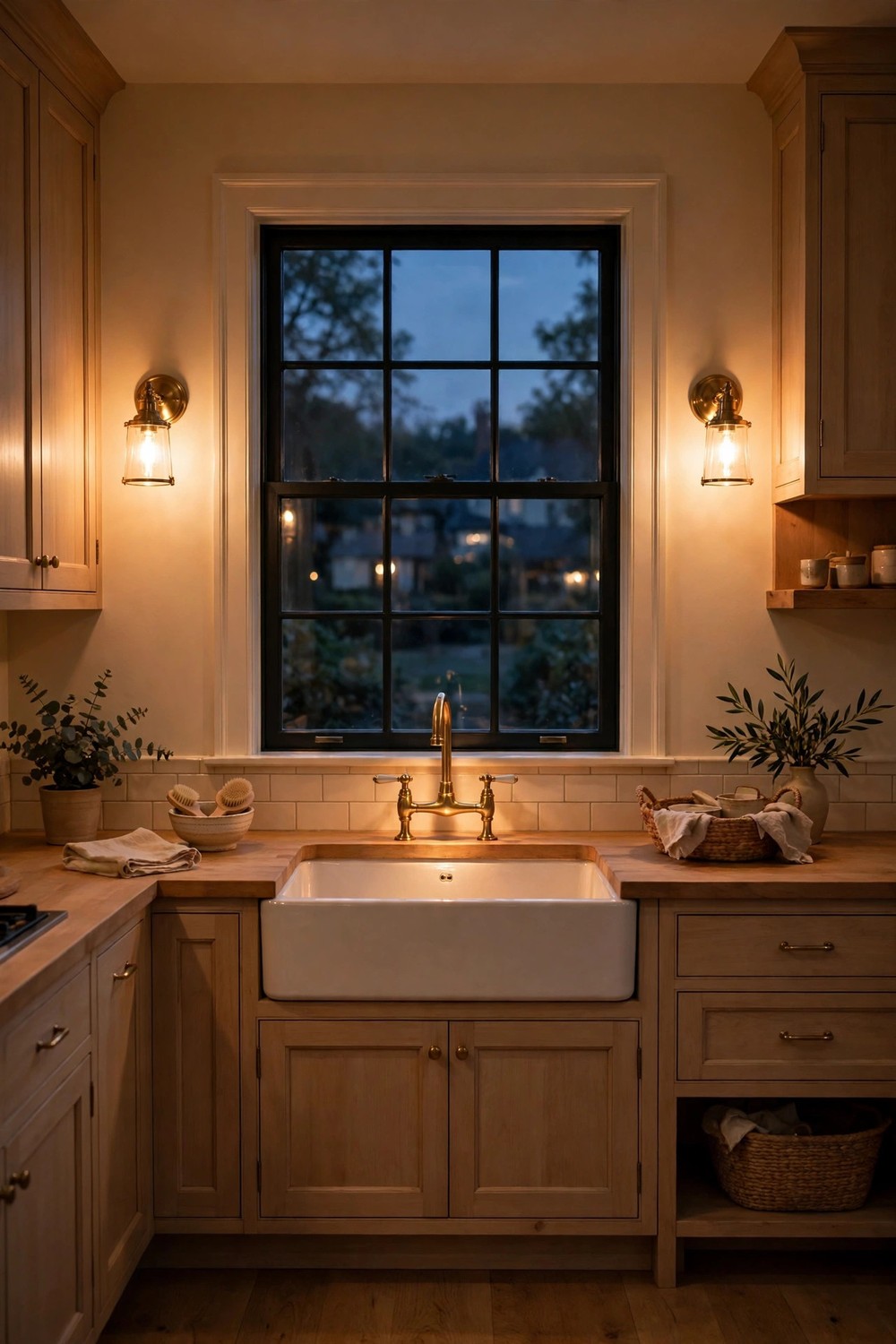
The sink is where you wash, rinse, fill pots, and often stare out of the window while your hands are busy, so it deserves better than leftover ceiling light. A pair of sconces flanking the window, or one wide sconce mounted above it, gives your face and the sink basin an even, flattering light that makes evening washing up feel far less stark. Choose a finish that echoes your faucet or your cabinet pulls so the sconces feel planned rather than added on. Shades that point some light down into the sink and some outward into the room usually work best here. If wiring above the window is tricky, this is also a good spot to ask an electrician about early, since the wall is often shared with plumbing. Keep the bulbs warm, because you will see this light up close, reflected in the window glass after dark.
8. Brighten the Range With Strong Hood Lighting
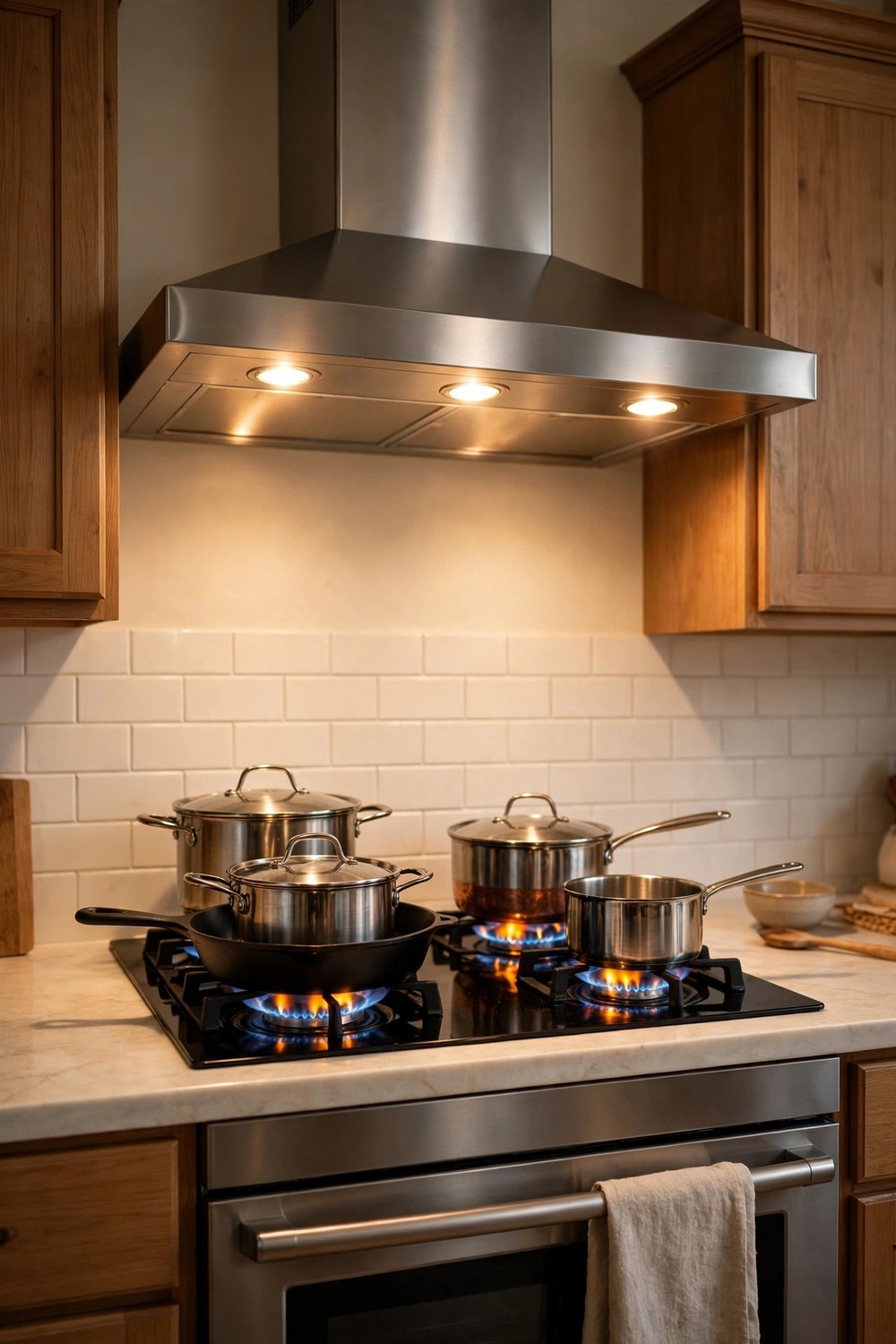
A lot of cooking confidence comes down to whether you can actually see what is happening in the pan, and that is the job of good hood lighting. Many range hoods come with a single weak bulb that leaves the back burners in shadow, so upgrading to brighter, warm toned bulbs that suit your hood can change weeknight cooking more than you’d expect. The light should cover all the burners as evenly as possible and land inside your pots, not just on the cooktop around them. If you are choosing a new hood, look closely at where the lights sit and how easy the bulbs are to change, because a bulb you cannot reach is a bulb that stays dead. Keep a dim or low setting in mind for the evening, when the hood light alone can act as a gentle night light for the whole cooking zone. Clean the covers now and then, since a film of cooking grease quietly dims everything.
9. Install In-Cabinet Lights So Nothing Hides
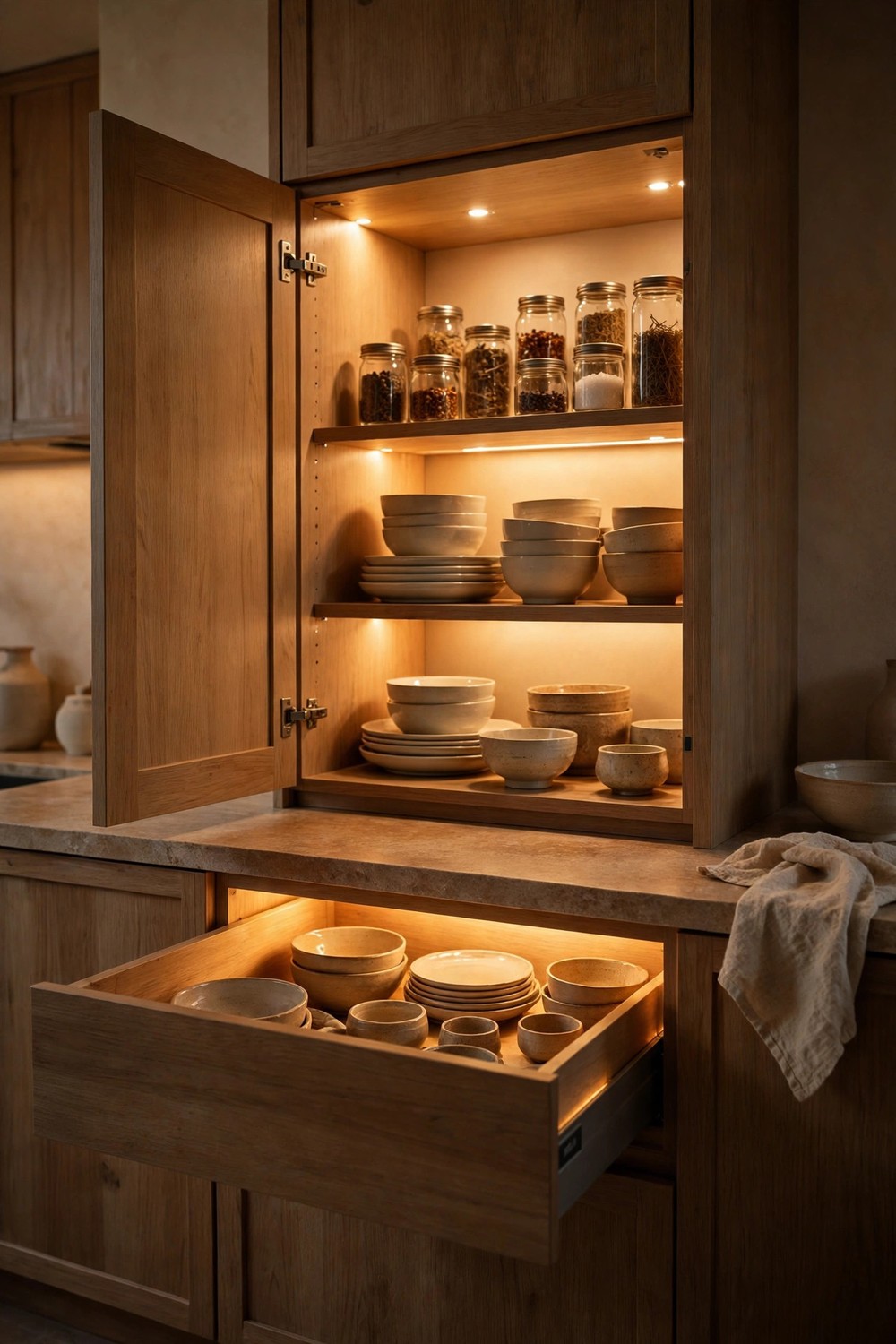
Deep cabinets and drawers swallow light, which is why the spice jar, the measuring cup, and the lid you need always seem to hide at the back. Small in cabinet lights fix that in a very practical way. Slim strips or little puck lights mounted inside the cabinet frame, or along the side of a deep drawer, switch on as you open the door and show you the whole shelf at once. Battery and rechargeable options make this an easy weekend job with no wiring, and they are especially helpful in a pantry cabinet or a corner unit that never sees daylight. Keep the tone warm and not overly bright, since the light is close to your eyes when you open the door at night. Start with the one cabinet that frustrates you most, usually the baking or spice cabinet, and add more only if the first one earns its place.
10. Aim Track Lighting Over Busy Work Zones
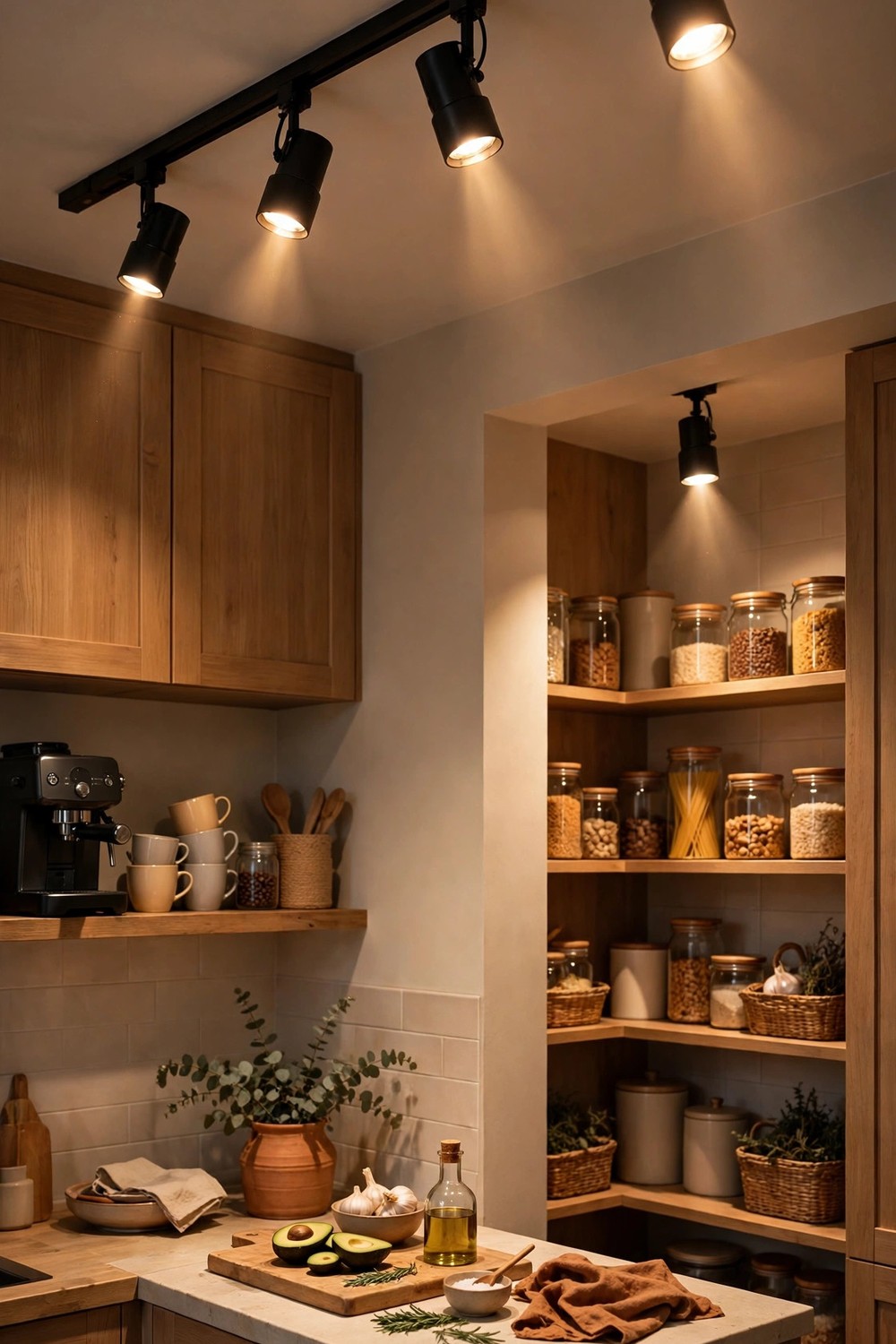
Track lighting earns its keep in kitchens that change a lot, because each head on the track can be aimed exactly where you need it and moved again when your habits change. Point one head at the coffee corner, one at the main prep counter, and one toward the pantry door, and you have task light that follows your real routine rather than a fixed plan. It is a practical fit for kitchens with beams, sloped ceilings, or a single central electrical box, since the track spreads light out from that one point. Choose heads with a warm bulb and a shade that shields your eyes from glare when you look up. Tracks can look busy if the heads point every which way, so aim them with intention and keep the angles calm and roughly parallel. If your kitchen layout is still settling, this flexibility is worth a lot.
Layer In Accent Light for Warmth and Depth
Accent light is the soft layer that stops a well lit kitchen from feeling flat or a little clinical. It picks out texture, adds a low glow at floor and shelf level, and gives your eyes somewhere gentle to rest in the evening. None of these ideas needs to be bright. In fact, accent light usually works best when it is the quietest light in the room.
11. Add Toe-Kick Lighting for a Floating Glow
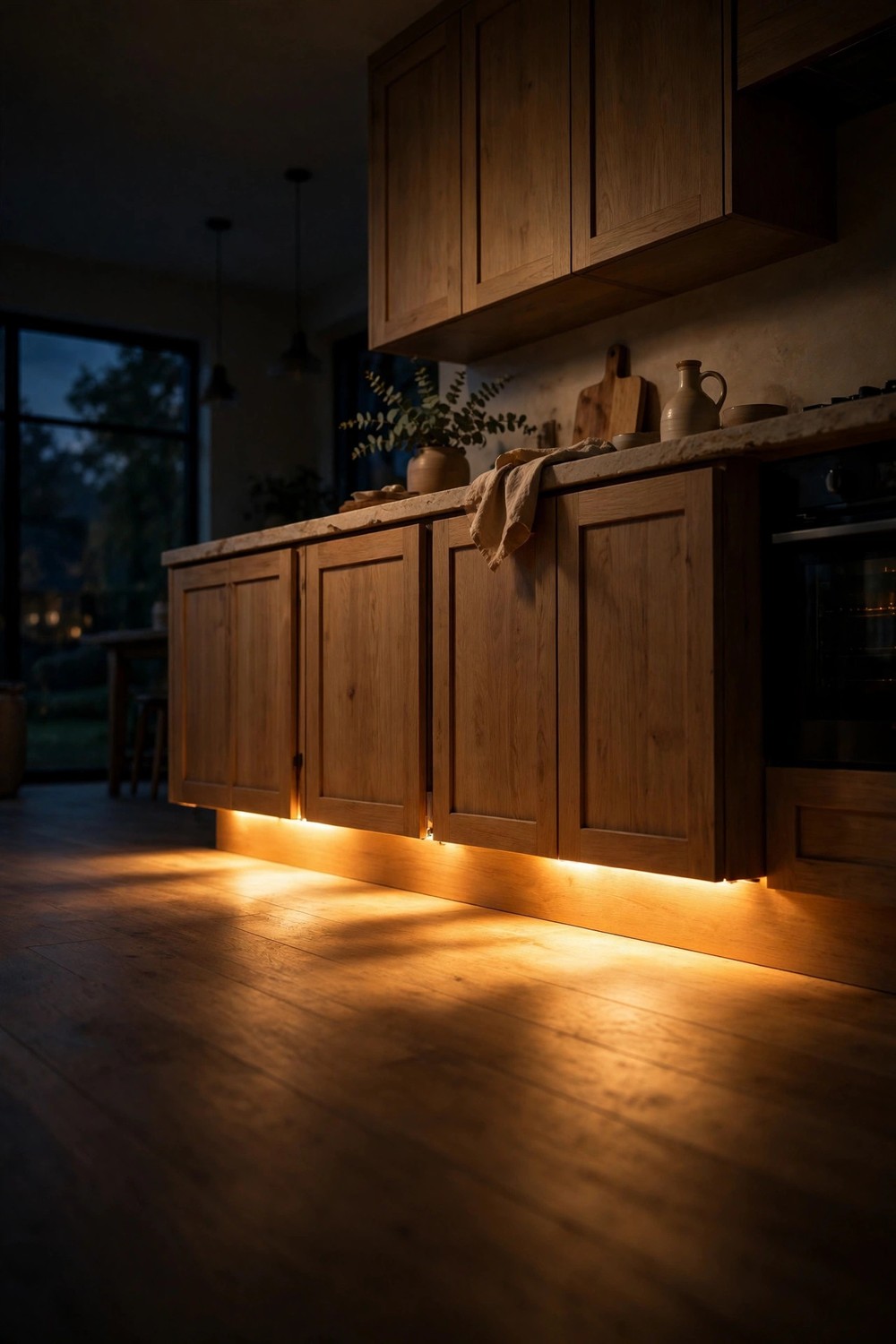
Toe kick lighting tucks a slim strip under the base of your lower cabinets, where your feet go, and washes a soft pool of light across the floor. The effect is subtle and a little magical in the evening, because the cabinets seem to float and the kitchen feels calm without any overhead light on at all. It is also genuinely practical, since that low glow is enough for a glass of water at midnight without waking up the whole house or your own eyes. A warm tone is important here, because cool light at floor level can feel like a shop or an office. Many strips can link to the same switch as your under cabinet lights, or run on their own dimmer for a lower evening setting. Keep the strip set back a little so you see the glow on the floor, not the strip itself.
12. Line Open Shelves With Slim LED Strips
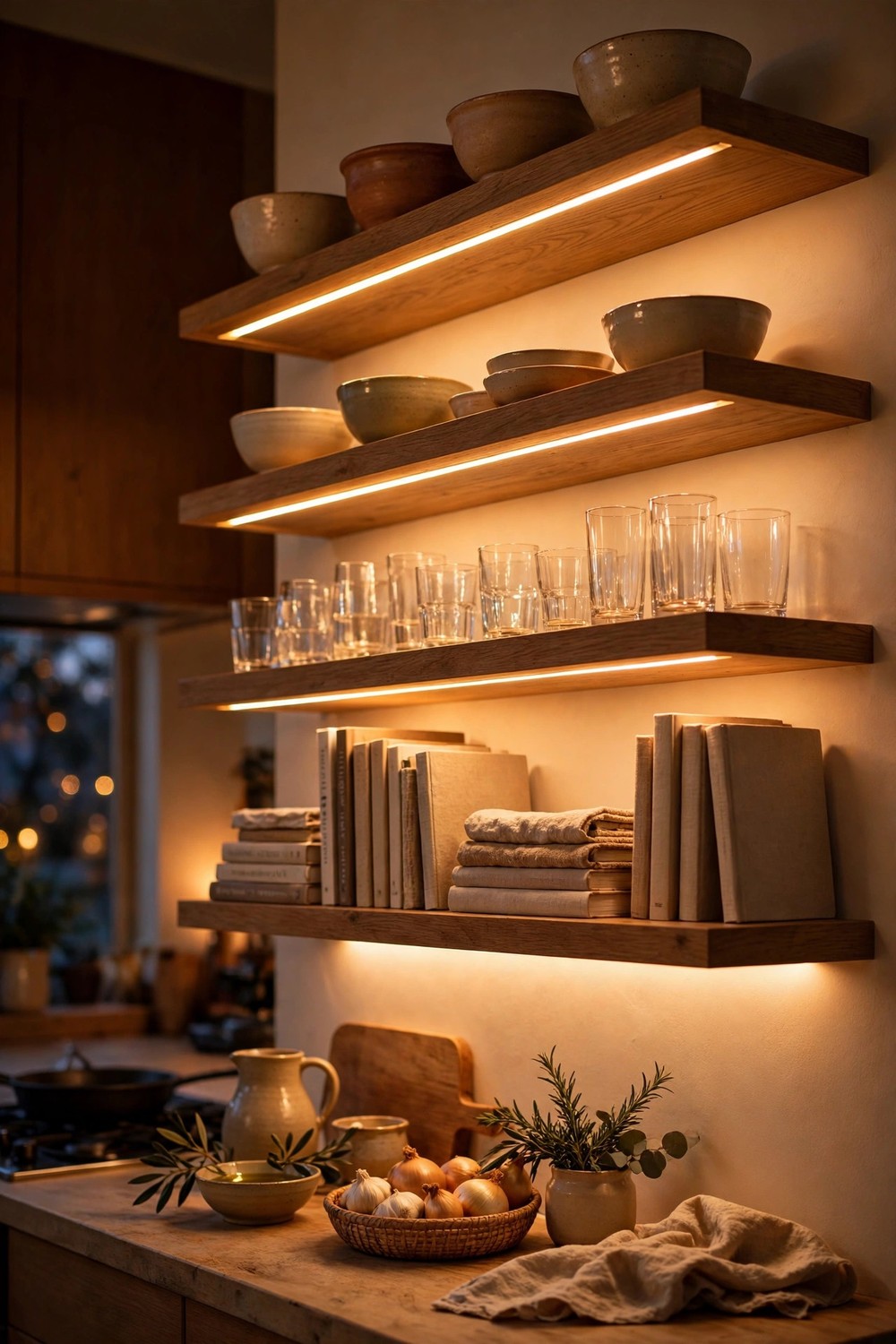
Open shelves look lovely in daylight and then go a little dark and dull after sunset, unless you give them a light of their own. A slim LED strip hidden under the front edge of each shelf casts a warm wash down over your bowls, glasses, and cookbooks, and turns everyday dishes into a quiet display. The light is close and low, so it does not need to be strong to register. A gentle warm tone usually flatters wood shelves and ceramic pieces best. Route the cord down the back corner where it will not be seen, or choose rechargeable strips if your shelves sit far from an outlet. Keep the styling on the shelves simple once they are lit, because lit clutter still looks like clutter, just brighter. Two or three shelves with breathing room between objects will glow. A crowded shelf will just glare.
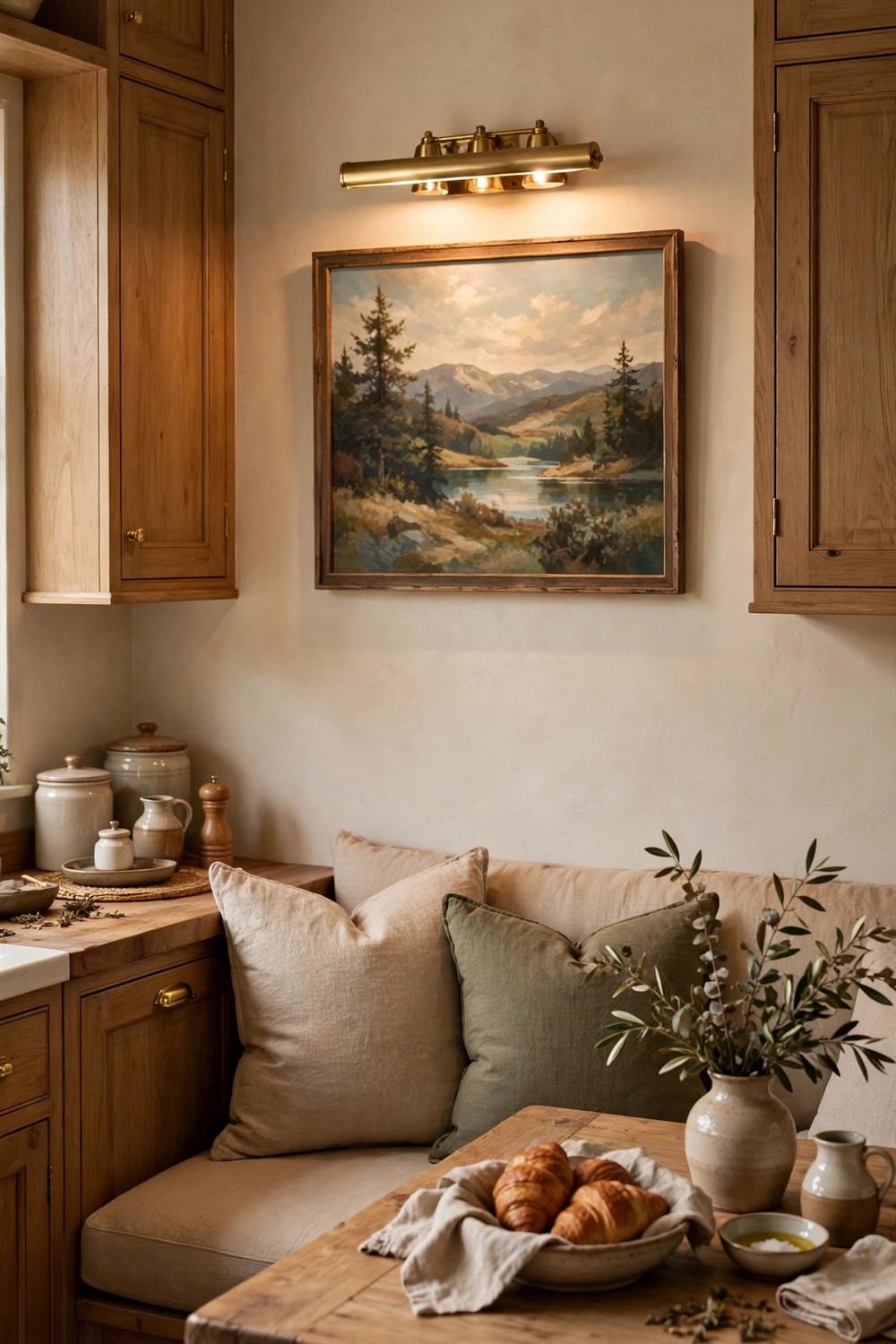
13. Add Picture Lights Over Kitchen Art
Kitchens collect more art than we give them credit for, from a framed print over a banquette to a small painting beside the pantry door, and a picture light gives that piece the same treatment a gallery would. A slim bar mounted above the frame washes soft light down over the artwork, which adds depth to the wall and makes the whole corner feel considered in the evening. Battery operated picture lights are widely available and usually need nothing more than a few screws, so this can be a one afternoon project. Choose a warm finish that suits your other metals, and keep the light gentle rather than bright, since art light is about mood, not reading. This trick also works over a framed menu, a family recipe card, or a row of small prints above open shelves. It is a small light that makes the room feel personal.
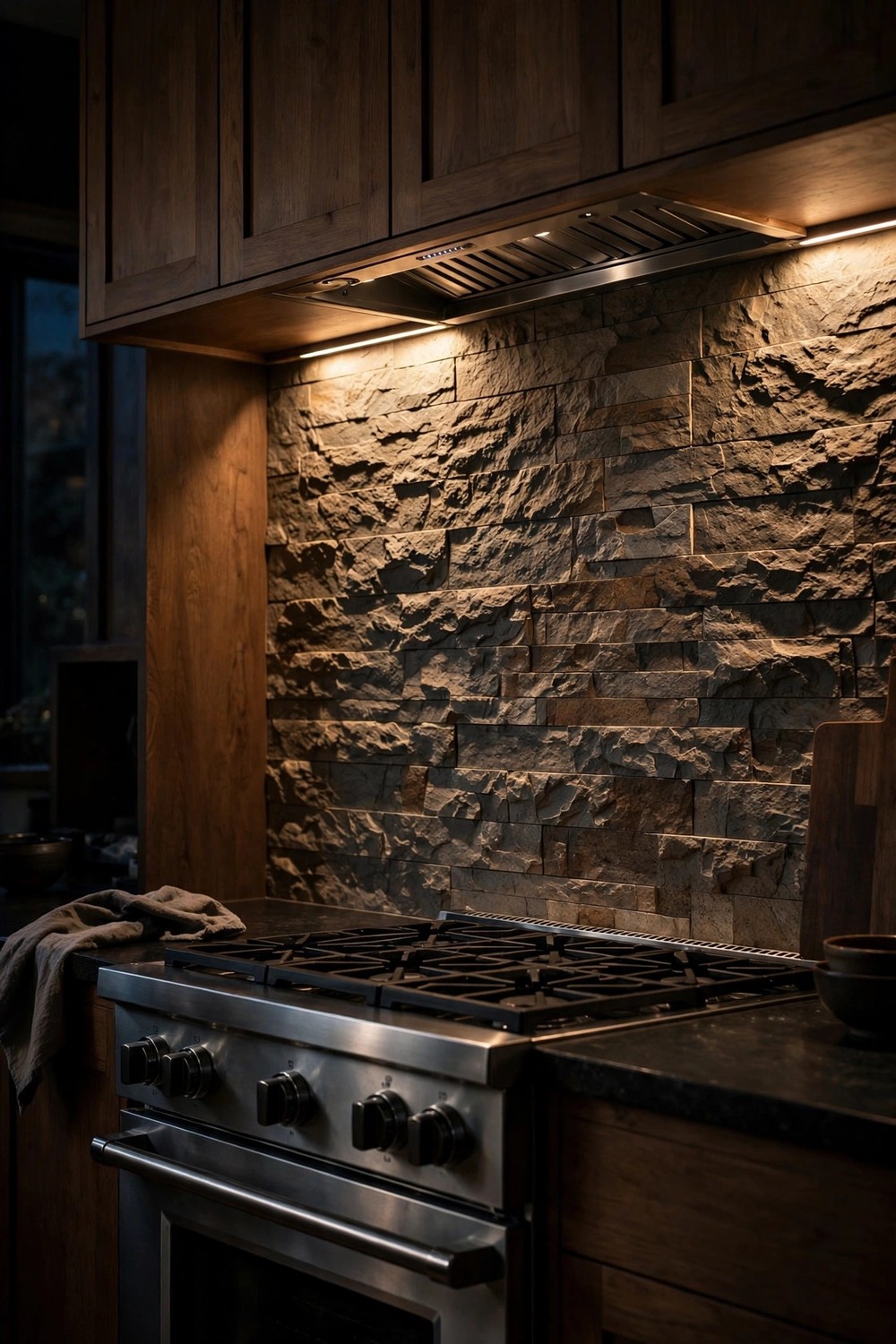
14. Highlight a Stone Backsplash With Grazing Accent Light
A stone, handmade tile, or textured backsplash has a lot of quiet detail that flat overhead light simply washes away. Grazing light, which skims across a surface from close beside it, picks out every ridge, grout line, and gentle imperfection and turns the backsplash into a feature after dark. Your under cabinet strips already do some of this work, and you can strengthen the effect by mounting them closer to the wall for one short run where the tile deserves the attention, like behind the range. The shadows stay soft if the light source is continuous rather than a row of separate spots. This is one place where a slightly warmer bulb can make stone and handmade glaze look especially rich. If your backsplash is smooth and glossy instead, grazing light will show every smear, so keep a soft cloth nearby and wipe it down before guests arrive.
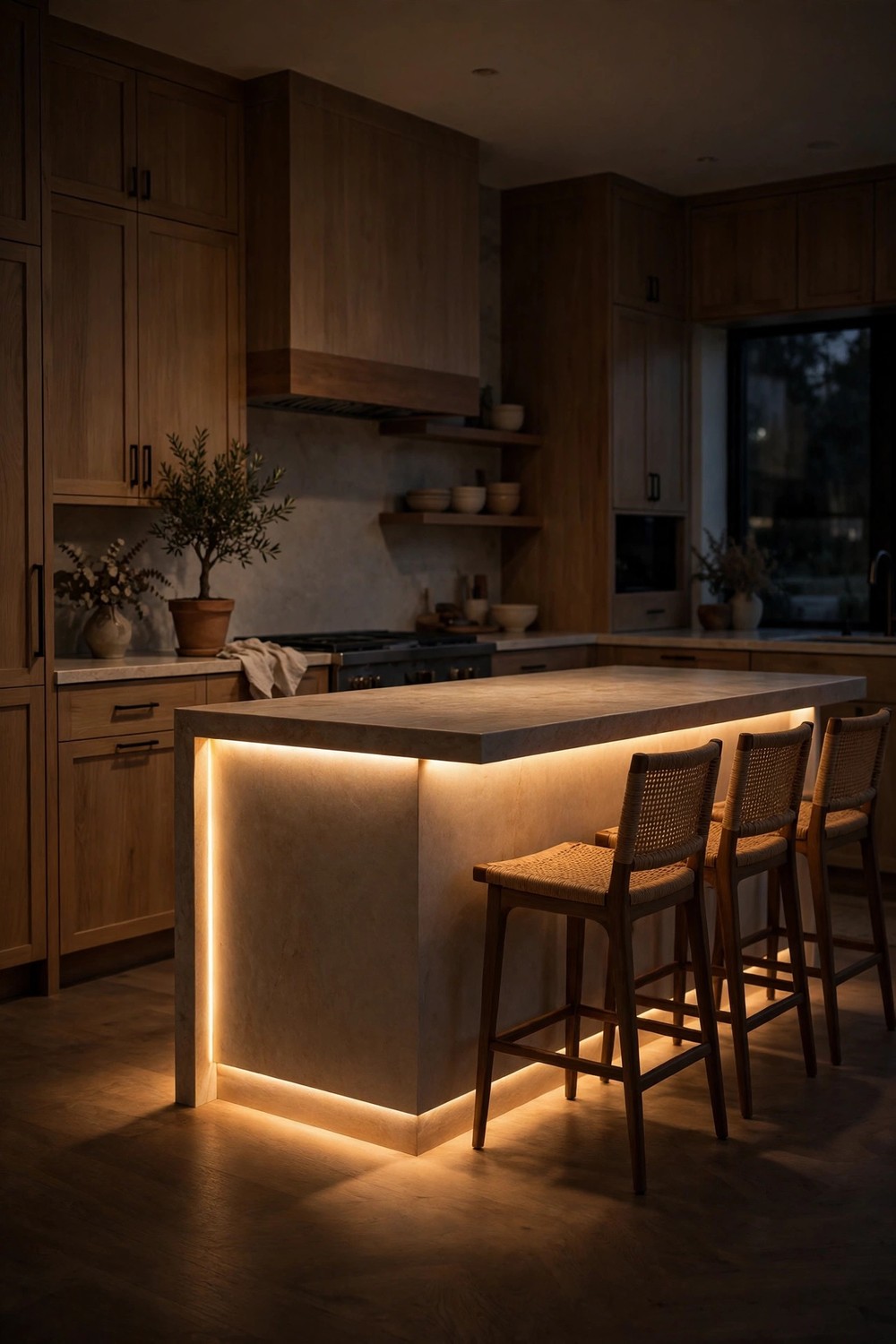
15. Put a Low Glow Under the Island Overhang
The space under an island overhang, where stools tuck in and knees go, is usually the darkest pocket in the whole kitchen, and a low strip of light hidden up under that lip changes it completely. The glow outlines the island, lights the floor gently for people sitting there, and gives the room a cozy, settled feeling in the evening that overhead lights cannot match. It pairs beautifully with toe kick lighting, since both sit low and warm and let the upper part of the room rest. Keep this strip on the dimmest, warmest setting you have, because it is pure atmosphere and should never compete with your pendants above. Installation is typically simple, since the strip is hidden and the underside of an overhang is a forgiving place to work. On movie nights and late dinners, this might be the only kitchen light you leave on.
Finish With Decorative Light and Simple Control
The last layer is the one people remember, because decorative fixtures are the jewelry of the kitchen and the controls decide how the room feels at six in the morning versus nine at night. A statement piece, the right bulb temperatures, and dimmers you actually use will pull all the other layers together. These final ideas are less about seeing more and more about feeling at home in the light you have built.
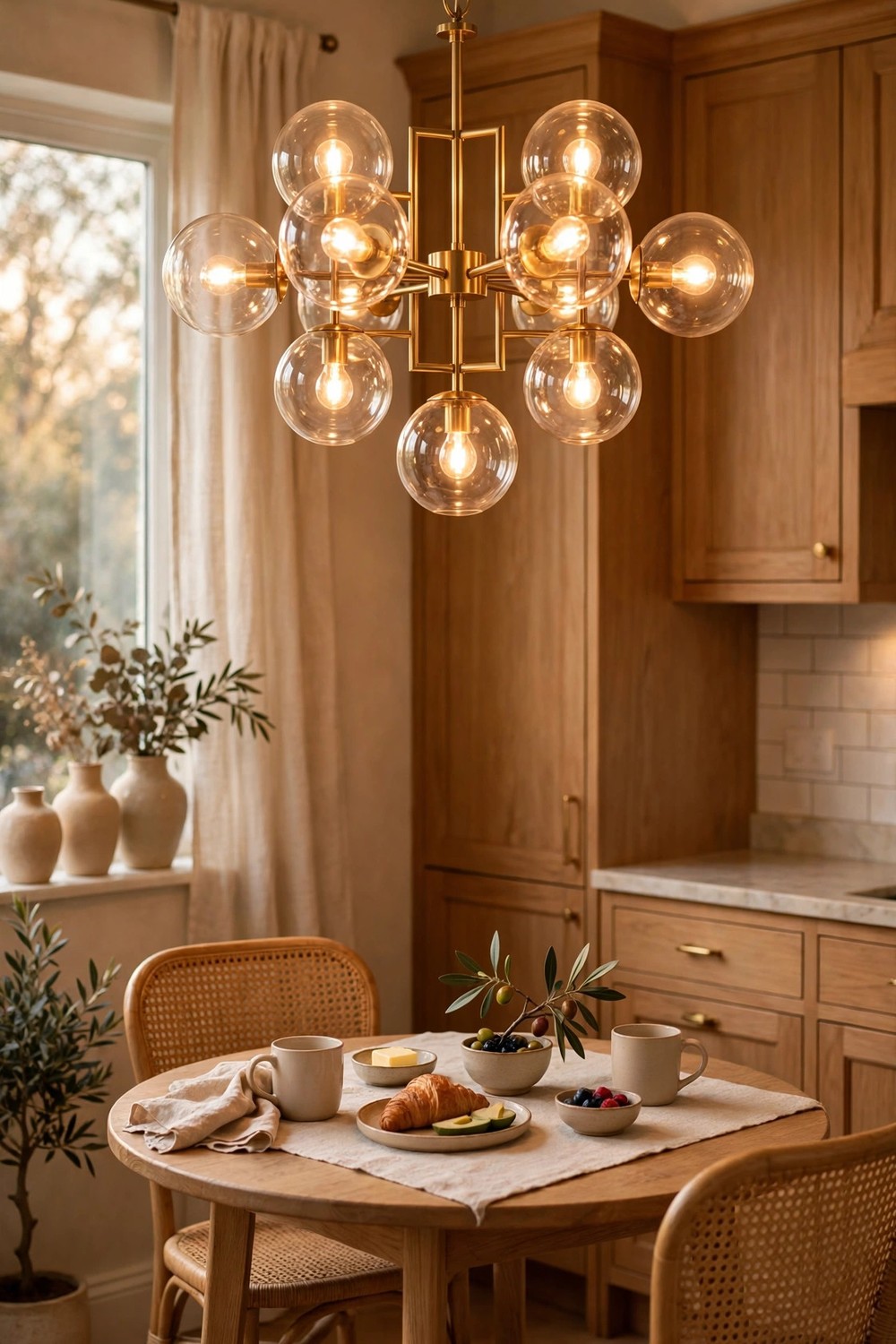
16. Hang a Statement Chandelier Over the Breakfast Table
If your kitchen includes a breakfast table, a small dining corner, or a wide island where people linger, a statement chandelier gives that spot a sense of occasion that plain task light never will. It does not need to be formal or dripping with crystal. A sculptural metal frame, a cluster of glass globes, or a woven shade can all carry the role, as long as the scale suits the table below it. As a rough guide, a fixture that is noticeably narrower than the table usually looks balanced and keeps sight lines open. Hang it low enough to feel intimate over the table, but high enough that nobody meets it with their forehead when they stand up. Put it on a dimmer without exception, because a chandelier at full brightness over dinner can feel harsh, while the same fixture turned low is basically candlelight with better manners.
17. Layer Bulb Temperatures for a Balanced Glow
Bulb temperature is the hidden reason some layered kitchens feel harmonious and others feel oddly patchy, even with good fixtures. Bulbs are described on a warm to cool scale, and mixing a very warm pendant with a cool blue recessed light in the same view will usually make both look wrong. A calmer approach is to keep your main ambient and task bulbs in a similar warm range, then let accent lights run just a touch warmer and softer, so evenings feel cozy rather than dim. Slightly crisper light can help right at the chopping counter or inside a pantry, where seeing true colors matters. Whatever you choose, buy one bulb and live with it for a few evenings before you commit to a whole room of them. Write the temperature on your shopping list once you find one you love, so replacements match later.
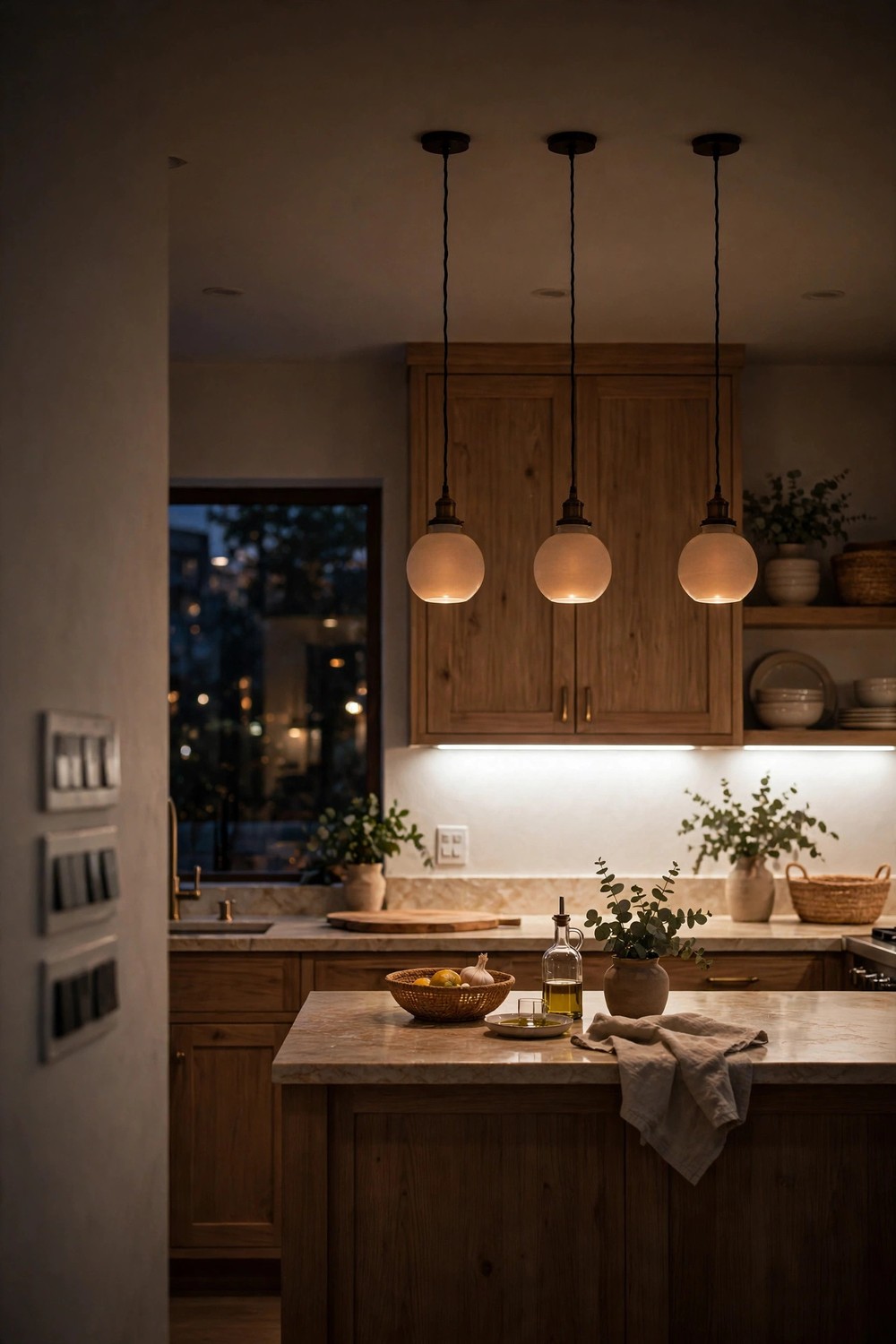
18. Put Each Layer on a Separate Dimmer Switch
The best kitchen lighting plan can still fall flat if everything turns on together at one brightness, which is why separate dimmers for each layer matter so much. With pendants, recessed cans, and under cabinet lights on their own controls, you can run bright task light for cooking, drop the overheads for dinner, and leave only a low warm glow for the late evening. That flexibility is what makes a kitchen feel different across the day without changing a single fixture. Label or arrange your switches in the order you reach for them, since a wall of mystery switches helps nobody at midnight. If rewiring is not on the table right now, smart bulbs or plug in dimmers for lamps and strips can give you a smaller version of the same control. Start with the layer you use most, usually the pendants or the under cabinet lights.
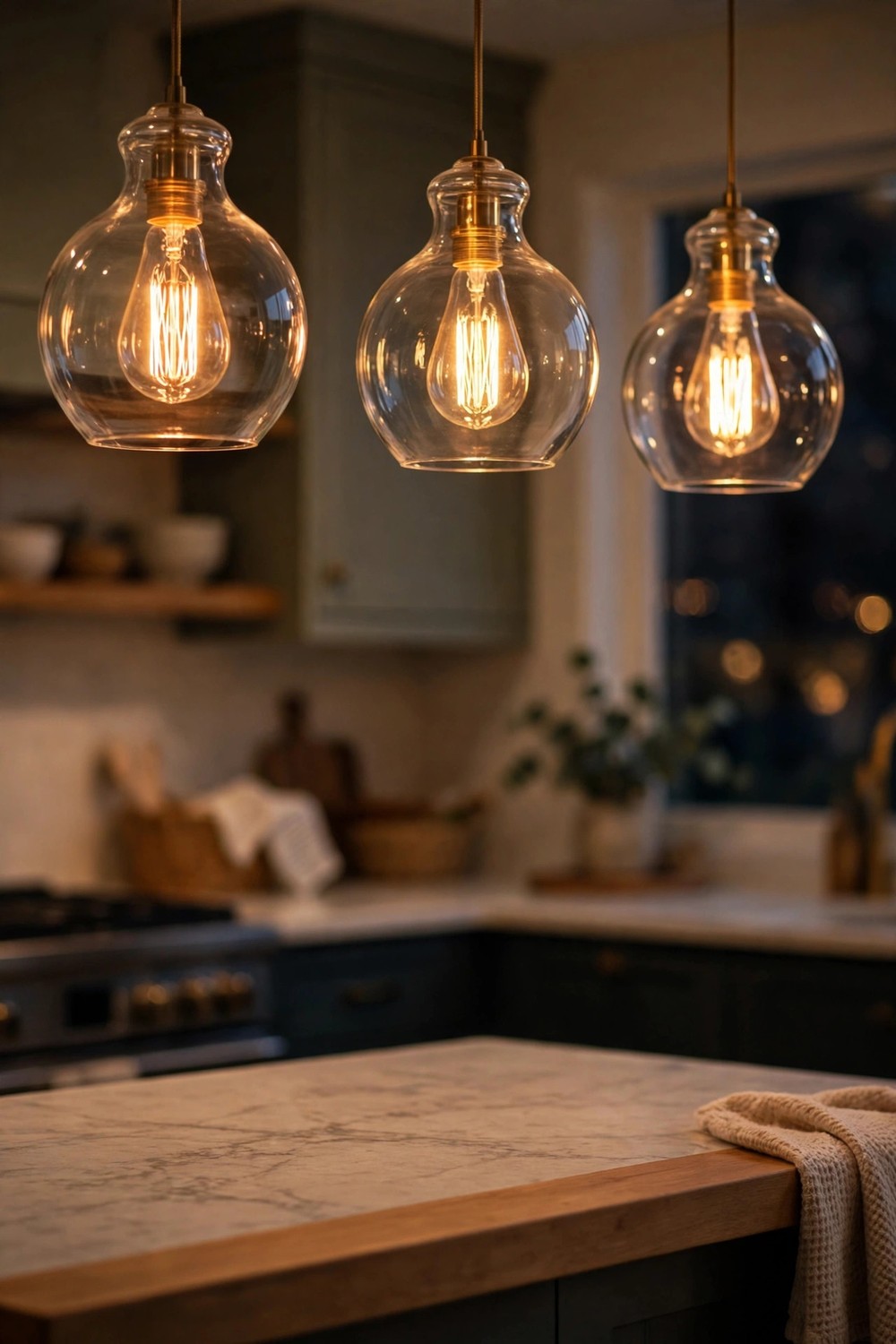
19. Choose Decorative Bulbs That Look Good Exposed
Open fixtures, clear glass pendants, and bare bulb sconces put the bulb itself on display, so the bulb needs to be part of the design rather than an afterthought. Decorative filament style bulbs, soft frosted globes, and gently tinted glass bulbs all look intentional in an exposed fitting and give off a warmer, kinder light than a harsh clear bulb does. Shape matters too. A round globe suits a modern pendant, while a longer tube or teardrop shape often suits a more traditional or vintage style fixture. Keep the brightness modest in exposed bulbs, because there is no shade to soften them and your eyes will meet them directly across the room. It also helps to buy a spare or two in the same style while they are easy to find, since decorative shapes change in shops fairly often. A pretty bulb is a small detail that guests notice more than you’d think.
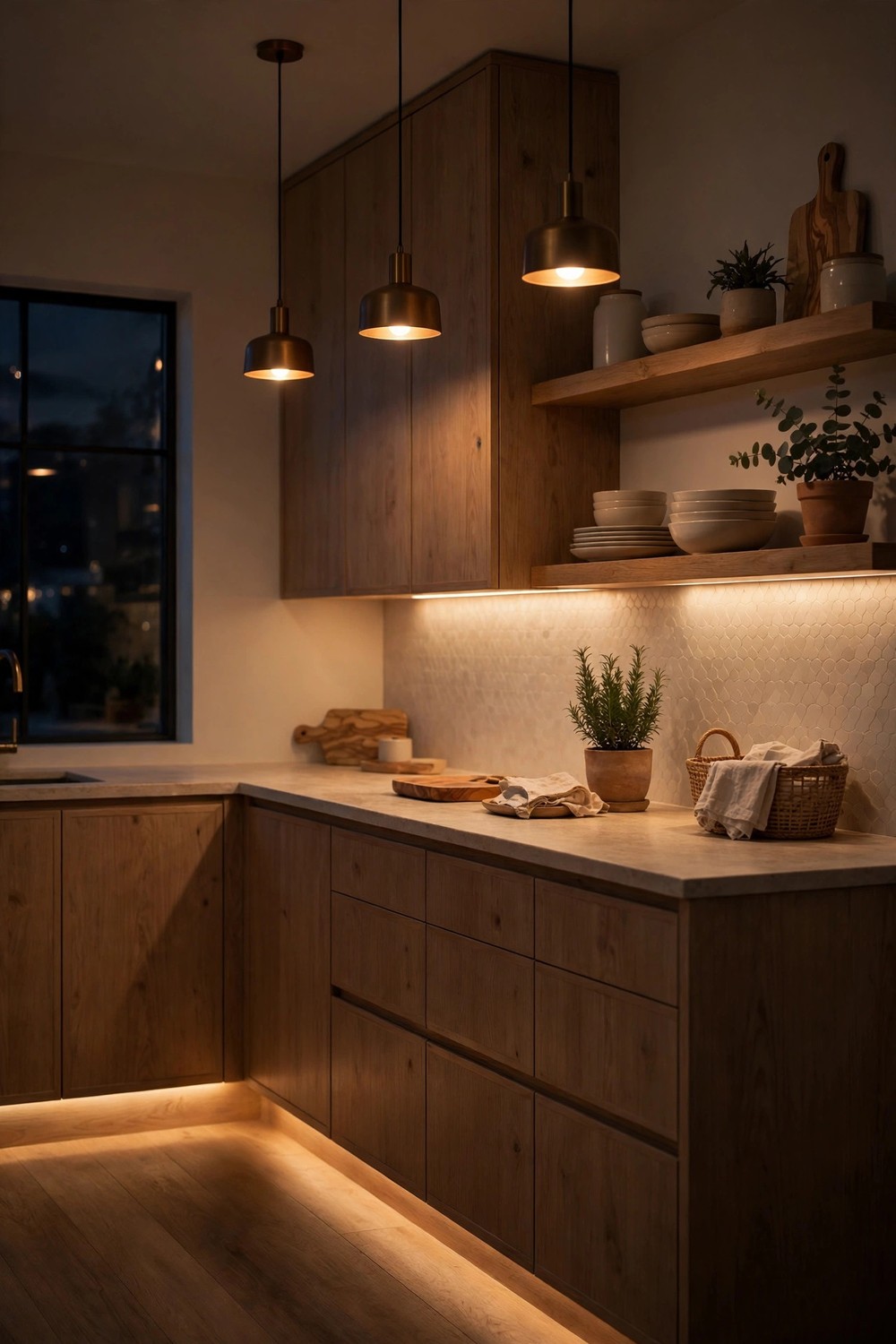
20. Set Evening Scenes With Smart Bulbs and Timers
Once your layers are in place, smart bulbs and simple timers let you enjoy them without thinking about switches at all. You can set an evening scene that brings the pendants down low, keeps the toe kick and shelf lights glowing warmly, and turns the bright task lights off after dinner, all at the tap of one button or at the same time each night. A morning scene can do the opposite, lifting the ambient light gently while the coffee brews. Start with one or two smart bulbs in the fixtures you use most, rather than changing every bulb in the room at once, so you can learn what you actually like. Keep at least one ordinary switch that works in the usual way, since guests and tired cooks should never need an app to make a cup of tea. Small, reliable routines are the goal here.
Light Your Kitchen the Way You Actually Live In It
When you step back, a well lit kitchen is not about having the most fixtures or the brightest bulbs. It is about having the right light in the right place at the right moment, bright and clear where you cook, soft and warm where you sit, and low and gentle when the day is winding down. If one corner still feels harsh, soften it with a dimmer or a warmer bulb. If a counter still sits in shadow, add light there before you change anything else. Layers forgive a lot, and small adjustments usually matter more than another big purchase ever could.
So start small this week. Cook one dinner with a new bulb in the hood, or switch the pendants to a dimmer and eat under them turned low. That single calmer evening will show you what your kitchen can feel like, and the next layer will probably suggest itself. Before long, your kitchen will not feel like a lighting project anymore. It will feel like the warm, easy heart of your home, ready for early mornings, busy dinners, and quiet last cups of tea.

Leave a Reply