
22 Neutral Living Room Ideas with Warm Earthy Layers
A neutral living room doesn’t have to feel cold, flat, or unfinished, and if yours does right now, you’re definitely not alone. The fix usually isn’t more color, it’s warmer layers. Think greige instead of cool gray, camel and tan instead of stark black, and plenty of linen, jute, wool, and wood sitting next to each other so the eye always has something soft to land on.
In this list, we’re building the room the way you’d actually put one together, starting with walls and big furniture, then adding texture, then finishing with the earthy details like clay, terracotta, dried grasses, and warm metals. Every idea works on its own, so you don’t need to do all twenty two. Most rooms only need three or four of these layers added in the right order to feel completely different.
As you read, notice which tones keep repeating in the photos you’re drawn to. That’s typically your clue. If you keep stopping at camel leather and warm wood, start there. If it’s the woven baskets and limewash walls, that’s your direction. Pick your starting layer, add it properly and generously, and then build the next one around it rather than buying a little bit of everything at once.
In This Article
- Greige Walls with a Warm White Ceiling
- Camel Leather Sofa Against Soft Linen Curtains
- Layered Jute and Wool Rug Pairing
- Natural Oak Coffee Table with Rounded Edges
- Clay and Terracotta Vases on Open Shelving
- Textured Limewash Accent Wall in Sandy Beige
- Cream Boucle Armchairs for Soft Contrast
- Woven Seagrass Baskets for Blankets and Storage
- Travertine Side Tables with Matte Stone Finish
- Dried Pampas and Wheat in a Tall Floor Vase
- Warm Walnut Built-Ins with Cane Fronts
- Linen Slipcovered Sofa in Oatmeal Tone
- Layered Throw Blankets in Tan, Rust and Cream
- Brass and Bronze Lighting with Warm Glow
- Low Natural Wood Media Console with Fluted Detail
- Stone Fireplace Surround in Warm Limestone
- Mixed Neutral Cushions in Linen, Wool and Leather
- Arched Floor Mirror with Light Wood Frame
- Handwoven Wall Hanging in Earthy Stripes
- Terracotta and Sand Colored Area Rug Underfoot
- Curved Sofa Shape to Soften Straight Lines
- Greenery in Clay Pots for a Living Neutral Layer
Start With a Warm Neutral Base
Your base is the walls, the main sofa, and whatever covers the floor, and getting the warmth right here makes every later choice simpler. These first ideas focus on greige and limewash walls, a generous oatmeal or camel sofa, and rugs that set the tone underfoot. If you’re working with furniture you already own, don’t panic if the tones aren’t identical. Close and warm usually blends better than exact and cold.
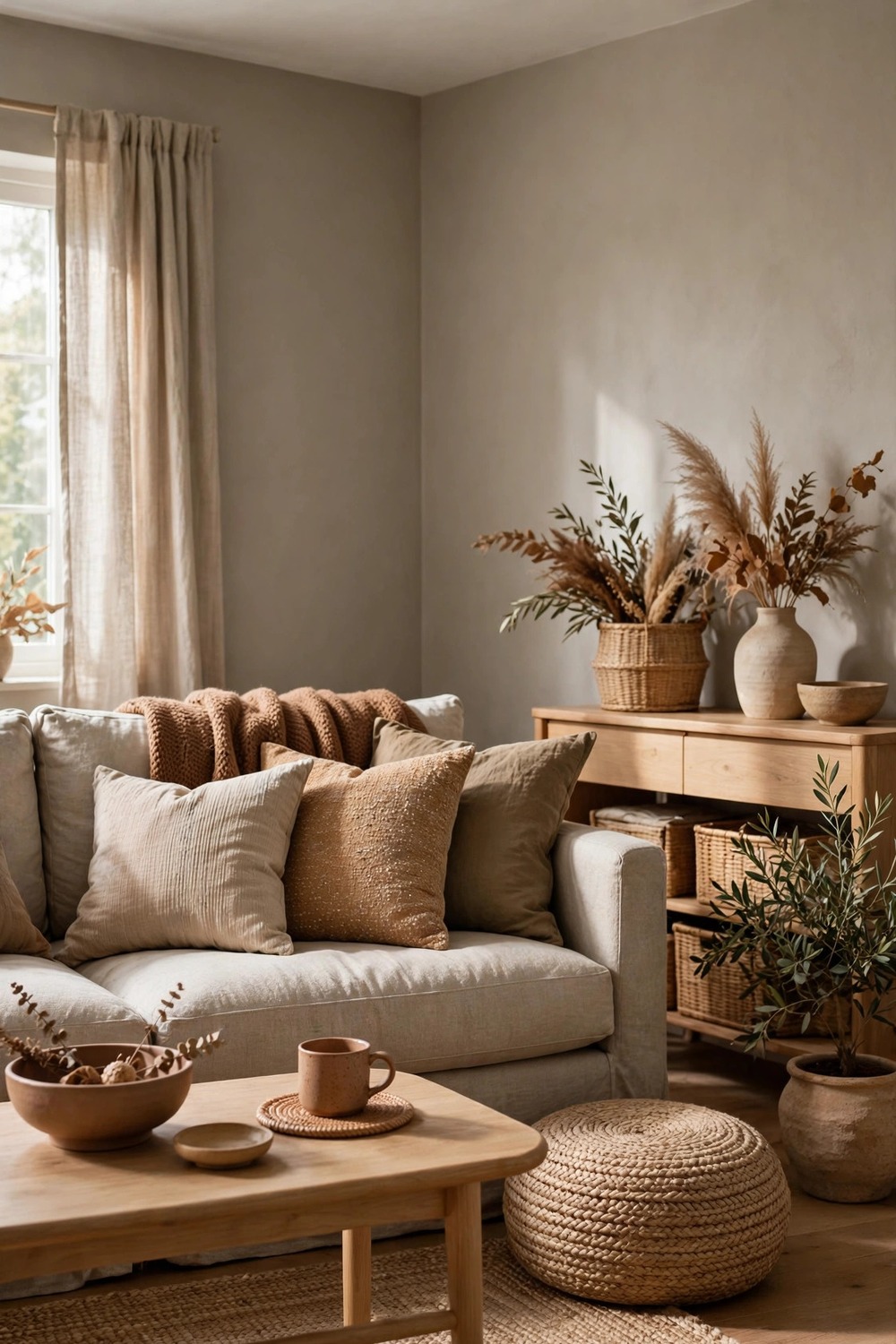
1. Greige Walls with a Warm White Ceiling
If you’re starting from scratch, this is the pairing that usually makes everything else feel easier. Greige sits right between gray and beige, so it doesn’t lean cold like a true gray can, and a warm white ceiling keeps the light bouncing without turning stark. Paint a large swatch and check it in morning and evening light, because greige typically shifts through the day. Once the walls are set, keep your biggest pieces in nearby tones like oatmeal, sand, and soft taupe so the room reads as one calm layer. You’ll notice the furniture doesn’t have to match exactly, and that slight variation is actually what keeps it interesting.
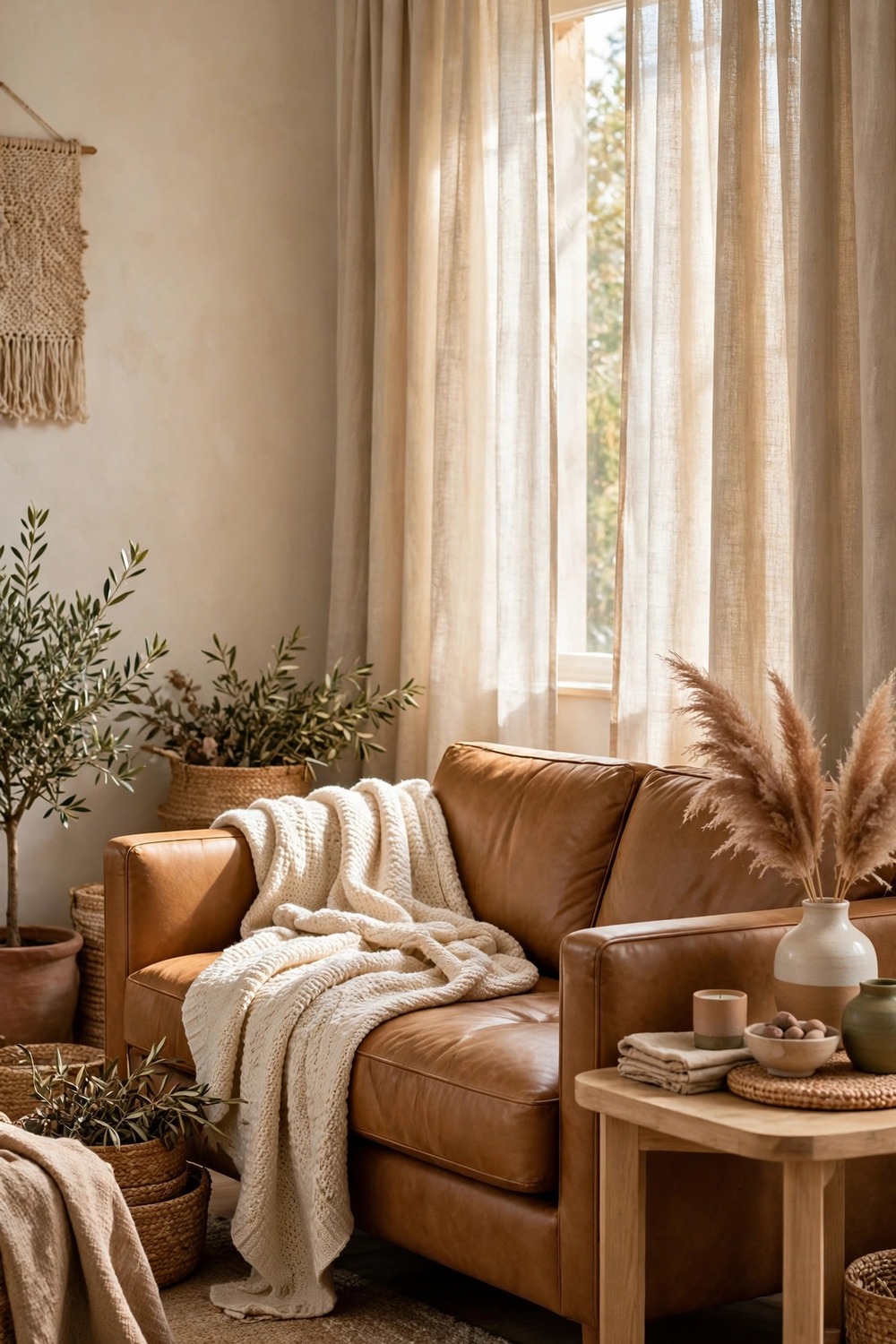
2. Camel Leather Sofa Against Soft Linen Curtains
A camel leather sofa gives a neutral room its anchor, and it’s warmer than black or charcoal leather by a long way. Hang soft linen curtains in a natural flax tone right behind or beside it, and the contrast between smooth leather and loose weave does a lot of the styling work for you. Leather usually softens and picks up a gentle patina over time, so it doesn’t stay looking showroom new, which is a good thing here. Add a cream throw and a light wood side table nearby, and you’ve got depth without adding a single loud color to the room.
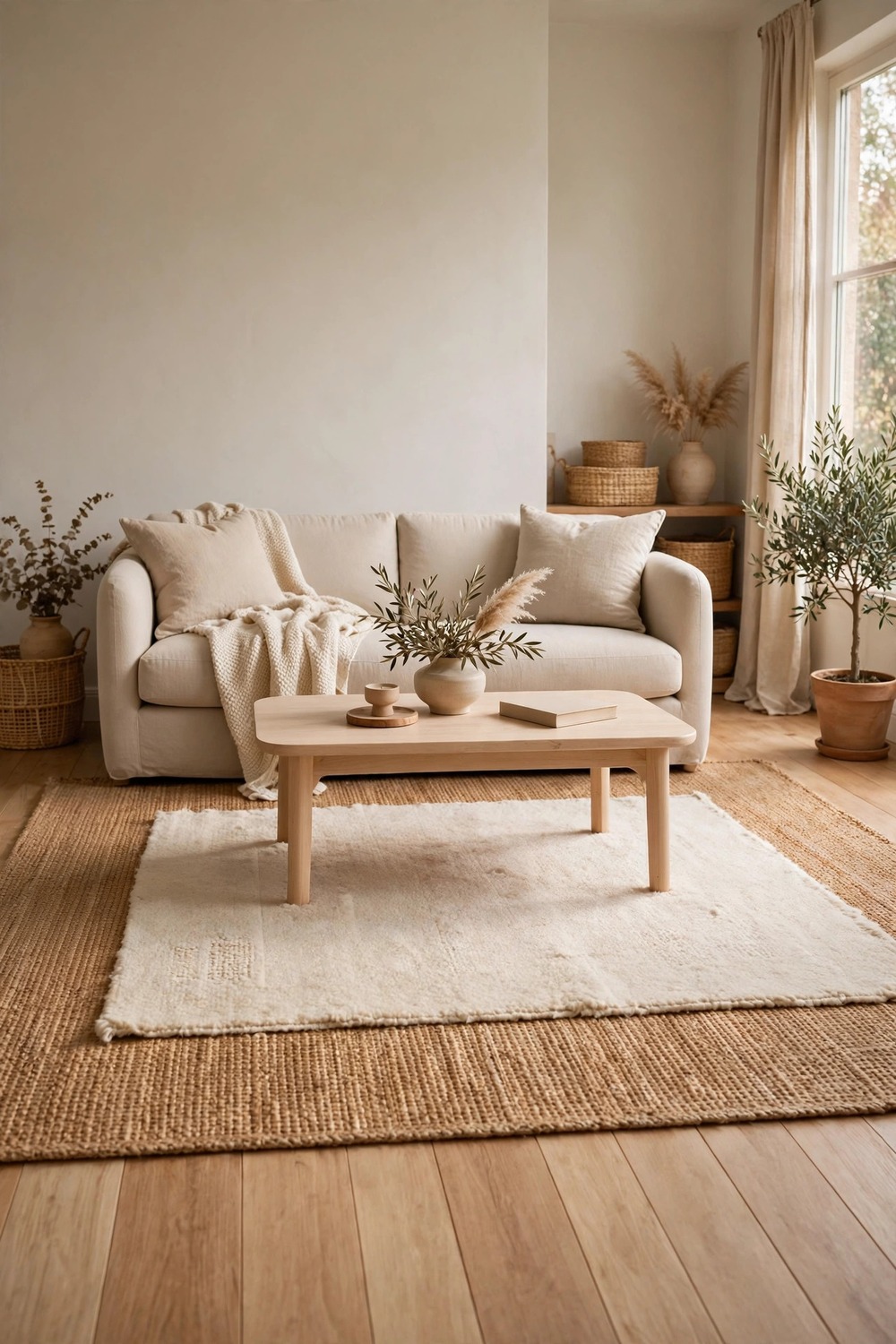
3. Layered Jute and Wool Rug Pairing
Layering rugs is one of the easiest ways to stop a neutral floor from looking bare. Start with a large flat jute rug that reaches under the front legs of your sofa and chairs, then lay a smaller wool rug in cream or warm ivory right on top where you actually sit. The jute brings a dry, natural texture, while the wool feels softer underfoot, and that mix is what makes the seating area feel finished. Keep the top rug centered on the coffee table, and don’t worry if the jute border isn’t perfectly even. It typically looks better a little relaxed.
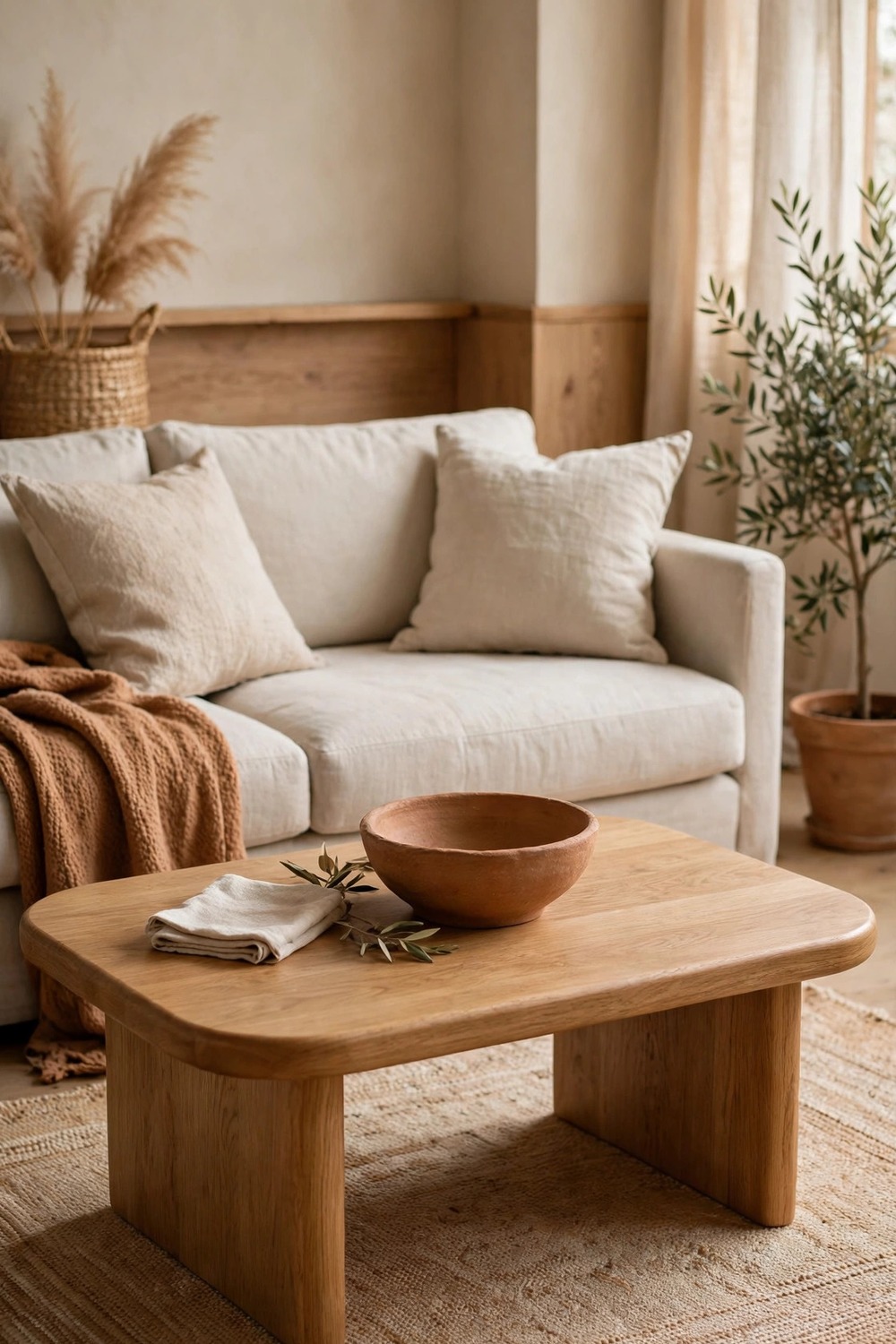
4. Natural Oak Coffee Table with Rounded Edges
A natural oak coffee table warms up pale upholstery without darkening the whole room. Look for rounded edges or a soft oval shape if your seating is boxy, because curves usually make the layout feel more welcoming and they’re kinder when you’re moving around it every day. Leave some of the wood grain visible and skip a heavy tablecloth, since that grain is part of the color story here. Style the top simply with a clay bowl, a stack of linen bound books with no readable covers facing up, and a small tray in brushed brass for remotes. Leave a little breathing room around each object, because a crowded top usually makes even a beautiful table look cluttered and smaller.
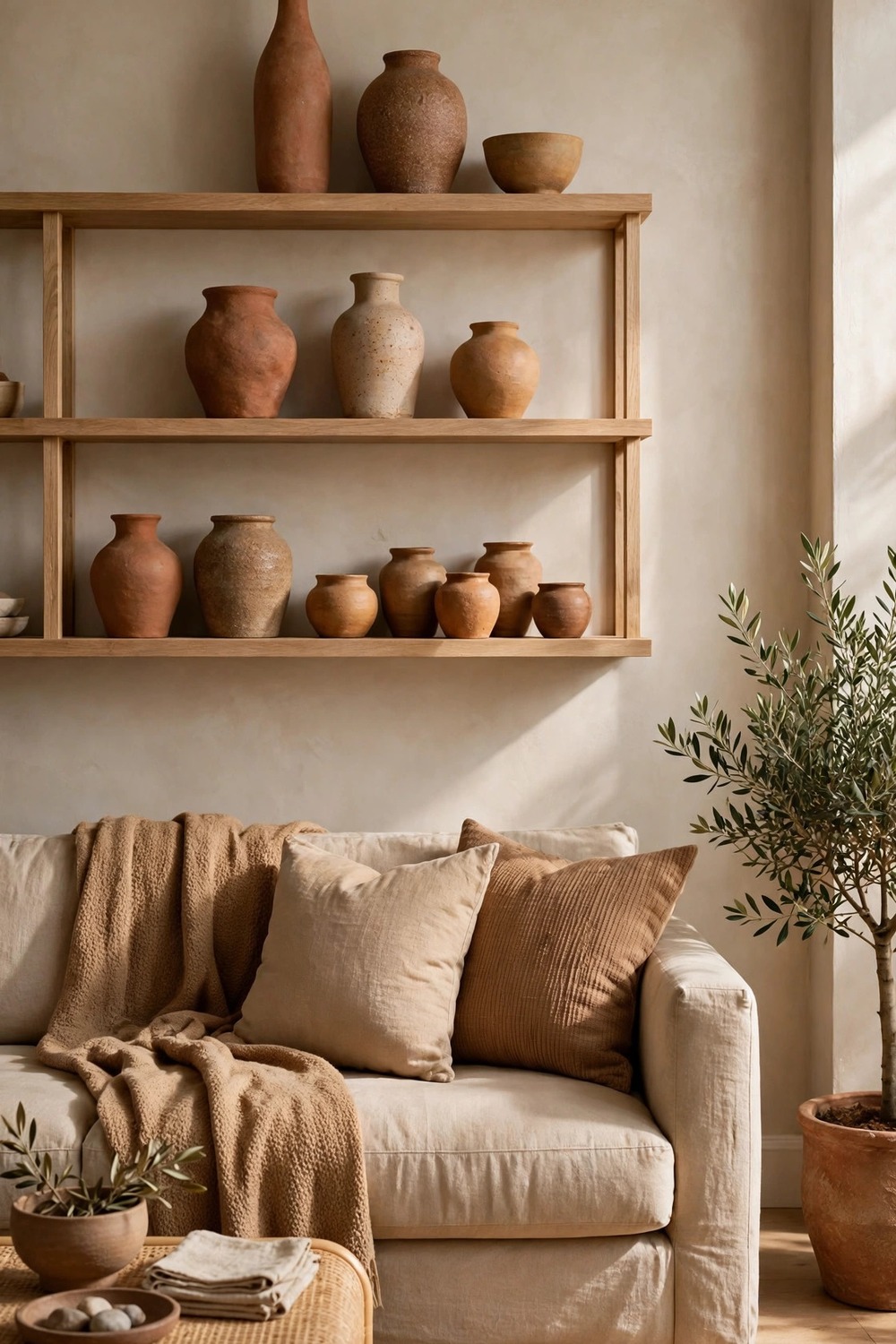
5. Clay and Terracotta Vases on Open Shelving
Open shelves can look messy fast, but a tight palette of clay and terracotta vases keeps them calm. Group vases in threes and vary the heights, with one tall matte piece, one rounder pot, and one smaller textured vessel in each cluster. Terracotta usually ranges from dusty rose brown to deep rust, so you’re getting real color while still staying inside a neutral scheme. Leave a little empty space between groups and don’t fill every shelf edge to edge. That breathing room is typically what separates a styled shelf from a storage shelf in a living room like this, and it costs you absolutely nothing to create.
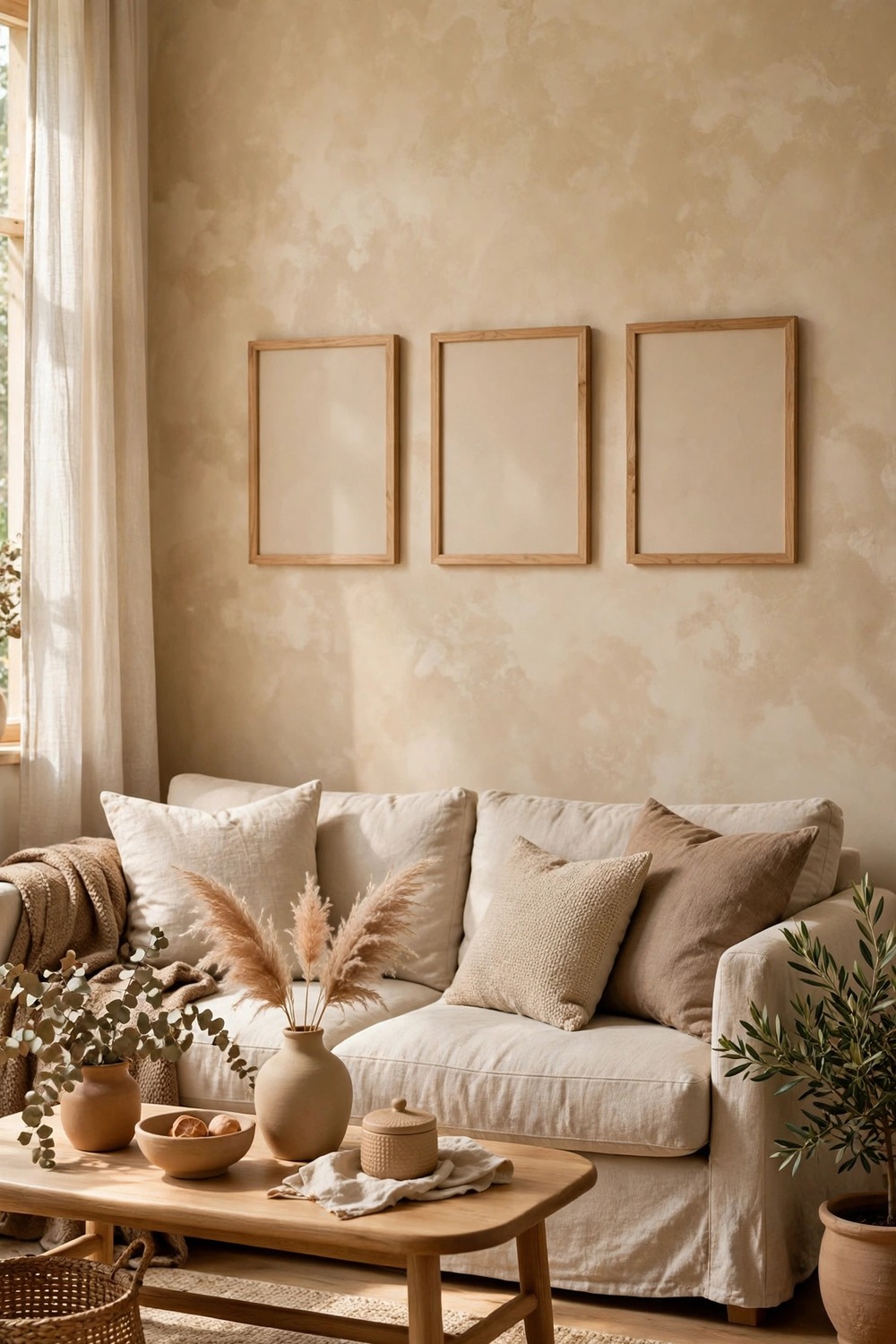
6. Textured Limewash Accent Wall in Sandy Beige
If flat paint feels a little too plain behind your sofa, a limewash finish in sandy beige adds movement without adding pattern. The brush strokes create soft clouds of lighter and darker tone, and the wall changes gently as daylight moves across it. It’s a forgiving finish, too, because small variations are part of the look and you don’t need a perfect surface underneath. Keep the furniture in front of it simple, like a linen sofa and a light oak frame or two, so the texture stays the focus. Most people find one limewash wall is plenty for a single room.
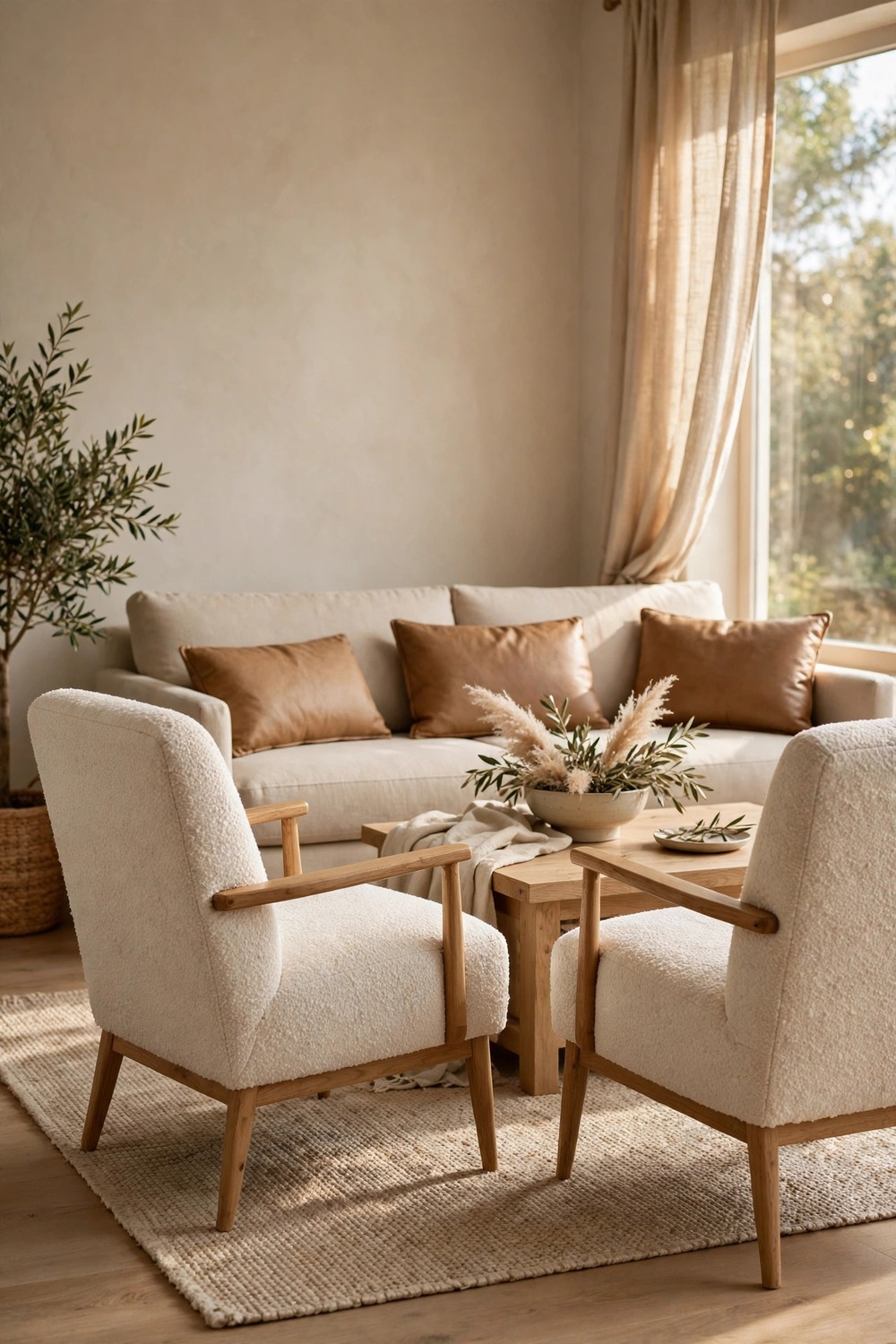
7. Cream Boucle Armchairs for Soft Contrast
Cream boucle armchairs are a quiet way to add contrast when your sofa is already beige or greige. The nubby looped fabric catches light differently from flat linen, so even in a very similar color the chairs read as a separate layer. Angle a pair toward each other rather than lining them up straight, and the seating instantly feels more conversational. Boucle typically needs a gentle vacuum with an upholstery tool, and it’s worth turning the cushions now and then if they’re loose. Add a small tan leather cushion to each chair to tie them back to warmer pieces nearby.
Add Texture, Wood and Natural Materials
Once the base is warm, texture is what stops the room from looking like a showroom set. This middle group leans on oak and walnut, woven seagrass, travertine stone, boucle, and dried stems, because a mix of smooth, nubby, rough, and woven surfaces is how a single palette gains real depth. You don’t need every material here. Two or three repeated thoughtfully through the room typically do the job.
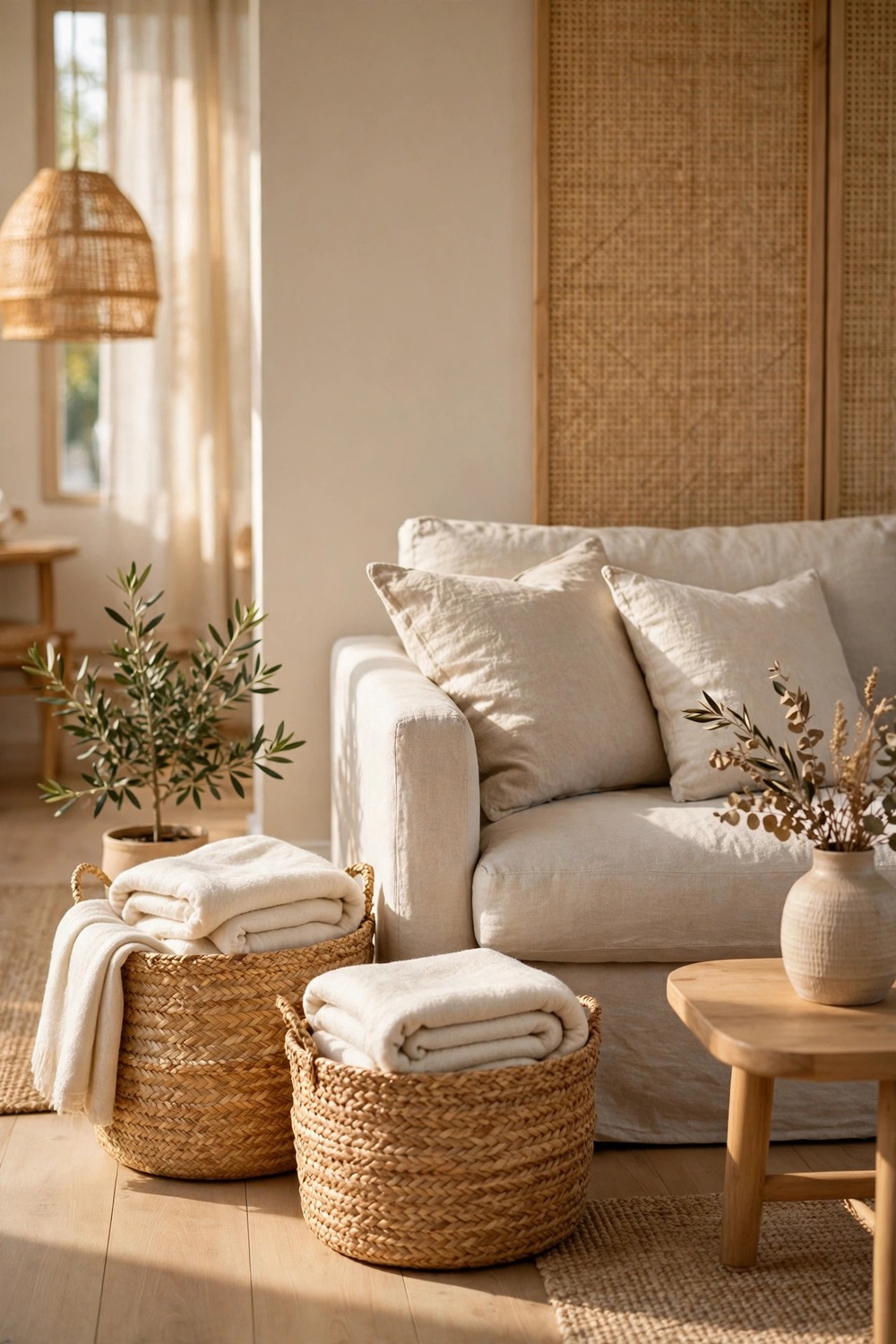
8. Woven Seagrass Baskets for Blankets and Storage
Seagrass baskets solve two problems at once, because they hide the everyday clutter and they add the woven texture a neutral room needs. Tuck one large basket beside the sofa for folded throws, and use a lower wider one under a side table for magazines or kids toys that you don’t want on display. The natural golden tone of seagrass usually sits happily between pale linen and medium wood, so it bridges pieces that might not connect otherwise. Don’t overfill them until they bulge. A loosely folded blanket draped over the edge usually looks softer and more intentional. Try one basket in the corner by the fireplace too, because repeating the weave in two spots helps the room feel thoughtfully pulled together.
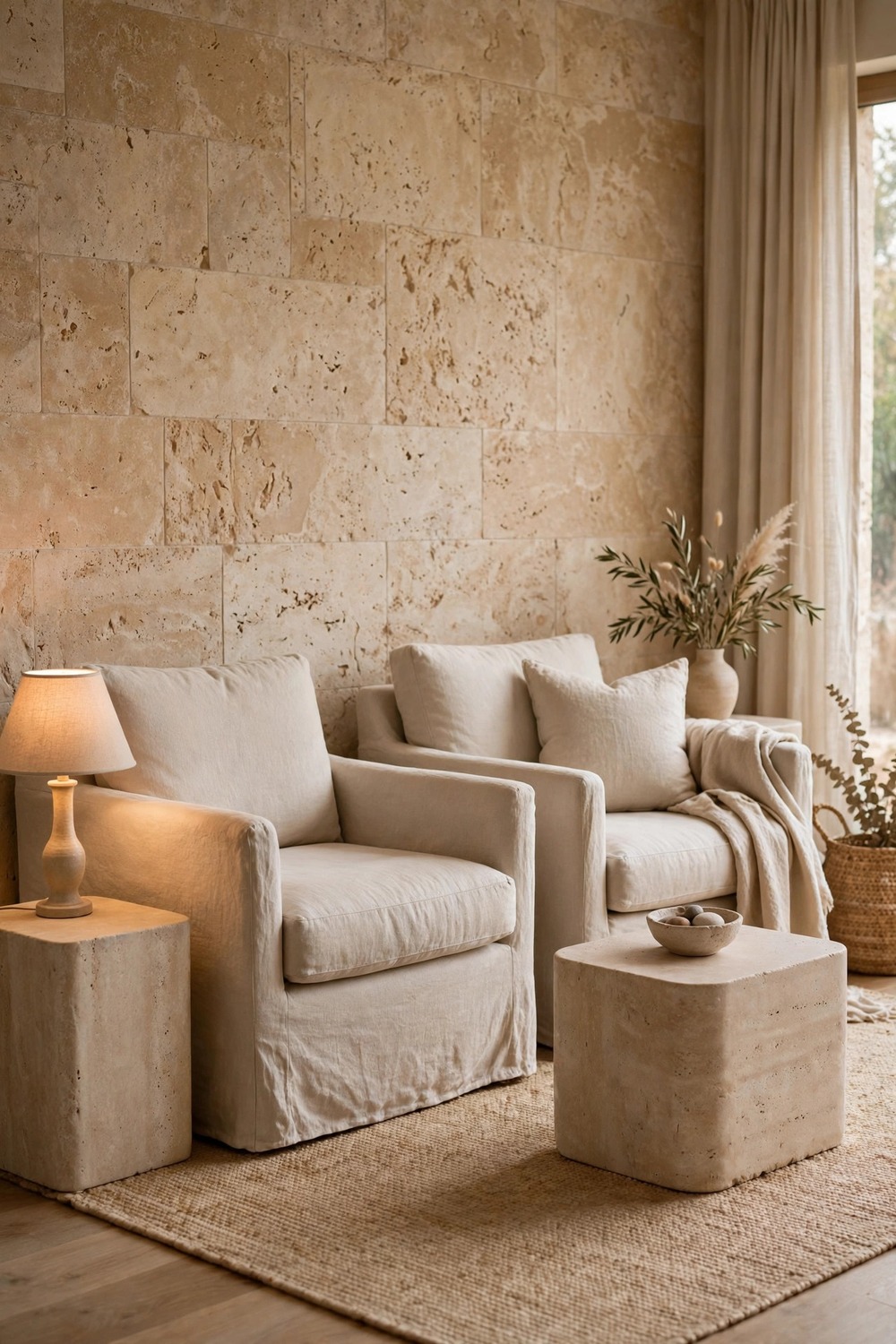
9. Travertine Side Tables with Matte Stone Finish
Travertine brings stone into a neutral scheme without the cold shine of polished marble. Its warm beige base and natural pitting fit right in with linen, jute, and light wood, and a matte finish keeps it from stealing attention. Use a pair as side tables flanking a sofa, or place one beside a reading chair with a small lamp on top. Stone is heavy, so it’s worth deciding on placement before you move it into the room. Wipe spills fairly quickly, since travertine can mark, and use coasters under drinks as your everyday habit here. A pair in slightly different heights usually looks more relaxed than two tables at exactly the same level side by side.
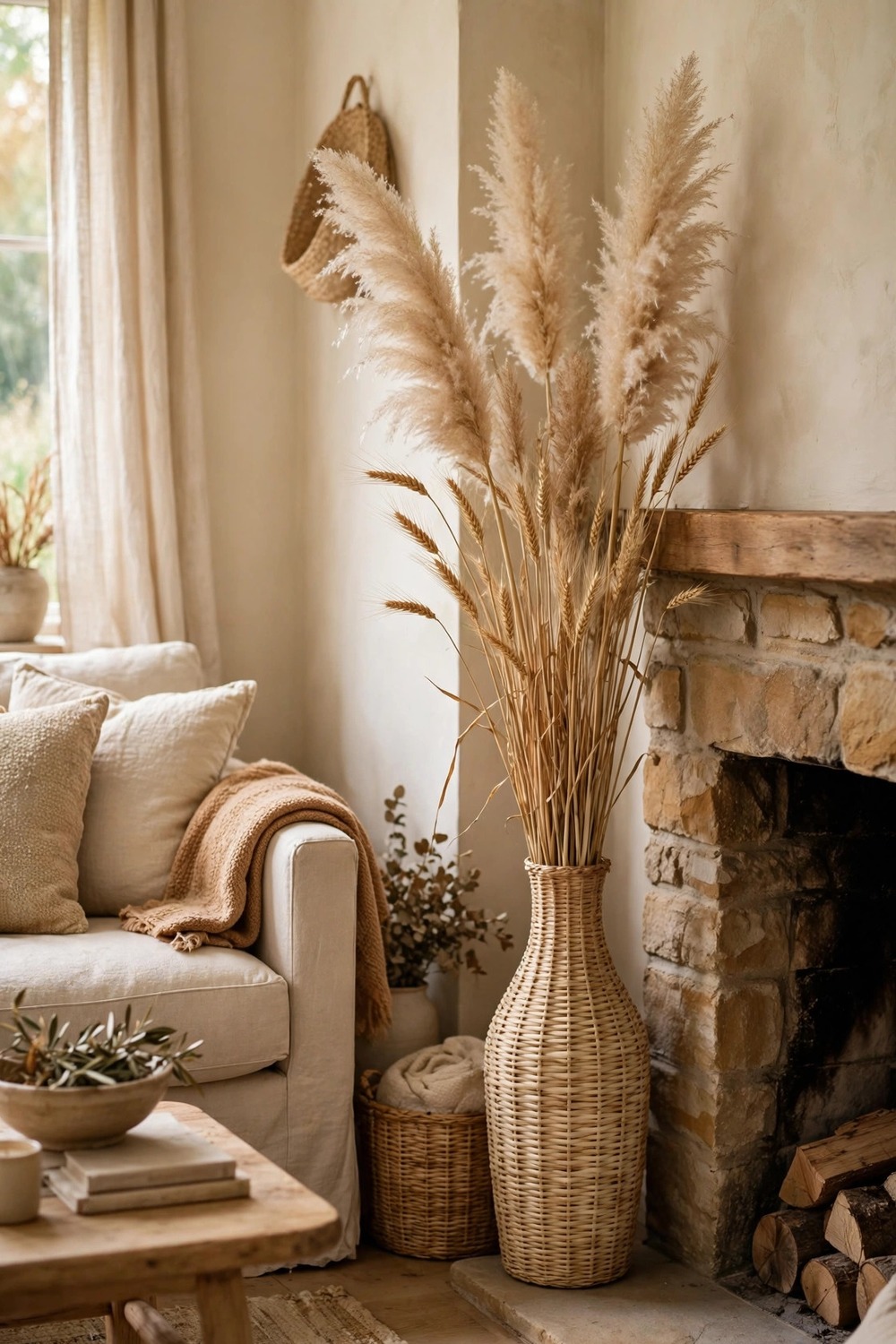
10. Dried Pampas and Wheat in a Tall Floor Vase
A tall floor vase filled with dried pampas and wheat adds height to a corner that furniture can’t reach. The feathery plumes soften hard lines around a fireplace or media console, and their natural cream and straw tones layer straight into an earthy palette. Stand the vase where it won’t get brushed every time someone walks past, because dried stems shed if they’re handled a lot. A light shake outside now and then usually keeps dust under control. If pampas feels too full for your space, use fewer stems and let the arrangement stay airy rather than dense. The soft shadow they cast on a pale wall in the afternoon is honestly part of the decoration too.
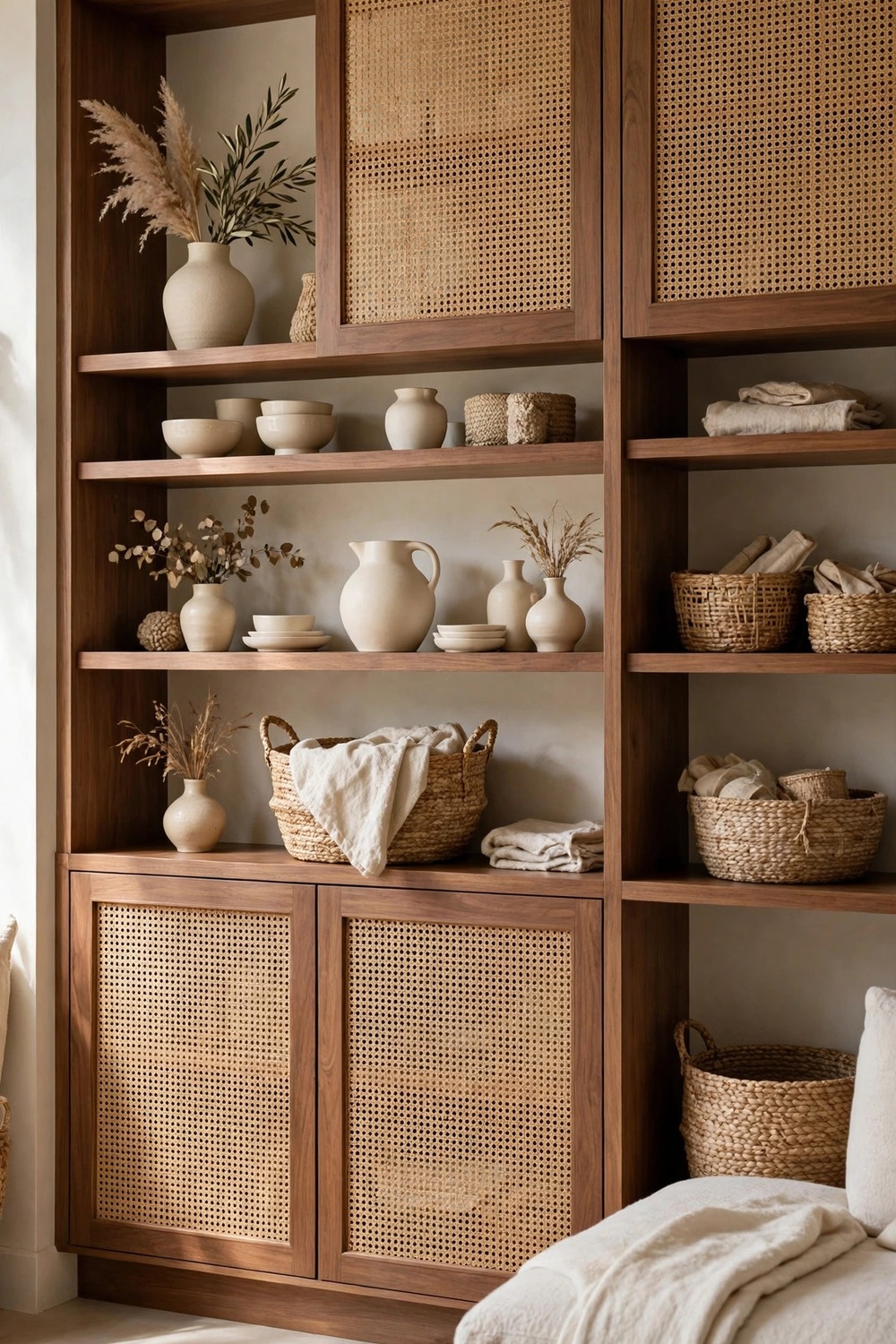
11. Warm Walnut Built-Ins with Cane Fronts
Walnut built-ins give a neutral living room a grounded, furniture like wall that pale paint alone can’t deliver. The wood is deeper than oak, so it creates real contrast against greige or warm white walls, and cane front panels keep the run from feeling heavy or closed in. Style the open sections with cream ceramics, woven baskets, and a few clay pieces, then let the cane doors hide the less pretty essentials. Walnut usually looks richer under warm lighting, so test your bulbs before you judge the color at night. It is a bigger project, but it typically anchors the whole room.
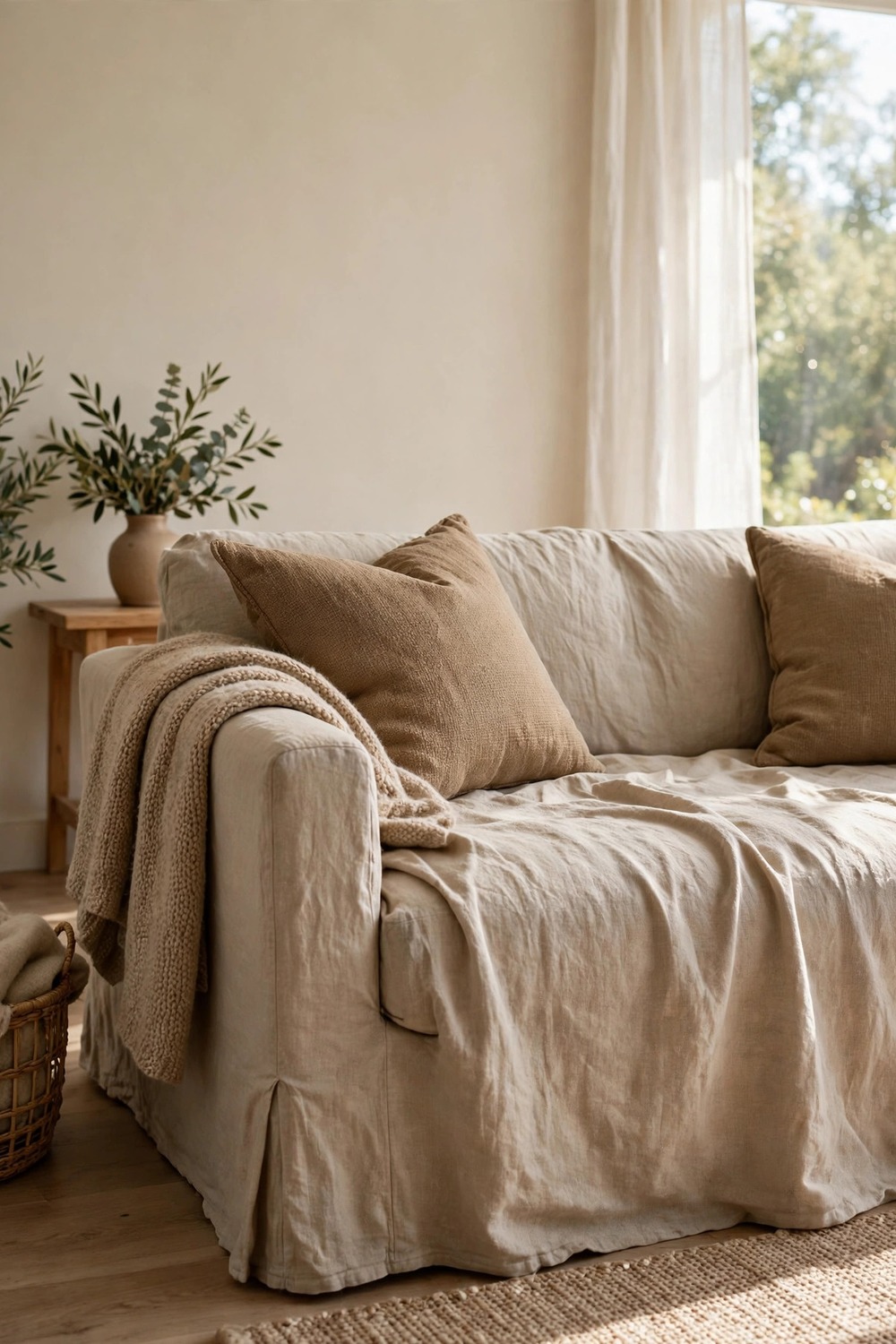
12. Linen Slipcovered Sofa in Oatmeal Tone
An oatmeal linen slipcovered sofa is about as forgiving as neutral seating gets. The slightly rumpled weave suits a relaxed room, and removable covers mean you can wash away everyday marks instead of living around them. Oatmeal has tiny flecks of darker fiber in it, which usually helps disguise light wear between washes. Pair it with slightly darker tan cushions so the sofa doesn’t disappear against pale walls, and add a wool throw over one arm for a second texture. If your room gets strong sun, rotate the cushions regularly, because linen can fade unevenly over time near bright windows.
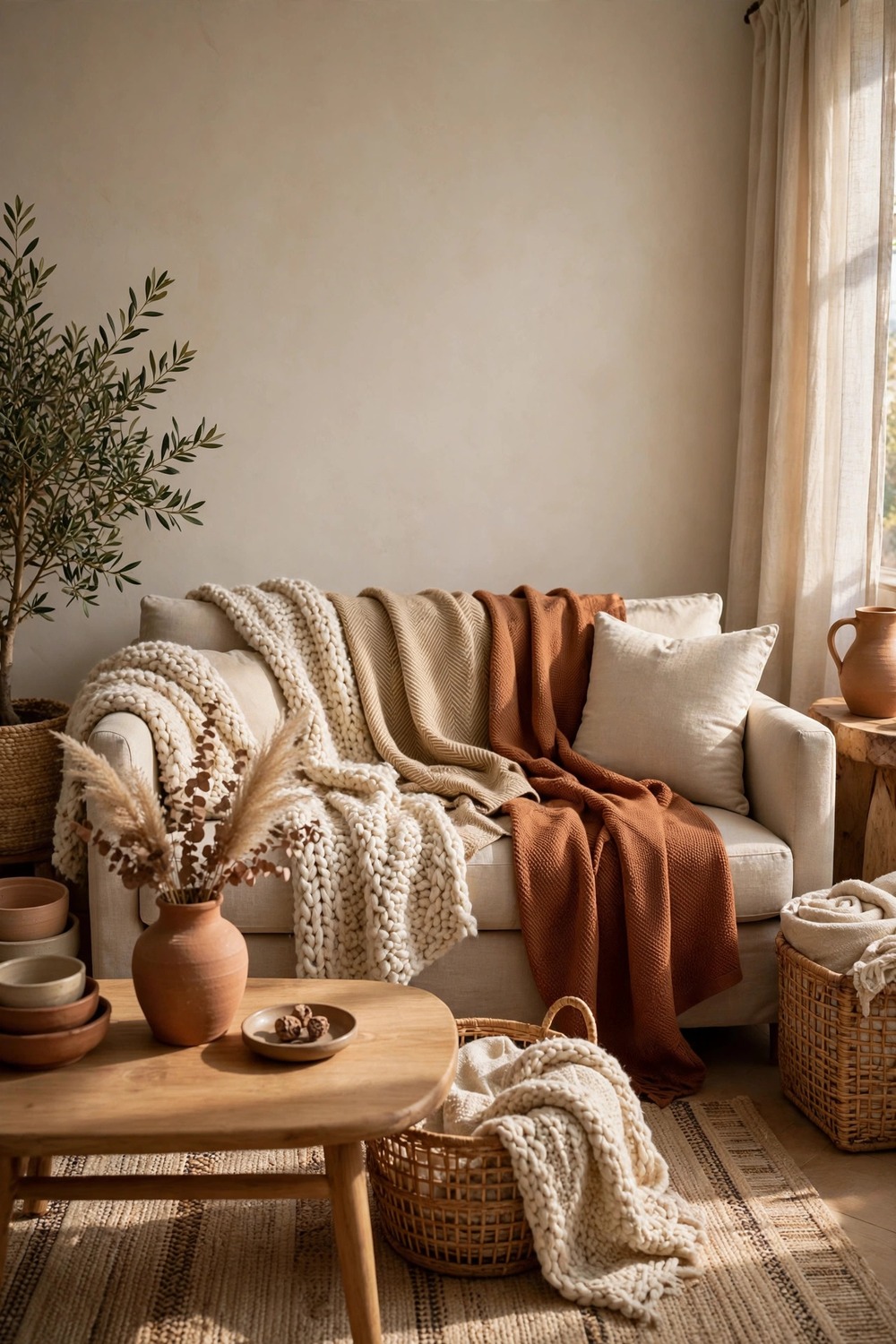
13. Layered Throw Blankets in Tan, Rust and Cream
Throws are where you can push a neutral palette a little warmer without repainting or replacing furniture. Drape a cream knit over the back of the sofa, fold a tan woven throw across one seat, and let a rust toned blanket sit over an arm where it catches the eye. Rust is earthy rather than bright, so it usually reads as part of the neutral family here. Mix at least two textures, like a chunky knit and a flat weave, so the layers don’t blur into one lump. Fold them loosely, because a too perfect stack often looks staged. On colder evenings you will actually pull them down and use them, so keep the softest one within easiest reach of your seat.
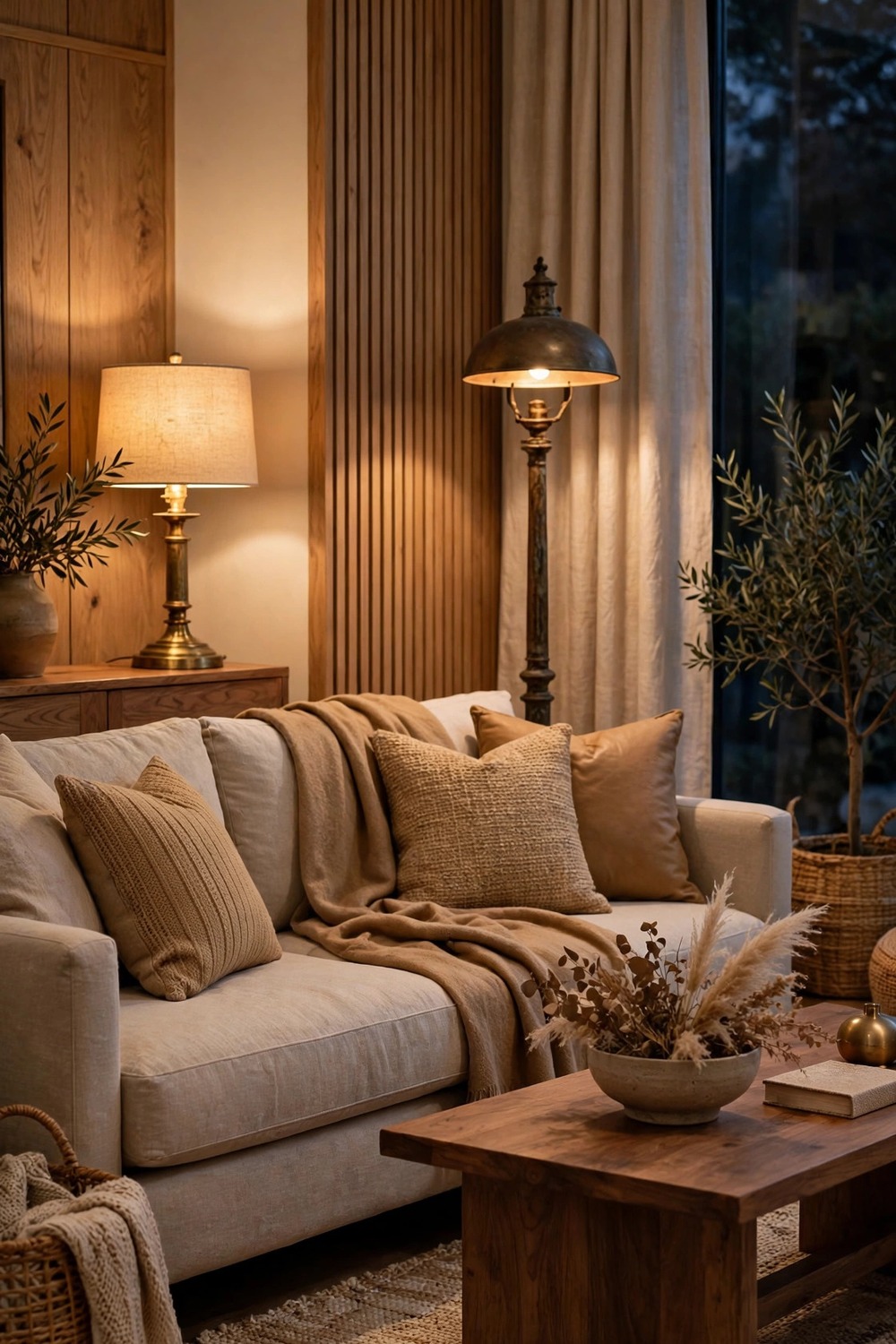
14. Brass and Bronze Lighting with Warm Glow
Metal finishes do a lot of quiet work in a neutral room, and warm brass or aged bronze fits an earthy scheme far better than chrome. Choose a floor lamp for a reading corner, table lamps on your side tables, and if you have a ceiling fixture, keep it in the same warm family so the metals feel related. Bulb color matters just as much, and a warm glow typically makes beige, camel, and wood tones look richer in the evening. Don’t polish aged finishes back to a mirror shine. That softened patina is usually what makes them sit comfortably here.
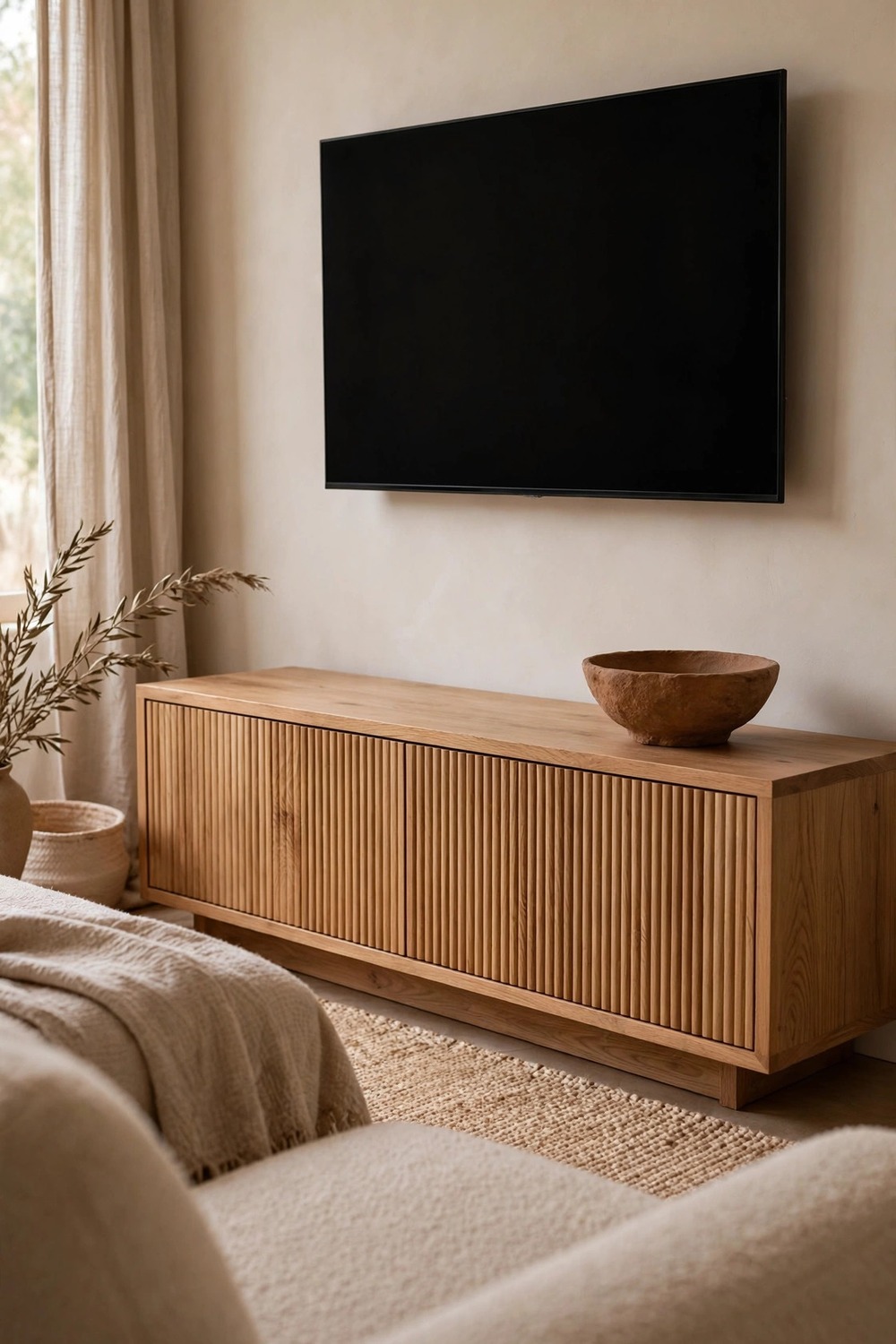
15. Low Natural Wood Media Console with Fluted Detail
A low media console in natural wood keeps a large screen from dominating a calm room. Fluted fronts add fine vertical lines and shadow, so the piece has texture even though its color stays quiet. Low height helps, too, because it leaves wall space above for a mirror or simple art and keeps sight lines open across the seating. Route cords through the back and keep the top mostly clear apart from a clay bowl or a small stack of objects. Wood tones usually look best here when they’re close to, but not exactly matching, your coffee table finish. That slight difference in tone is usually what keeps a wood heavy corner from looking like a matched furniture set.
Finish With Earthy Accents and Soft Contrast
The final layers are the ones guests notice without being able to name. A limestone fireplace, cushions in mixed fabrics, a curved silhouette, clay pots with real greenery, and one handwoven piece on the wall all add contrast that stays inside the earthy family. These are also the easiest ideas to try first if you’re renting or testing the look, because most of them move with you when you leave.
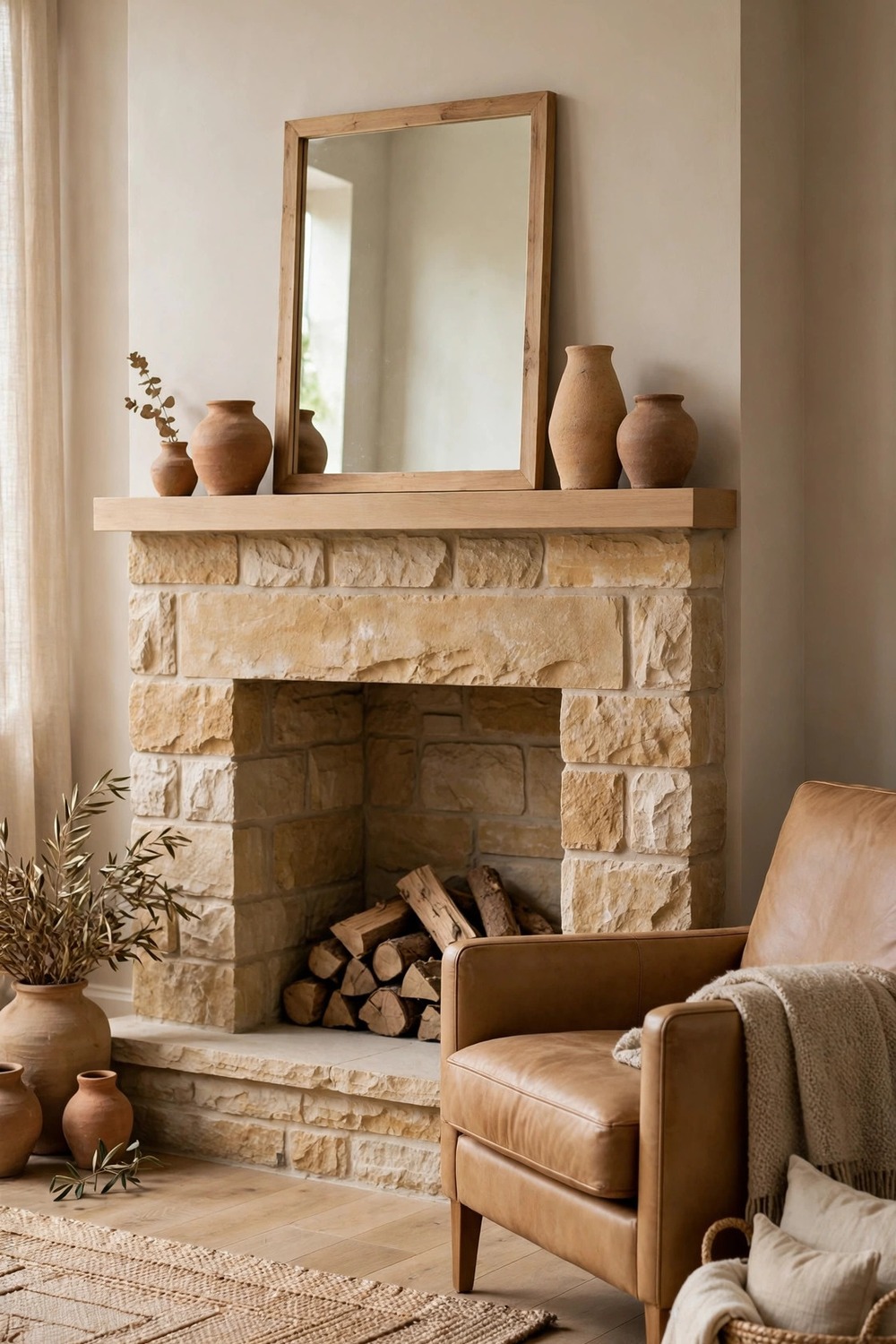
16. Stone Fireplace Surround in Warm Limestone
A limestone fireplace surround gives a neutral living room a natural focal point that doesn’t rely on color. The stone is pale but warm, with soft variation that pairs beautifully with greige walls and tan leather. Keep the mantel styling restrained, with a light wood framed mirror, a couple of clay vessels, and maybe a small bundle of dried grasses, so the stone itself stays the feature. If a full surround isn’t possible, a limestone look hearth extension or simple stone tiles can suggest the same effect. Limestone typically needs sealing, so ask about care before you commit to it.
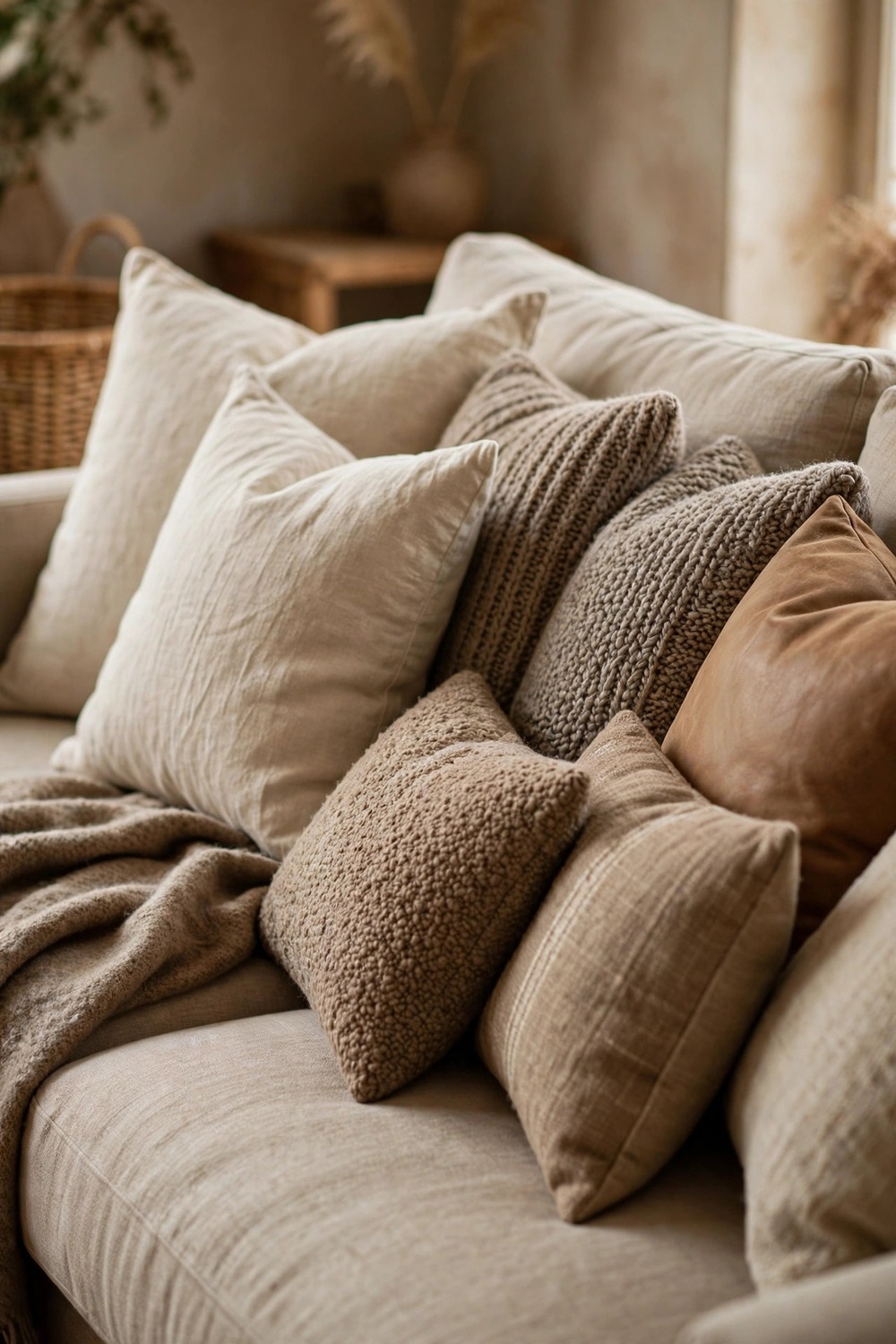
17. Mixed Neutral Cushions in Linen, Wool and Leather
Cushions are the cheapest layer to change, and mixing fabrics is what makes a neutral sofa look collected. Combine linen in cream, a wool cushion in warm taupe, and one smaller tan leather cushion for a smooth contrast against all that weave. Stay inside a tight range of tones, but vary the size and texture, because that is typically where the interest comes from. An odd number often arranges more naturally, and a gentle karate chop crease is not required for any of them. If the sofa starts to feel crowded, remove one cushion rather than adding another pattern into the mix.
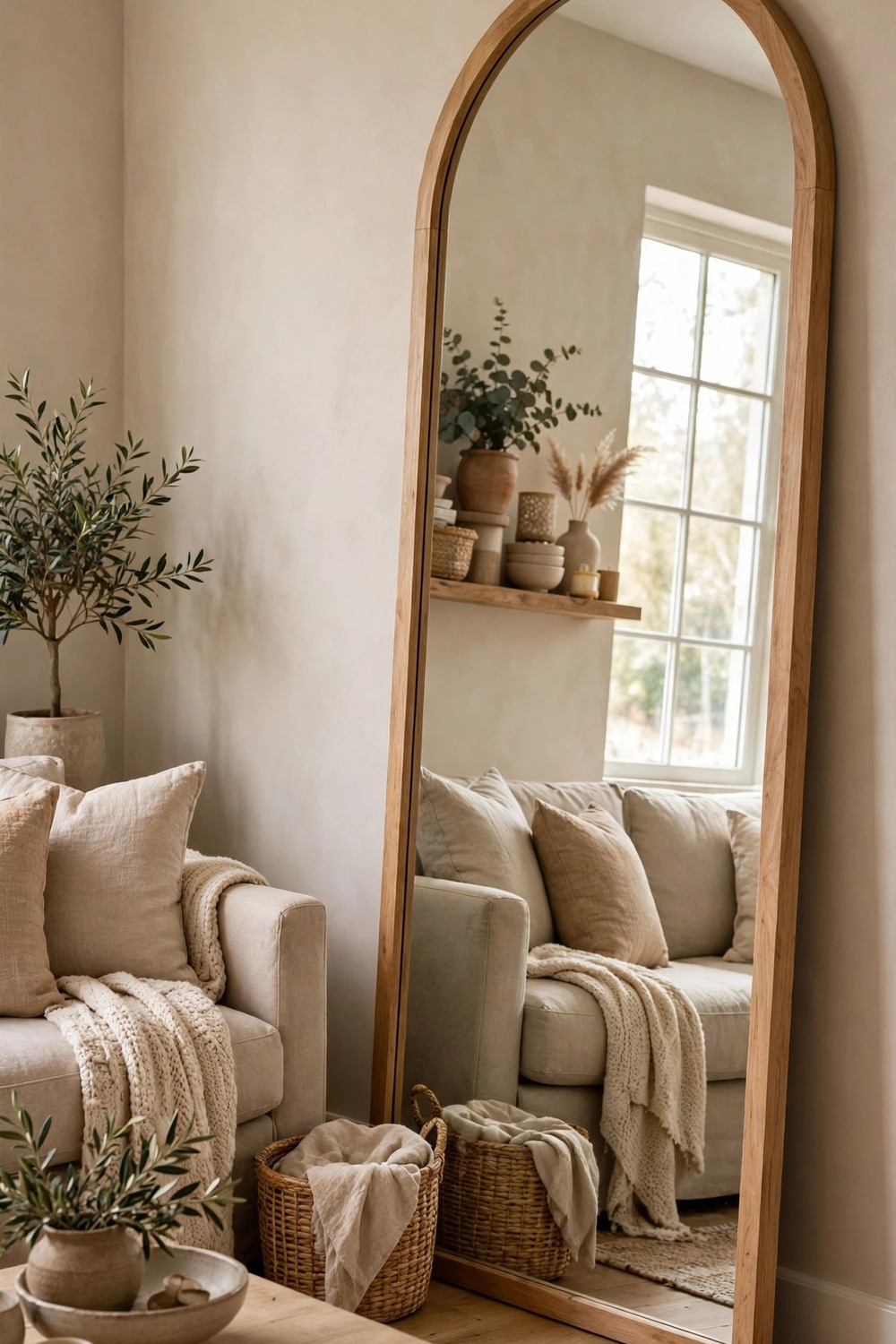
18. Arched Floor Mirror with Light Wood Frame
An arched floor mirror softens a room full of straight edged furniture, and leaning it against the wall keeps the look relaxed. A light wood frame ties it to oak tables and woven textures, while the mirror itself bounces daylight into darker corners, which usually makes beige and greige tones look fresher. Place it where it reflects something pleasant, like a window or a styled shelf, rather than a busy doorway. Make sure it is secured safely if you have kids or pets moving around it. You don’t need a huge size, but taller usually works better than wide here.
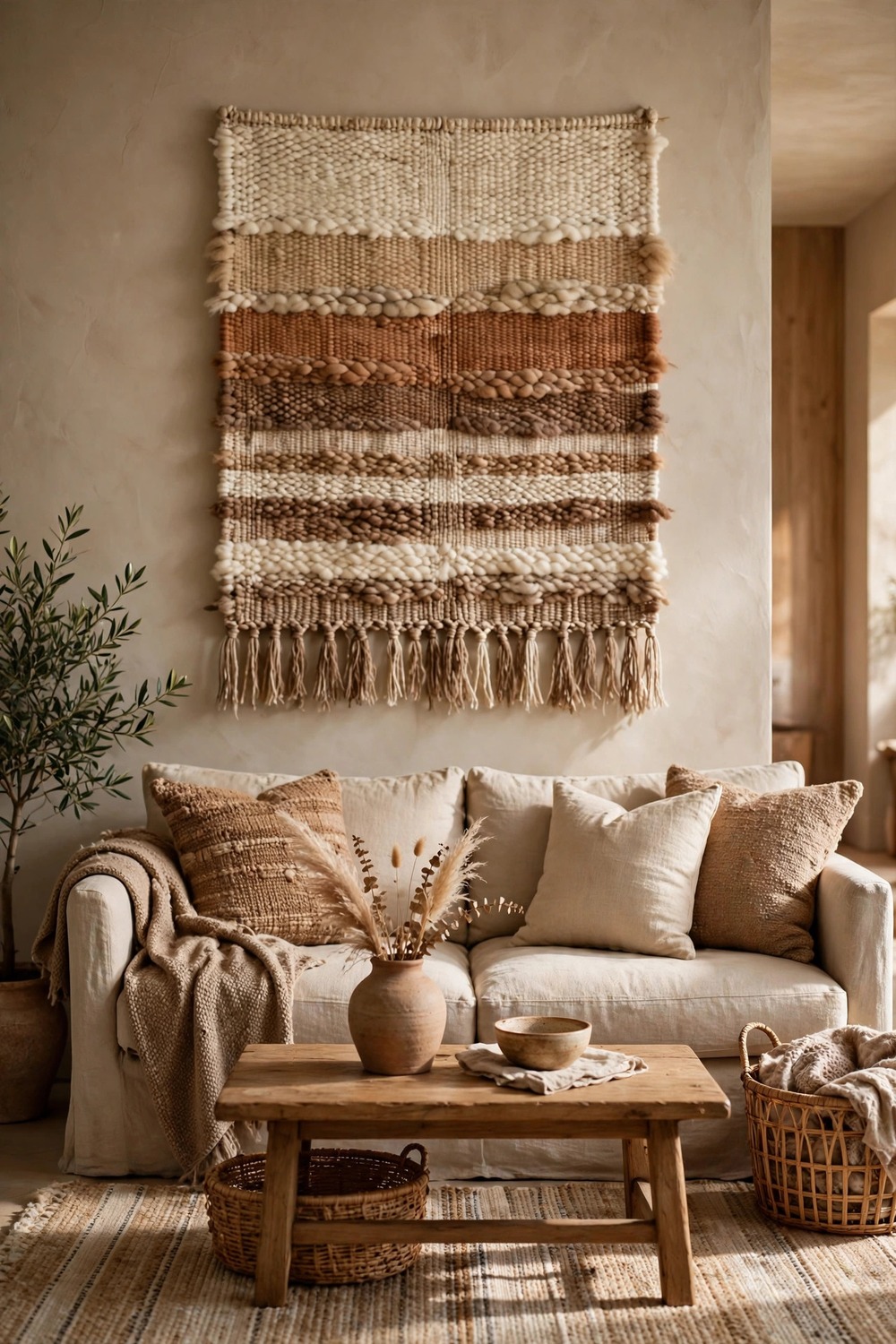
19. Handwoven Wall Hanging in Earthy Stripes
A handwoven wall hanging fills a large blank wall with texture instead of more framed prints. Look for horizontal or vertical stripes in cream, sand, clay, and soft brown, woven from wool or cotton with a slightly uneven hand made feel. Above a sofa, hang it so the bottom edge sits a comfortable distance above the cushions, and let the textile hang flat without stretching it tight. Textiles absorb a little sound, so a hanging can also take the edge off echo in a hard floored room. It is a light piece to swap seasonally, which makes it a low commitment layer.
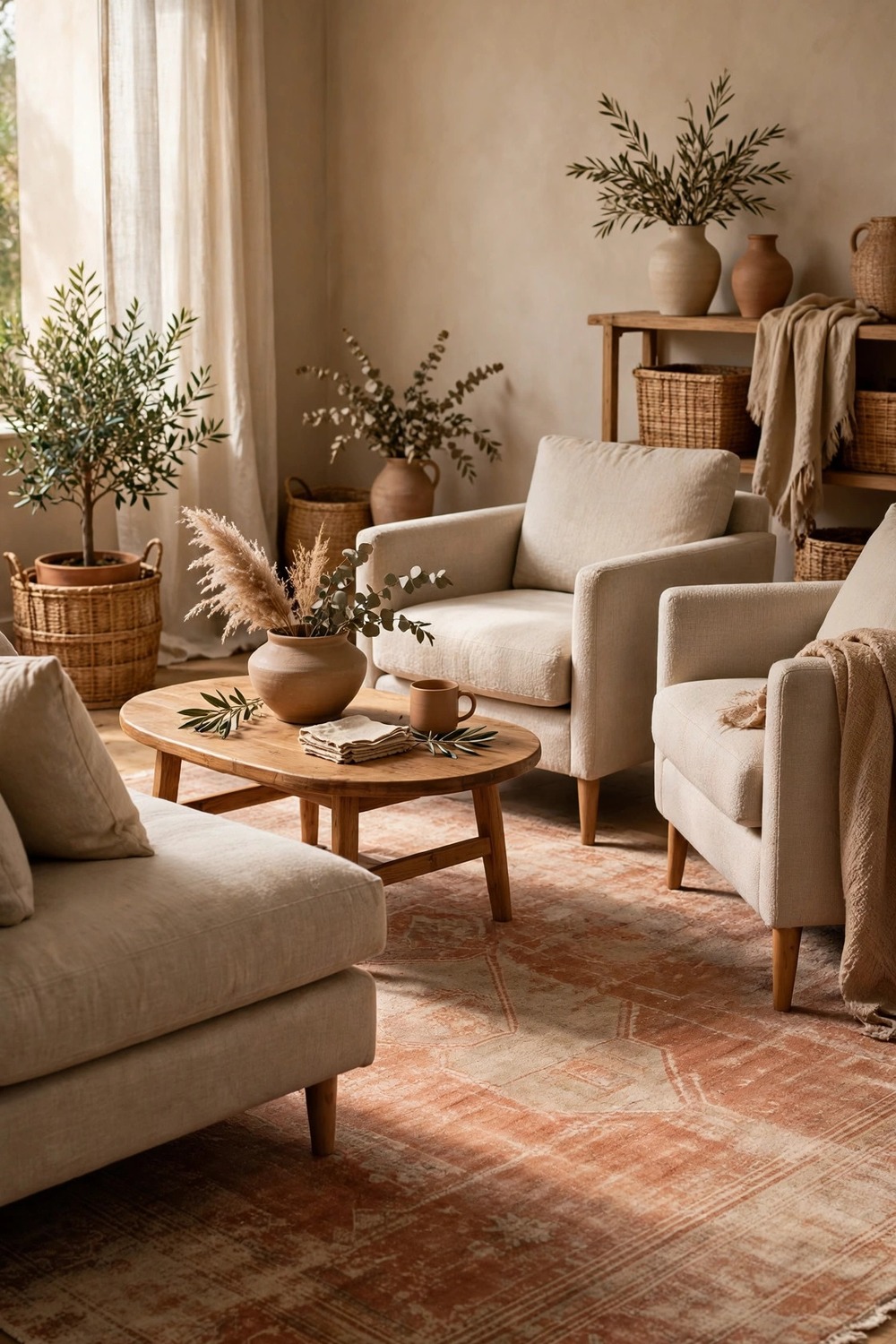
20. Terracotta and Sand Colored Area Rug Underfoot
If layered rugs feel like too much upkeep, a single area rug in terracotta and sand can carry the warmth on its own. The pattern should be faded or softly mottled rather than sharp and graphic, so it reads as an earthy wash of color under the seating. Size it generously, with the front legs of the sofa and chairs resting on it, because a too small rug typically makes the whole arrangement feel adrift. Wool or a wool blend usually handles foot traffic well and feels warm in cooler months. Keep nearby throws in cream or tan so the rug stays the main color moment.
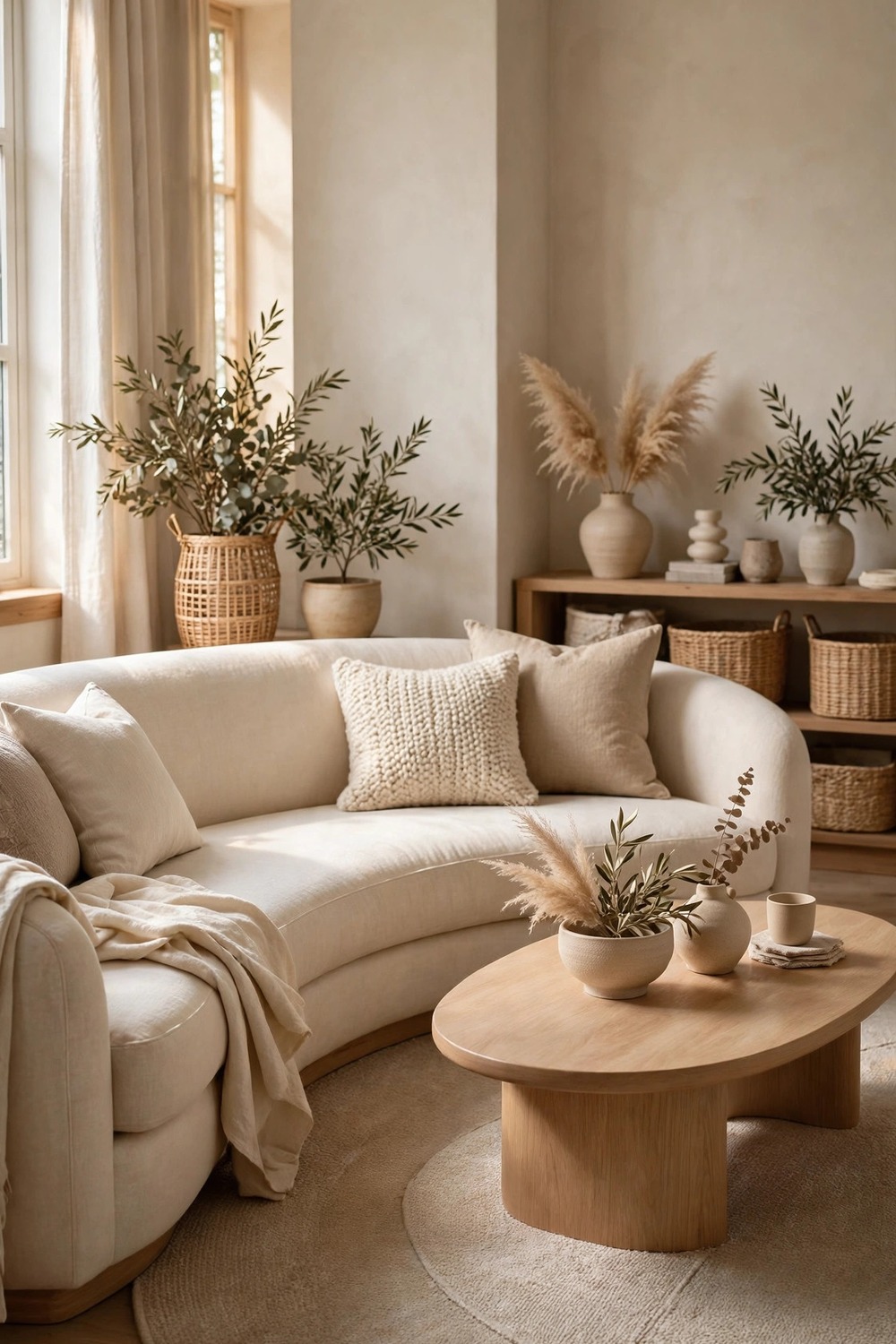
21. Curved Sofa Shape to Soften Straight Lines
A gently curved sofa changes the feel of a rectangular room more than any accessory can. The rounded back softens the box of walls, fireplace, and console, and it naturally turns seating inward for conversation. In a neutral fabric like warm ivory linen or soft greige weave, the shape stays calm rather than showy. Leave a little space behind the curve instead of pushing it flat to a wall, because the shadow line behind it is part of the effect. Pair it with a round or oval coffee table so the lines agree, and keep the rug large enough to hold the whole curve comfortably.
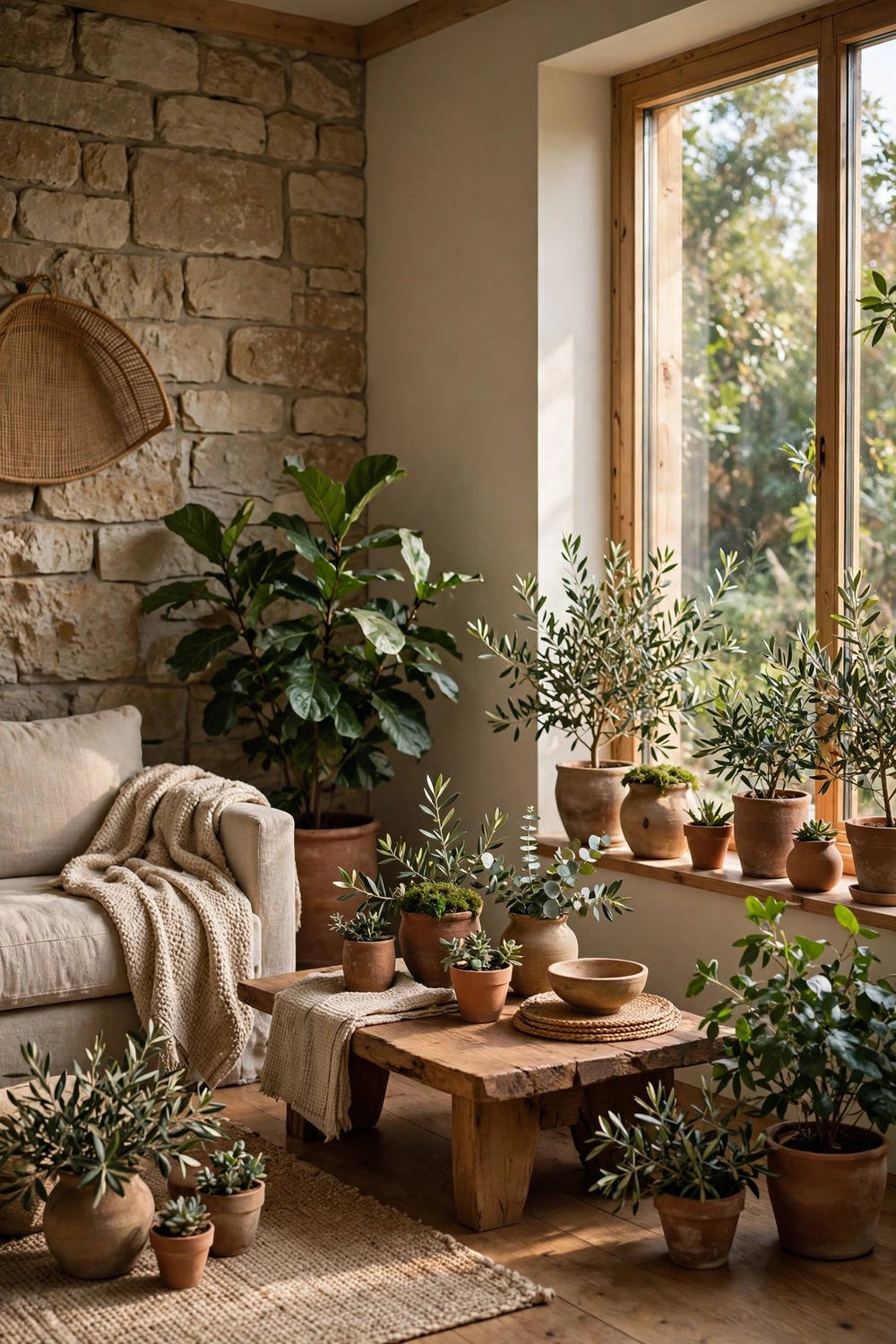
22. Greenery in Clay Pots for a Living Neutral Layer
Every earthy neutral room needs something alive in it, and simple greenery in clay pots is the most natural fit. Olive branches, a trailing plant on a shelf, or a leafy floor plant in a large terracotta pot all bring in green without breaking the palette, because green functions almost like a neutral against wood and stone. Clay pots usually develop a soft white patina over time, which only adds to the layered look. Group pots in different sizes near a window where the plants will actually thrive, and don’t scatter single tiny pots everywhere. Fewer, healthier plants typically look better.
When you step back, a warm neutral room really comes down to repetition with variation. Let greige, cream, camel, and clay show up more than once, but change the material each time, so the same tone appears as paint, then as leather, then as a woven throw. That’s the layering that makes the space feel collected over time instead of bought in one afternoon, and it’s a forgiving approach because you can keep adding pieces slowly as you find ones you love.
Start with whichever idea feels most doable this week, whether that’s swapping in warmer bulbs and brass lamps or finally layering a wool rug over your jute one. Live with each change for a few days before you judge it, because neutral layers typically reveal themselves in different light through the day. Before long, you’ll have a living room that feels calm in the morning, cozy at night, and never, ever flat.

Leave a Reply