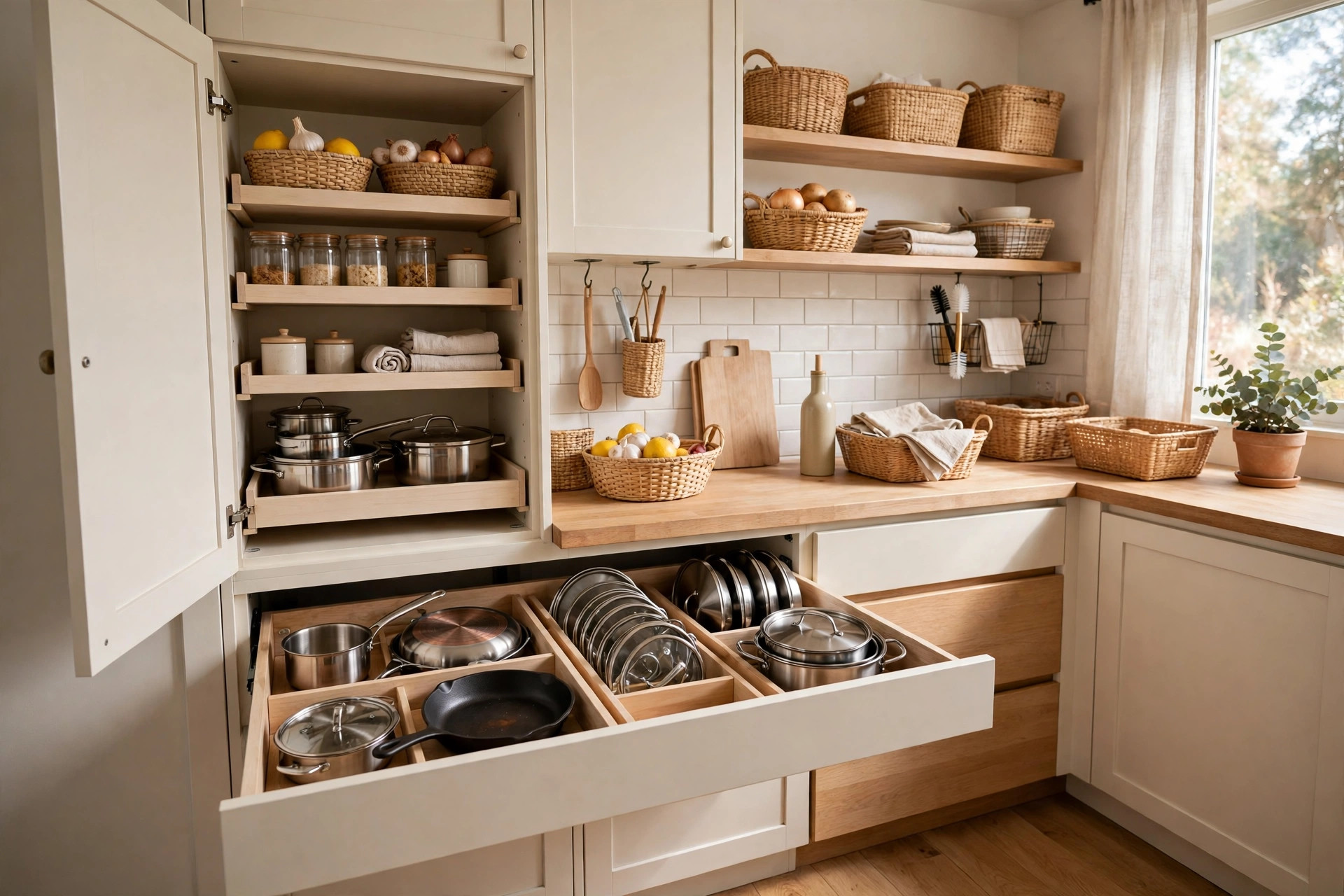
If your counters disappear under groceries and every cabinet feels like a guessing game, you are not alone. A small kitchen can hold a surprising amount, but only if everything has a proper home. Otherwise the blender ends up in the hallway and the baking trays live in the oven, which helps nobody.
Here is the good news. You usually do not need a bigger kitchen at all. You just need the space you already have to work twice as hard, especially inside cabinets, inside drawers, and on all that forgotten vertical space. Small tweaks typically make the biggest difference because they fix the spots you open ten times a day.
Below are 21 small kitchen storage ideas that genuinely double how your kitchen feels, grouped by where they work best. Start with the cabinets, since that is where most of us lose the most space without even realizing it.
Cabinet Storage Multipliers
Most cabinets waste nearly half their height because everything just sits on the bottom shelf. These ideas stack, divide, and layer that empty air so a standard cabinet suddenly holds much more.
Add tiered shelf risers so you can see everything at once. A simple stepped riser lifts cans, jars, and mugs into rows, so nothing hides at the back anymore. It usually costs very little and takes about two minutes to set up. Choose a width that leaves a little room at the front for taller bottles, and you will wonder why you waited so long.
Pop a turntable in those deep, awkward corners. A lazy Susan brings the back of the cabinet right to you with one gentle spin. It works especially well for oils, sauces, and spice jars that typically get lost and bought twice. Go for a single layer rather than a tall double one if your shelf height is tight.
Hang under-shelf baskets to use the empty gap. These little wire baskets hook over a shelf and create a bonus level underneath for mugs, small bowls, or packets. They are perfect for renters because there is nothing to screw in or drill. Slide one or two in and that dead space above your plates finally starts earning its keep.
Decant dry goods into slim, matching containers. Bags of flour and boxes of pasta are all different shapes, so they never stack neatly. Slim containers in one or two sizes line up like books and usually free up a whole extra row. You can also see at a glance when you are running low, which makes the weekly shop much calmer.
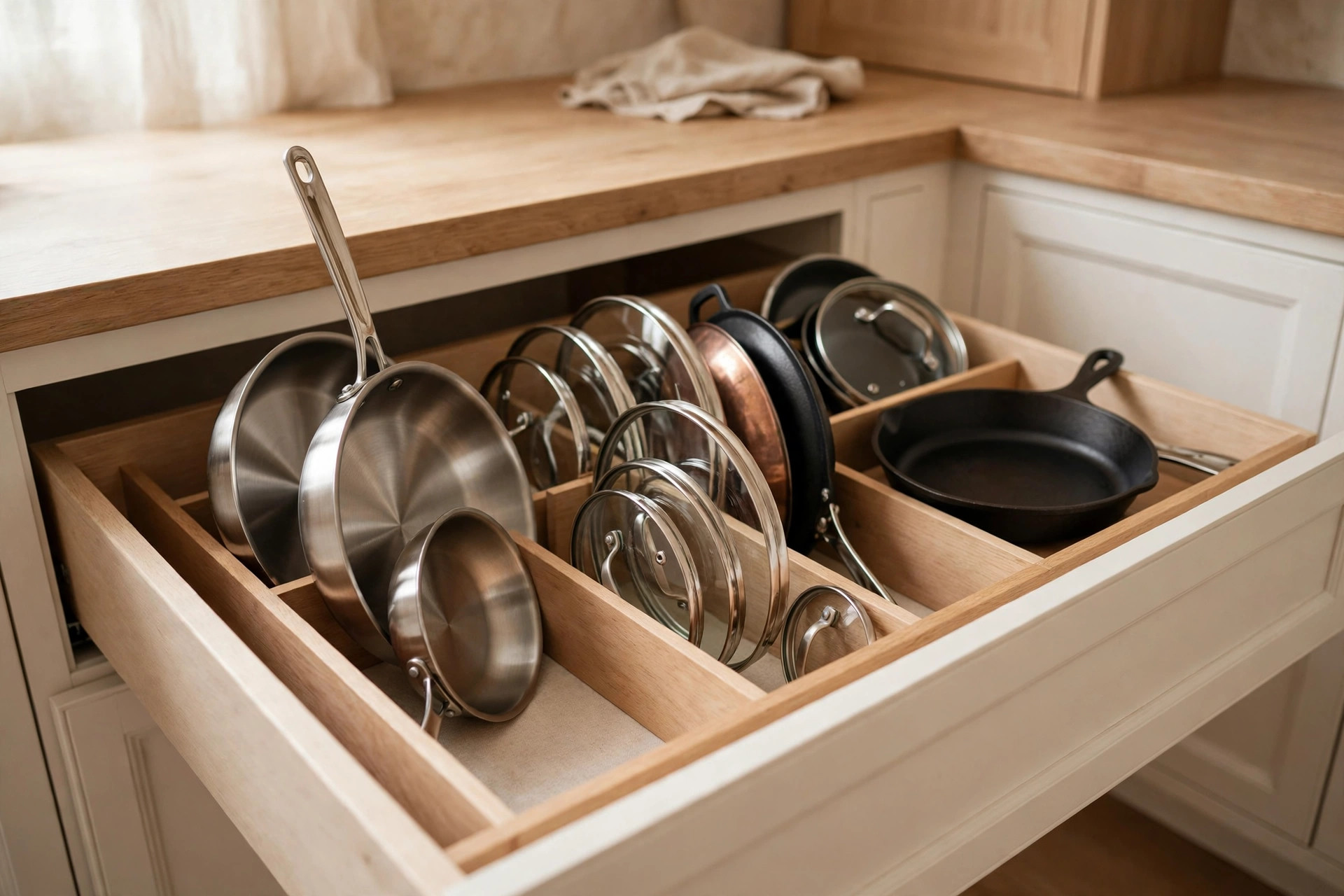
File trays, boards, and lids upright instead of stacking them. A simple vertical divider or tension rack lets you store baking trays and chopping boards on their sides, just like files in a drawer. You pull out exactly the one you need without lifting a heavy, clattering pile. It also stops lids from vanishing to the very back of the cupboard, which typically happens at the worst moment.
Drawers and Pull-Outs
Drawers almost always beat low cabinets in a small kitchen because you can see and reach everything without crouching down. If you are planning even a small refresh, this is where your money usually works hardest.
Deep drawers
Swap one low cabinet for a stack of deep drawers. Pots, pans, and mixing bowls fit far better in a wide deep drawer than behind a cabinet door. You open it, you see everything, and you are done. Many people find that one drawer stack replaces the storage of two standard cupboards, simply because nothing gets buried.
Use pegs or dividers to keep pots calm inside the drawer. Adjustable peg boards and simple dividers stop pans from sliding and nesting into one tangled heap. Give lids their own upright slot along one side and they will stay put. It takes a few minutes to set up, but every cooking session feels easier afterward.
Hide a shallow inner drawer inside a deep one. That slim secret drawer at the top of a deep drawer is ideal for cutlery, utensils, or spice packets. It uses the few inches that usually go to waste above your pots. If you cannot add one, a shallow tray that slides back and forth gives you a similar two-level effect.
Corner pull-outs
Fit swing-out shelves in a blind corner cabinet. Corner cabinets are famous for swallowing things whole, but pull-out shelves that swing right out change that completely. You get to use the full depth without getting on your knees with a flashlight. They are typically a job for a fitter, but the storage you win back is honestly huge.
Try corner drawers that open on the diagonal. Instead of a door, corner drawers pull straight toward you and use that tricky angle surprisingly well. They are great for utensils, wraps, or pantry packets that you reach for daily. Not every kitchen can fit them, but if you are redoing your layout, they are well worth asking about.
Slide a narrow pull-out into that tiny gap beside the stove. Most kitchens have a skinny wasted gap of just a few inches, and a slim pull-out tower fills it perfectly. It is just wide enough for oils, spices, and sauces right where you cook. Once you have one, cooking feels smoother because everything is literally at your elbow.
Vertical and Door Storage
When floor and cabinet space run out, look up and look at your doors. Walls, backsplashes, and the insides of cabinet doors are usually the most underused storage in the whole kitchen.
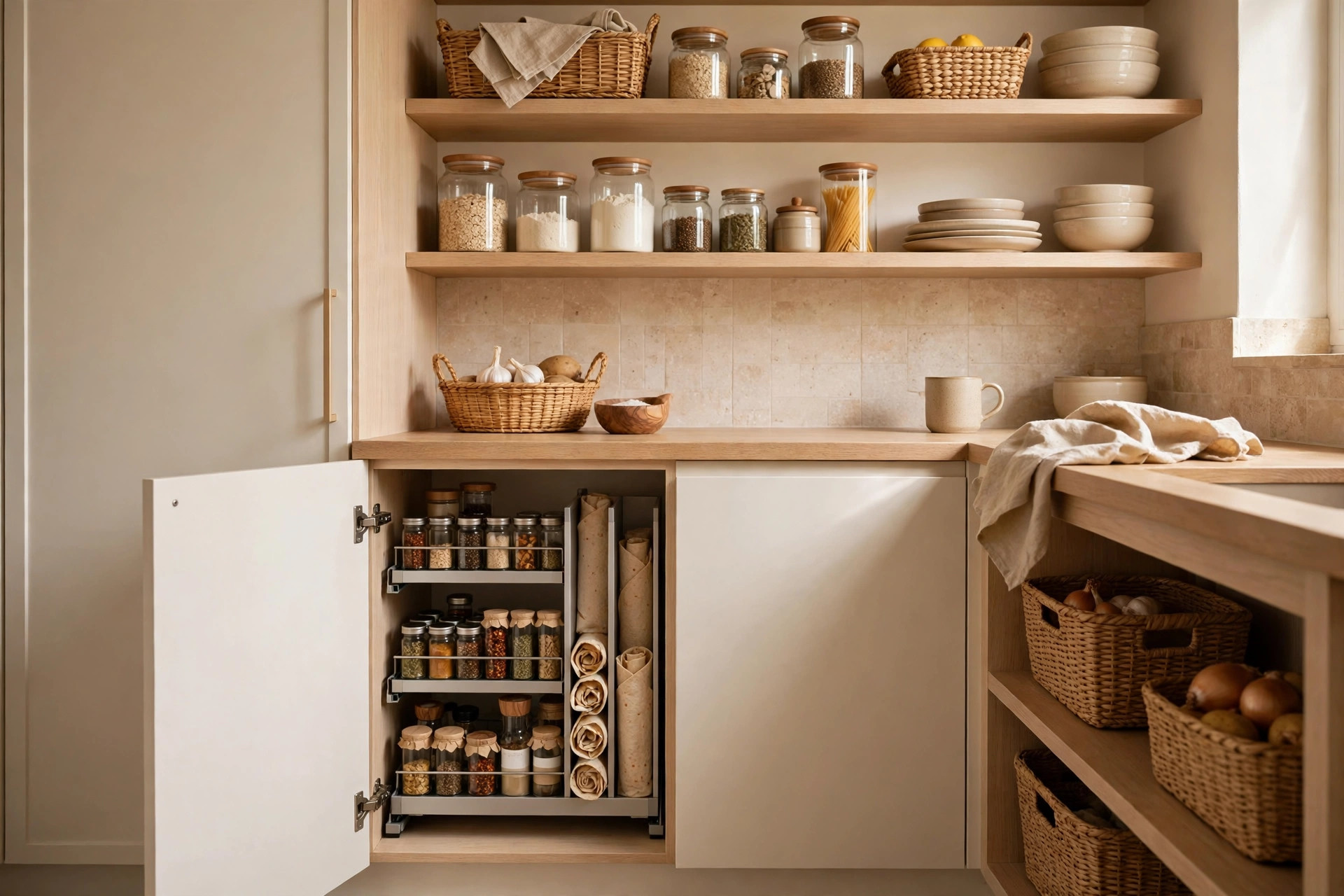
Fit slim racks inside cabinet doors for spices and wraps. The inside of a door is flat, close at hand, and perfect for the small things that clutter drawers. A narrow rack holds spice jars, foil, and wrap so they stand in a tidy row. Just check that the rack is slim enough that the door still closes comfortably over your shelves.
Run a rail along the backsplash for daily tools. A simple rail with hooks keeps ladles, scissors, and measuring cups off the counter and off your worktop. It also looks warm and lived in, especially with light wood or brushed metal hooks. Keep only the things you use every day on it, or it can start to feel busy quite quickly.
Add one or two open shelves above the counter. Open shelves use wall space that cabinets cannot always reach, and they are ideal for everyday bowls, glasses, and jars. Keeping them to daily items means they stay tidy and dust does not really get a chance to settle. Style them simply in warm neutrals and they will feel calm rather than cluttered.
Use magnetic strips and under-cabinet holders. A magnetic strip holds knives safely on the wall and frees up a whole drawer. Under-cabinet holders for paper towels or mugs use the hidden underside that normally does nothing at all. Together they clear two surprisingly bulky things from your counters in one afternoon.
Hang lids and measuring cups on hooks inside a door. Small hooks turn a plain door into a neat home for pot lids, funnels, and measuring cups that usually rattle around in a drawer. Everything hangs flat, stays visible, and takes up zero shelf space. It is one of those tiny changes that makes opening a cabinet feel oddly satisfying.
What to Store Outside the Kitchen
This might be the most freeing idea of all. Not everything you own for cooking has to live in the kitchen. Moving the rarely used and the bulky overflow out gives your daily things room to breathe.
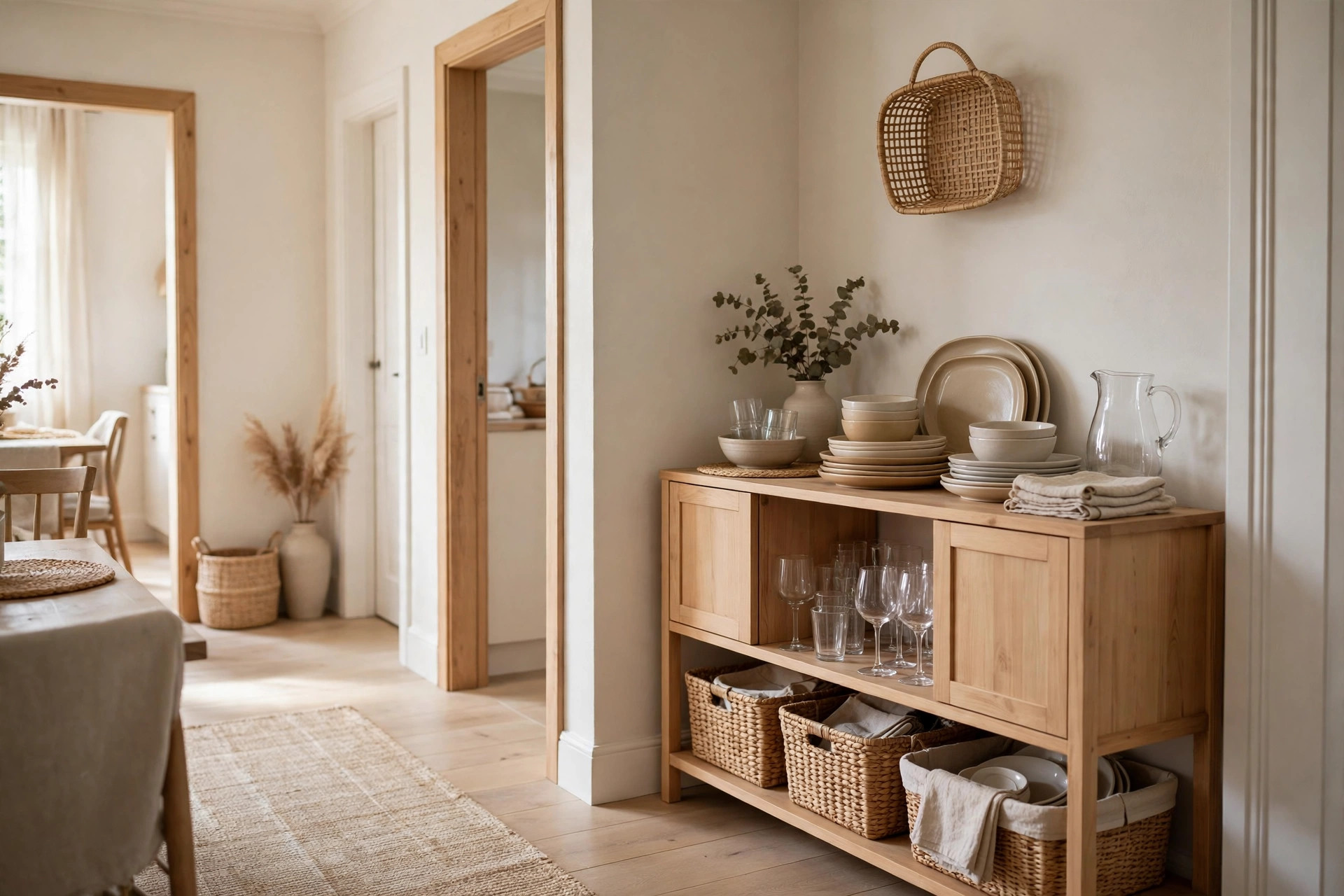
Keep serving dishes in a dining room sideboard. Platters, big salad bowls, and special glassware are lovely, but you probably only use them when guests come. A small sideboard or cabinet in the dining area holds them beautifully and frees a whole kitchen shelf. Your everyday plates and bowls will thank you for the extra space.
Park a rolling cart in a nook or hallway. A slim trolley can hold pantry overflow, cookbooks, or small appliances and roll out only when you need it. Tuck it beside the fridge, in a hallway alcove, or even in a wide doorway corner. Because it moves, it never really blocks anything, which is perfect for a tight home.
Give linens and rare appliances a bench or closet shelf. Table linens, the fondue set, and that waffle maker you use twice a year do not need prime kitchen real estate. A storage bench, a hallway closet shelf, or the top of a wardrobe keeps them safe and out of the way. Label the box clearly and you will still find everything in seconds when you need it.
Use high shelves and the top of the fridge for bulk buys. Bulk packs and backup supplies are heavy, bulky, and not needed every day, so they are ideal for higher spots outside your main cabinets. A sturdy shelf in a utility space or laundry area works well too. Just keep a small everyday amount in the kitchen and refill it as you go.
Rotate seasonal items out completely. Holiday bakeware, picnic gear, and preserving jars can live in a labeled box in a closet, under a bed, or on a garage shelf for most of the year. Swapping them in and out with the seasons keeps your kitchen focused on how you actually live right now. It typically takes an hour twice a year and makes the kitchen feel twice as big.
You do not have to do all 21 of these to feel a difference. Pick the one cabinet that annoys you most, add a riser or a divider, and notice how much calmer it feels to open. Small kitchens reward small, thoughtful changes, and once your daily things have room, the whole space usually feels double the size, even though you have not added a single inch.


Leave a Reply